



BMP-2 Antibody
(Synonyms: Bone morphogenetic protein 2; BMP 2; BMP 2A; BMP2A; BMP-2; BMP2_HUMAN.)Based on 1 Customer Validation
BMP-2 Antibody is a Rabbit-derived and non-conjugated IgG polyclonal antibody, targeting to BMP-2.
-
Host:
Rabbit
-
Isotype:
IgG
-
Application:
WB, ELISA, IHC-P, IHC-F, ICC/IF
-
Reactivity :
Human, Mouse, Rat
-
Formulation:
Supplied in 0.01M TBS(pH7.4) with 1% BSA, 0.03% Proclin300 and 50% Glycerol.
-
Conjugation:
Non-conjugated


To place orders, for customer services and technical support, please contact: MedChemExpress USA
Tel: 609-228-6898 E-mail: [email protected] [email protected]





Applications
| Application |
WB

WB: Western Blot
|
ELISA
ELISA: Enzyme Linked Immunosorbent Assay
|
IHC-P
IHC-P: Immunohistochemistry-Paraffin
|
IHC-F
IHC-F: Immunohistochemistry-Frozen
|
ICC/IF
ICC/IF: Immunocytochemistry/
Immunofluorescence |
|---|---|---|---|---|---|
| Dilution Ratio | 1:500-2000 | 1:5000-10000 | 1:100-500 | 1:100-500 | 1:100-500 |


Product Details
BMP-2 Antibody is a Rabbit-derived and non-conjugated IgG polyclonal antibody, targeting to BMP-2.
-
Host Rabbit

-
Clonality Polyclonal

-
Species ReactivityHuman, Mouse, Rat Predicted Reactivity: Chicken,Dog,Cow,Horse,Rabbit,Sheep
Note: The predicted reactivity is for reference only and should not be considered a guarantee of product performance.
-
Observed Molecular WeightObserved band size: 60 kDa
Note: Due to possible protein modifications or aggregation, the molecular weight should be confirmed by actual measurement, and the predicted value is for reference only.

-
Calculated Molecular Weight Predicted band size: 45 kDa

Entrez Gene: 650 Human ; 12156 Mouse ; 29373 Rat
SwissProt: P12643 Human ; P21274 Mouse ; P49001 Rat
OMIM: 112600 Human
KLH conjugated synthetic peptide derived from human BMP2: 283-365/396
Endogenous
affinity purified
Non-conjugated
Unmodified
IgG


Product Properties
-
Appearance
Solution
-
Formulation
Supplied in 0.01M TBS(pH7.4) with 1% BSA, 0.03% Proclin300 and 50% Glycerol.
-
Concentration
Batch-dependent, Please check the COA for the concentration of each lot. Check Lot Concentration
-
Storage & Stability
Stored at -20°C for 1 year. Avoid repeated freeze / thaw cycles.
-
Shipping
Shipping with blue ice.


Verification Images
-
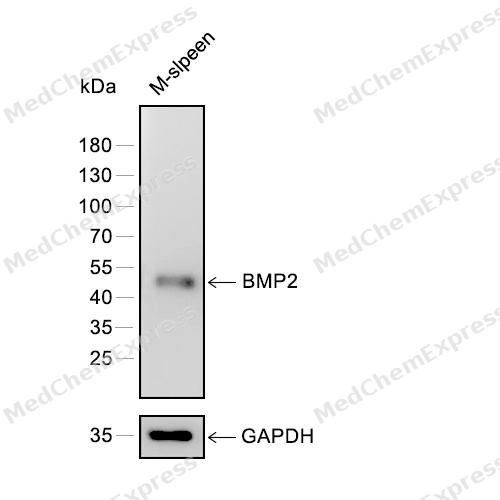 Western blot analysis of extracts from M-Spleen using BMP2 antibody. Proteins were transferred to a PVDF membrane and blocked with 5% nonfat powdered milk in PBST for 2 hour at room temperature. The primary antibody (1/2000) and Loading control antibody (GAPDH, 1/3000) was diluted with 5% nonfat powdered milk in PBST at 4°C overnight. Goat Anti-Rabbit IgG-HRP Secondary Antibody (1/8,000) was incubated for 45min at room temperature.
 -
 Immunocytochemistry analysis of MCF-7 cells labeling BMP-2 with BMP-2 Antibody (HY-P81093) at 1/100 dilution. Cells were fixed in 4% paraformaldehyde for 15 minutes at room temperature, permeabilized with 0.1% Triton X-100 in PBS for 15 minutes at room temperature, then blocked with quick block buffer for 10 minutes at room temperature. Cells were then incubated with BMP-2 Antibody (HY-P81093) at 1/100 dilution in quick block buffer overnight at 4 ℃. AF488-conjugated Goat Anti-Rabbit IgG H&L (HY-P8002, Green) was used as the secondary antibody at 1/1,000 dilution. PBS instead of the primary antibody was used as the secondary antibody only control. The Nuclear counterstain was DAPI (Blue).
 -
 Immunocytochemistry analysis of MCF-7 cells labeling BMP-2 with BMP-2 Antibody (HY-P81093) at 1/300 dilution. Cells were fixed in 4% paraformaldehyde for 15 minutes at room temperature, permeabilized with 0.1% Triton X-100 in PBS for 15 minutes at room temperature, then blocked with quick block buffer for 10 minutes at room temperature. Cells were then incubated with BMP-2 Antibody (HY-P81093) at 1/300 dilution in quick block buffer overnight at 4 ℃. AF488-conjugated Goat Anti-Rabbit IgG H&L (HY-P8002, Green) was used as the secondary antibody at 1/1,000 dilution. PBS instead of the primary antibody was used as the secondary antibody only control. The Nuclear counterstain was DAPI (Blue).


Background
-
Function
BMP-2 is a Growth factor of the TGF-beta superfamily that plays essential roles in many developmental processes, including cardiogenesis, neurogenesis, and osteogenesis. Induces cartilage and bone formation. Initiates the canonical BMP signaling cascade by associating with type I receptor BMPR1A and type II receptor BMPR2. Once all three components are bound together in a complex at the cell surface, BMPR2 phosphorylates and activates BMPR1A. In turn, BMPR1A propagates signal by phosphorylating SMAD1/5/8 that travel to the nucleus and act as activators and repressors of transcription of target genes. Also acts to promote expression of HAMP, via the interaction with its receptor BMPR1A/ALK3. Can also signal through non-canonical pathways such as ERK/MAP kinase signaling cascade that regulates osteoblast differentiation. Also stimulates the differentiation of myoblasts into osteoblasts via the EIF2AK3-EIF2A-ATF4 pathway by stimulating EIF2A phosphorylation which leads to increased expression of ATF4 which plays a central role in osteoblast differentiation. Acts as a positive regulator of odontoblast differentiation during mesenchymal tooth germ formation, expression is repressed during the bell stage by MSX1-mediated inhibition of CTNNB1 signaling[1][2][3][4][5][6][7][8][9][10].
-
Subcellular Localization
Secreted
-
Expression
Tissue_specificity:It is particularly abundant in the lungs, spleen, and colon, and present in lower but significant amounts in the heart, brain, placenta, liver, skeletal muscle, kidneys, pancreas, prostate, ovaries, and small intestine. -
Subunit
Homodimer; disulfide-linked (PubMed:10074410). Interacts with SOSTDC1 (PubMed:15020244). Interacts with GREM2, RGMA, RGMB and RGMC. Interacts with ASPN (By similarity). Interacts with MAFP5 (By similarity). Interacts with FBN1 (via N-terminal domain) and FBN2 (PubMed:18339631). Interacts with type I receptor BMPR1A (PubMed:15064755). Interacts with type II receptor BMPR2 (PubMed:7791754). Interacts with SCUBE3 (PubMed:33308444). Interacts with TNFAIP6 (primarily via Link domain); this interaction is inhibited by hyaluronan. Interacts with ERFE (PubMed:31800957). Interacts with BMPR1A/ALK3; the interaction may induce HAMP expression (PubMed:31800957). Forms heterodimers with BMP6 in vitro; the heterodimer then binds to its receptor BMPR1A /ALK3 and may induce HAMP expression (PubMed:31800957). Interacts with TGFBR3 (PubMed:18184661)
-
SwissProt ID
-
Synonyms
Bone morphogenetic protein 2; BMP 2; BMP 2A; BMP2A; BMP-2; BMP2_HUMAN.


Documentation
-
Data Sheet (263 KB)
-
SDS (252 KB)
- English - EN (252 KB)
- Français - FR (252 KB)
- Deutsch - DE (252 KB)
- Norwegian - NO (252 KB)
- Español - ES (252 KB)
- Swedish - SV (252 KB)
- Italian - IT (252 KB)
- Korean - KR (252 KB)
- Portuguese - PT (252 KB)
-
User Guide for Antibodies (1077 KB)
References
[1]. Lavery K, et al. BMP-2/4 and BMP-6/7 differentially utilize cell surface receptors to induce osteoblastic differentiation of human bone marrow-derived mesenchymal stem cells. J Biol Chem. 2008 Jul 25;283(30):20948-58. [Content Brief]
[2]. Tanaka K, et al. Involvement of the osteoinductive factors, Tmem119 and BMP-2, and the ER stress response PERK-eIF2α-ATF4 pathway in the commitment of myoblastic into osteoblastic cells. Calcif Tissue Int. 2014 Apr;94(4):454-64. [Content Brief]
[3]. Seeherman HJ, et al. A BMP/activin A chimera is superior to native BMPs and induces bone repair in nonhuman primates when delivered in a composite matrix. Sci Transl Med. 2019 Apr 24;11(489):. [Content Brief]
[4]. Wozney JM, et al. Novel regulators of bone formation: molecular clones and activities. Science. 1988 Dec 16;242(4885):1528-34. [Content Brief]
[5]. Keller S, et al. Molecular recognition of BMP-2 and BMP receptor IA. Nat Struct Mol Biol. 2004 May;11(5):481-8. [Content Brief]
[6]. Weber D, et al. A silent H-bond can be mutationally activated for high-affinity interaction of BMP-2 and activin type IIB receptor. BMC Struct Biol. 2007 Feb 12;7:6. [Content Brief]
[7]. Liu F, et al. Human type II receptor for bone morphogenic proteins (BMPs): extension of the two-kinase receptor model to the BMPs. Mol Cell Biol. 1995 Jul;15(7):3479-86. [Content Brief]
[8]. Wang CY, et al. Erythroferrone lowers hepcidin by sequestering BMP2/6 heterodimer from binding to the BMP type I receptor ALK3. Blood. 2020 Feb 6;135(6):453-456. [Content Brief]
[9]. Tsukahara S, et al. Tumour necrosis factor alpha-stimulated gene-6 inhibits osteoblastic differentiation of human mesenchymal stem cells induced by osteogenic differentiation medium and BMP-2. Biochem J. 2006 Sep 15;398(3):595-603. [Content Brief]
[10]. Jun JH, et al. BMP2-activated Erk/MAP kinase stabilizes Runx2 by increasing p300 levels and histone acetyltransferase activity. J Biol Chem. 2010 Nov 19;285(47):36410-9. [Content Brief]

 Powered by Bioz
