



Osteopontin Antibody
(Synonyms: SPP1; BNSP; OPN; PSEC0156; Osteopontin; Bone sialoprotein 1; Nephropontin; Secreted phosphoprotein 1; SPP-1; Urinary stone protein; Uropontin)Based on 2 publication(s) in Google Scholar
Osteopontin Antibody is a Rabbit-derived and non-conjugated IgG polyclonal antibody, targeting to Osteopontin.
-
Host:
Rabbit
-
Isotype:
IgG
-
Application:
WB, IHC-P, ICC/IF, ELISA
-
Reactivity :
Human, Mouse, Rat
-
Formulation:
Supplied in 1*PBS (pH 7.3), 50% glycerol and 0.5% BSA. Preservative: 0.02% sodium azide.
-
Conjugation:
Non-conjugated


To place orders, for customer services and technical support, please contact: MedChemExpress USA
Tel: 609-228-6898 E-mail: [email protected] [email protected]



-

HY-P81217
Osteocalcin Antibody -
HY-P80137
GAPDH Antibody (YA418) -

HY-P70499
Osteopontin/OPN Protein, Human (HEK293, His) -
HY-P8001
HRP-conjugated Goat Anti-Rabbit IgG H&L -
HY-P81227
Collagen I Antibody -
HY-P80316
RUNX2 Antibody (YA085) -
HY-P81093
BMP-2 Antibody -
HY-P80438
Beta Actin Antibody (YA823) -
HY-P86653
Alkaline phosphatase Antibody (YA6345)
Publications Citing Use of MedChemExpress (MCE) Osteopontin Antibody
More

Applications
| Application |
WB

WB: Western Blot
|
IHC-P
IHC-P: Immunohistochemistry-Paraffin
|
IF/ICC
|
ELISA
ELISA: Enzyme Linked Immunosorbent Assay
|
|---|---|---|---|---|
| Dilution Ratio | 1:500-1:2000 | 1:100-1:500 | 1:100-1:500 | 1:5000-1:20000 |


Product Details
Osteopontin Antibody is a Rabbit-derived and non-conjugated IgG polyclonal antibody, targeting to Osteopontin.
-
Host Rabbit

-
Clonality Polyclonal

-
Species ReactivityHuman, Mouse, Rat
-
Observed Molecular WeightObserved band size: 55-60 kDa
Note: Due to possible protein modifications or aggregation, the molecular weight should be confirmed by actual measurement, and the predicted value is for reference only.

-
Calculated Molecular Weight Predicted band size: 35 kDa

Synthetic peptide corresponding to Human Osteopontin.AA range:261-310.
Endogenous
affinity purified
Non-conjugated
Unmodified
IgG


Product Properties
-
Appearance
Solution
-
Formulation
Supplied in 1*PBS (pH 7.3), 50% glycerol and 0.5% BSA. Preservative: 0.02% sodium azide.
-
Concentration
Batch-dependent, Please check the COA for the concentration of each lot. Check Lot Concentration
-
Storage & Stability
Stored at -20°C for 1 year. Avoid repeated freeze / thaw cycles.
-
Shipping
Shipping with blue ice.


Publications (2)
-
Journal Impact Factor
-
Most Recent
-
Pharmacol Res
2025 Aug 26:220:107933. PMID: 40876522 -
J Mol Histol
Dendrobine promotes osteogenesis-angiogenesis in postmenopausal osteoporosis by inhibiting Hippo signaling pathway. [Abstract]2026 May 13;57(3):164. PMID: 42126726


Verification Images
-
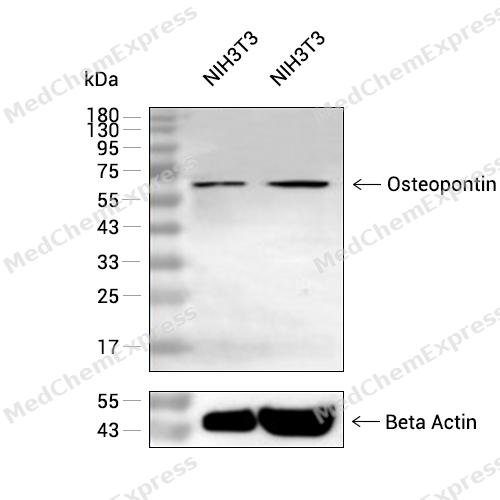 Western blot analysis of extracts from NIH3T3(lane 2(20μg) and NIH3T3(lane 3(40μg) using Osteopontin (HY-P80771) Rabbit mAb. Proteins were transferred to a PVDF membrane and blocked with 5% non-fat milk in TBST for 2 hour at room temperature. The primary antibody (1/1000) and Loading control antibody (Beta Actin, HY-P80438, 1/10000) was used in 5% non-fat milk in TBST at 4°C overnight. Goat Anti-Mouse/Rabbit IgG-HRP Secondary Antibody (1/10000) was used for 1 hour at room temperature.
 -
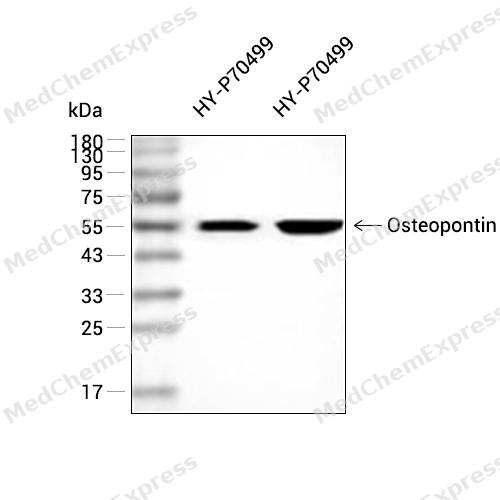 Western blot analysis of extracts from HY-P70499 (lane 2(25 ng) and HY-P70499 (lane 3(50 ng) using Osteopontin (HY-P80771) Rabbit mAb. Proteins were transferred to a PVDF membrane and blocked with 5% non-fat milk in TBST for 2 hour at room temperature. The primary antibody (1/1000) and Loading control antibody (Beta Actin, HY-P80438, 1/10000) was used in 5% non-fat milk in TBST at 4°C overnight. Goat Anti-Mouse/Rabbit IgG-HRP Secondary Antibody (1/10000) was used for 1 hour at room temperature.
 -
 Immunohistochemical analysis of paraffin-embedded Mouse kidney tissue using Osteopontin Antibody. The section was pre-treated using heat mediated antigen retrieval with sodium citrate buffer (pH 6.0) for 8 minutes. The tissues were blocked in QuickBlock for 20 minutes at room temperature, washed with ddH2O and PBS, and then probed with the primary antibody (HY-P80771, 1/100) in 4℃ overnight. The detection was performed using an HRP conjugated compact polymer system. DAB was used as the chromogen. Tissues were counterstained with hematoxylin and mounted with DPX.
 -
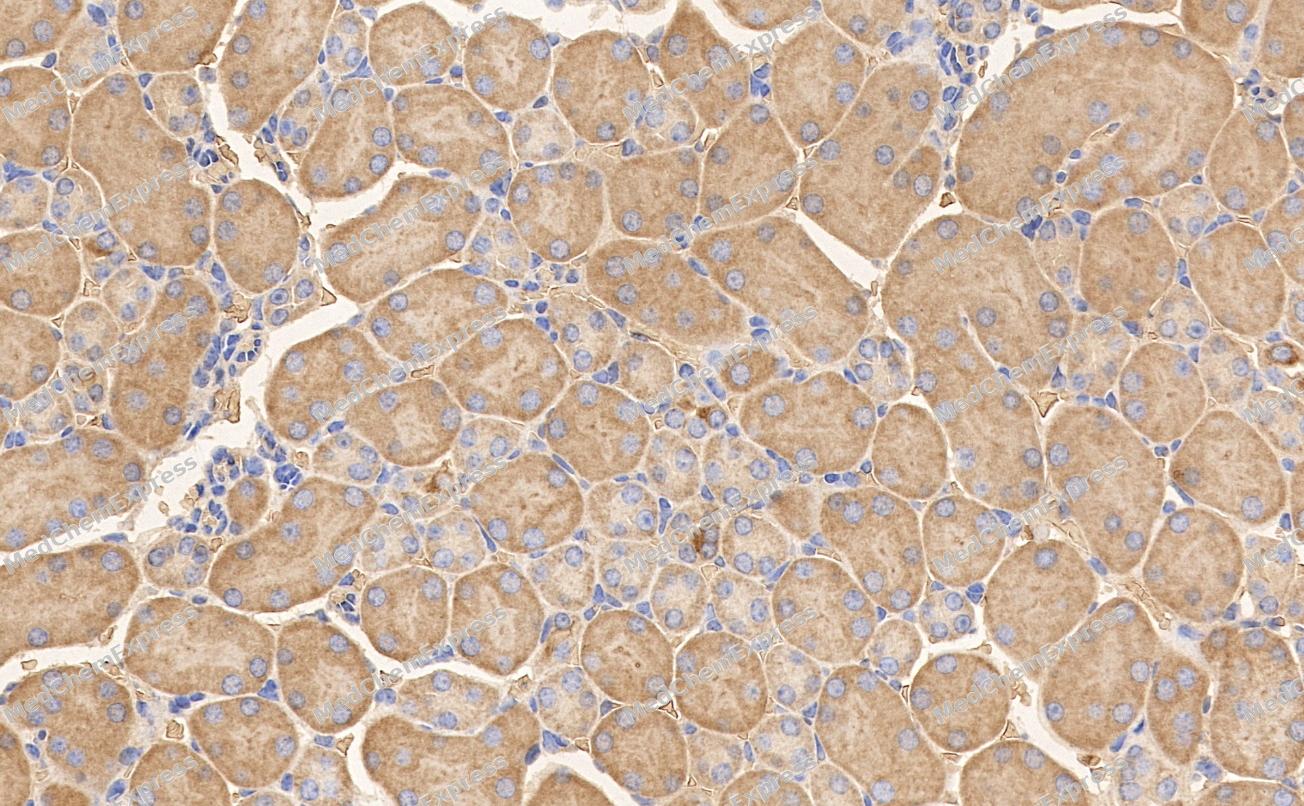 Immunohistochemical analysis of paraffin-embedded Mouse kidney tissue using Osteopontin Antibody. The section was pre-treated using heat mediated antigen retrieval with sodium citrate buffer (pH 6.0) for 8 minutes. The tissues were blocked in QuickBlock for 20 minutes at room temperature, washed with ddH2O and PBS, and then probed with the primary antibody (HY-P80771, 1/100) in 4℃ overnight. The detection was performed using an HRP conjugated compact polymer system. DAB was used as the chromogen. Tissues were counterstained with hematoxylin and mounted with DPX.


Background
-
Function
Osteopontin (OPN) is a secreted, multifunctional, extracellular matrix (ECM), calcium-binding, glycosylated phosphoprotein that is associated with various normal biological functions and pathological processes. OPN is physiologically produced by a wide range of cells and has been identified in various body fluids, playing a crucial role in bone remodeling and vascularization. OPN is also expressed by multiple immune cells, acting as a chemotactic factor, a mediator of cell activation and cytokine production, and an anti-apoptotic factor, thereby regulating inflammation and immune responses. OPN can be involved in the tumorigenesis of various cancer types, including head and neck squamous cell carcinoma (HNSCC), by promoting cell proliferation, adhesion, invasion, and migration through multiple signaling pathways[1][2].
-
Subcellular Localization
Secreted
-
Expression
Tissue_specificity:Protein levels were detected in cerebrospinal fluid and urine (PubMed:25326458, PubMed:36213313, PubMed:37453717) . In bone. Found in plasma. -
Isoforms & Post-Translational Modification
P10451 has 4 isomers: P10451-1: 35423 Da (predicted); P10451-3: 32355 Da (predicted); P10451-4: 33017 Da (predicted); P10451-5: 33843 Da (predicted).
Forms covalent cross-links mediated by transglutaminase TGM2, between a glutamine and the epsilon-amino group of a lysine residue, forming homopolymers and heteropolymers, increasing its collagen binding properties;Extensively phosphorylated by FAM20C in the extracellular medium at multiple sites within the S-x-E/pS motif (PubMed:15869464, PubMed:22582013, PubMed:26091039). The phosphorylated form inhibits hydroxyapatite crystallization. Dephosphorylation via a mechanism involving ALPL/TNAP promotes hydroxyapatite crystallization (By similarity);O-glycosylated. Isoform 5 is GalNAc O-glycosylated at Thr-59 or Ser-62 -
Subunit
Interacts (via N-terminus) with integrin ITGA9:ITGB1
-
SwissProt ID
-
Synonyms
SPP1; BNSP; OPN; PSEC0156; Osteopontin; Bone sialoprotein 1; Nephropontin; Secreted phosphoprotein 1; SPP-1; Urinary stone protein; Uropontin
-
Research Field
Cardiovascular
Documentation
-
Data Sheet (260 KB)
-
SDS (252 KB)
- English - EN (252 KB)
- Français - FR (252 KB)
- Deutsch - DE (252 KB)
- Norwegian - NO (252 KB)
- Español - ES (252 KB)
- Swedish - SV (252 KB)
- Italian - IT (252 KB)
- Korean - KR (252 KB)
- Portuguese - PT (252 KB)
-
User Guide for Antibodies (1077 KB)
References

 Powered by Bioz
