



Alkaline phosphatase Antibody (YA6345)
(Synonyms: ALPL; AKP2; Alkaline phosphatase liver/bone/kidney; Alkaline phosphatase liver/bone/kidney isozyme; Alkaline phosphatase tissue nonspecific isozyme; AP TNAP; AP-TNAP; APTNAP; BALP; BAP; FLJ40094; FLJ93059; Glycerophosphatase; HOPS; Liver/bone/kidney isozyme; Liver/bone/kidney type alkaline phosphatase; MGC161443; MGC167935; PHOA; PPBT_HUMAN; Tissue non specific alkaline phosphatase; Tissue nonspecific ALP; TNAP; TNSALP.)
Based on 1 Customer Validation
Alkaline phosphatase Antibody (YA6345) is a Rabbit-derived and non-conjugated IgG monoclonal antibody, targeting to Alkaline phosphatase.
-
Host:
Rabbit
-
Isotype:
IgG
-
Application:
WB
-
Reactivity :
Human, Mouse, Rat
-
Formulation:
Supplied in 0.01M TBS(pH7.4) with 1% BSA, 0.03% Proclin300 and 50% Glycerol.
-
Conjugation:
Non-conjugated


To place orders, for customer services and technical support, please contact: MedChemExpress USA
Tel: 609-228-6898 E-mail: [email protected] [email protected]





Applications
| Application |
WB

WB: Western Blot
|
|---|---|
| Dilution Ratio | 1:500-2000 |


Product Details
Alkaline phosphatase Antibody (YA6345) is a Rabbit-derived and non-conjugated IgG monoclonal antibody, targeting to Alkaline phosphatase.
-
Host Rabbit

-
Clonality Monoclonal

-
Species ReactivityHuman, Mouse, Rat
-
Observed Molecular WeightObserved band size: 80 kDa
Note: Due to possible protein modifications or aggregation, the molecular weight should be confirmed by actual measurement, and the predicted value is for reference only.

-
Calculated Molecular Weight Predicted band size: 56 kDa

KLH conjugated synthetic peptide derived from human Alkaline phosphatase, tissue-nonspecific isozyme aa 18-50
affinity purified.
Non-conjugated
Unmodified
IgG


Product Properties
-
Appearance
Liquid
-
Formulation
Supplied in 0.01M TBS(pH7.4) with 1% BSA, 0.03% Proclin300 and 50% Glycerol.
-
Concentration
Batch-dependent, Please check the COA for the concentration of each lot. Check Lot Concentration
-
Storage & Stability
Stored at -20°C for 1 year. Avoid repeated freeze / thaw cycles.
-
Shipping
Shipping with blue ice.


Verification Images
-
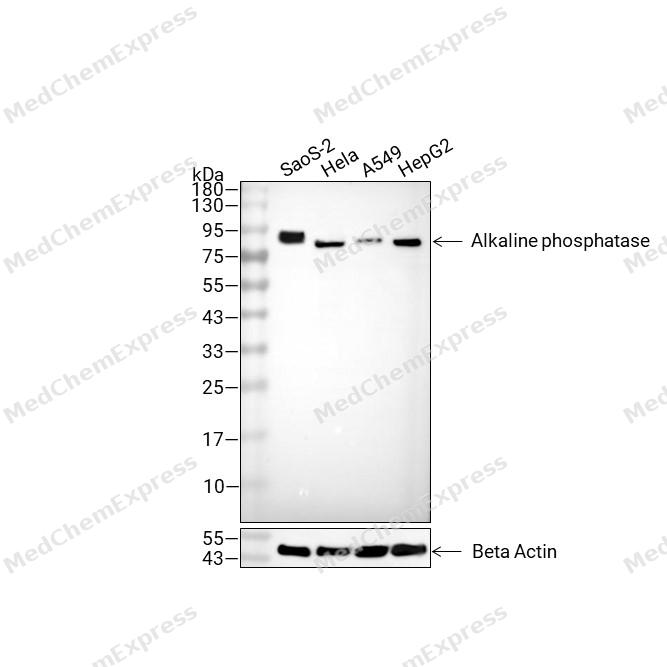 Western blot analysis of extracts from SaoS-2 (lane2(20μg), Hela (lane3(20μg), A549 (lane4(20μg) and HepG2 (lane5(20μg) using Alkaline phosphatase Antibody (HY-P86653). Proteins were transferred to a PVDF membrane and blocked with 5% non-fat milk in TBST for 2 hour at room temperature. The primary antibody (1/1000) and Loading control antibody (Beta Actin, HY-P80993, 1/10,000) was used in 5% non-fat milk in TBST at 4°C overnight. Goat Anti-Rabbit IgG-HRP Secondary Antibody (HY-P8001 ,1/10,000) was used for 1 hour at room temperature.


Background
-
Function
Alkaline phosphatase is an Alkaline phosphatase that metabolizes various phosphate compounds and plays a key role in skeletal mineralization and adaptive thermogenesis. Has broad substrate specificity and can hydrolyze a considerable variety of compounds: however, only a few substrates, such as diphosphate (inorganic pyrophosphate; PPi), pyridoxal 5'-phosphate (PLP) and N-phosphocreatine are natural substrates. Plays an essential role in skeletal and dental mineralization via its ability to hydrolyze extracellular diphosphate, a potent mineralization inhibitor, to phosphate: it thereby promotes hydroxyapatite crystal formation and increases inorganic phosphate concentration. Acts in a non-redundant manner with PHOSPHO1 in skeletal mineralization: while PHOSPHO1 mediates the initiation of hydroxyapatite crystallization in the matrix vesicles (MVs), ALPL/TNAP catalyzes the spread of hydroxyapatite crystallization in the extracellular matrix. Also promotes dephosphorylation of osteopontin (SSP1), an inhibitor of hydroxyapatite crystallization in its phosphorylated state; it is however unclear whether ALPL/TNAP mediates SSP1 dephosphorylation via a direct or indirect manner. Catalyzes dephosphorylation of PLP to pyridoxal (PL), the transportable form of vitamin B6, in order to provide a sufficient amount of PLP in the brain, an essential cofactor for enzymes catalyzing the synthesis of diverse neurotransmitters. Additionally, also able to mediate ATP degradation in a stepwise manner to adenosine, thereby regulating the availability of ligands for purinergic receptors. Also capable of dephosphorylating microbial products, such as lipopolysaccharides (LPS) as well as other phosphorylated small-molecules, such as poly-inosine:cytosine (poly I:C). Acts as a key regulator of adaptive thermogenesis as part of the futile creatine cycle: localizes to the mitochondria of thermogenic fat cells and acts by mediating hydrolysis of N-phosphocreatine to initiate a futile cycle of creatine dephosphorylation and phosphorylation. During the futile creatine cycle, creatine and N-phosphocreatine are in a futile cycle, which dissipates the high energy charge of N-phosphocreatine as heat without performing any mechanical or chemical work[1][2][3][4][5][6].
-
Subcellular Localization
Cell membrane; Lipid-anchor, GPI-anchor; Extracellular vesicle membrane; Lipid-anchor, GPI-anchor; Mitochondrion membrane; Lipid-anchor, GPI-anchor; Mitochondrion intermembrane space
-
Isoforms & Post-Translational Modification
P05186 has 3 isomers: P05186-1: 57305 Da (predicted); P05186-2: 48909 Da (predicted); P05186-3: 51045 Da (predicted).
N-glycosylated -
Subunit
Homodimer
-
SwissProt ID
-
Synonyms
ALPL; AKP2; Alkaline phosphatase liver/bone/kidney; Alkaline phosphatase liver/bone/kidney isozyme; Alkaline phosphatase tissue nonspecific isozyme; AP TNAP; AP-TNAP; APTNAP; BALP; BAP; FLJ40094; FLJ93059; Glycerophosphatase; HOPS; Liver/bone/kidney isozyme; Liver/bone/kidney type alkaline phosphatase; MGC161443; MGC167935; PHOA; PPBT_HUMAN; Tissue non specific alkaline phosphatase; Tissue nonspecific ALP; TNAP; TNSALP.


Documentation
-
Data Sheet (235 KB)
-
SDS (254 KB)
- English - EN (254 KB)
- Français - FR (254 KB)
- Deutsch - DE (254 KB)
- Norwegian - NO (254 KB)
- Español - ES (254 KB)
- Swedish - SV (254 KB)
- Italian - IT (254 KB)
- Korean - KR (254 KB)
- Portuguese - PT (254 KB)
-
User Guide for Antibodies (1077 KB)

 Powered by Bioz
