



CTLA4 Antibody (YA3503)
(Synonyms: CD 152; CD152; CD152 antigen; Celiac disease 3; CELIAC3; CTLA 4; CTLA-4; Cytotoxic T cell associated 4; Cytotoxic T lymphocyte associated 4; Cytotoxic T lymphocyte associated antigen 4; Cytotoxic T lymphocyte associated protein 4; Cytotoxic T lymphocyte associated serine esterase 4; Cytotoxic T lymphocyte protein 4; Cytotoxic T-lymphocyte-associated antigen 4; Cytotoxic T-lymphocyte-associated protein 4; GSE; IDDM12; CD152 isoform; CTLA4_HUMAN; GRD4; ICOS; Ligand and transmembrane spliced cytotoxic T lymphocyte associated antigen 4. )
Based on 1 Customer Validation
CTLA4 Antibody (YA3503) is a Rabbit-derived and non-conjugated IgG monoclonal antibody, targeting to CTLA4.
-
Host:
Rabbit
-
Isotype:
IgG
-
Application:
WB, ICC/IF
-
Reactivity :
Human, Mouse, Rat
-
Formulation:
Supplied in 50mM Tris-Glycine(pH 7.4), 0.15M NaCl, 40%Glycerol, 0.01% sodium azide and 0.05% BSA.
-
Conjugation:
Non-conjugated


To place orders, for customer services and technical support, please contact: MedChemExpress USA
Tel: 609-228-6898 E-mail: [email protected] [email protected]





Applications
| Application |
WB

WB: Western Blot
|
ICC/IF
ICC/IF: Immunocytochemistry/
Immunofluorescence |
|---|---|---|
| Dilution Ratio | 1:500-1:1000 | 1:50-1:200 |


Product Details
CTLA4 Antibody (YA3503) is a Rabbit-derived and non-conjugated IgG monoclonal antibody, targeting to CTLA4.
-
Host Rabbit

-
Clonality Monoclonal,Recombinant

-
Species ReactivityHuman, Mouse, Rat
-
Observed Molecular WeightObserved band size: 43 kDa
Note: Due to possible protein modifications or aggregation, the molecular weight should be confirmed by actual measurement, and the predicted value is for reference only.

-
Calculated Molecular Weight Predicted band size: 25 kDa

A synthesized peptide derived from human CTLA4 (CD152) aa6-78.
Endogenous
Affinity Purified
Non-conjugated
Unmodified
IgG


Product Properties
-
Appearance
Solution
-
Formulation
Supplied in 50mM Tris-Glycine(pH 7.4), 0.15M NaCl, 40%Glycerol, 0.01% sodium azide and 0.05% BSA.
-
Concentration
Batch-dependent, Please check the COA for the concentration of each lot. Check Lot Concentration
-
Storage & Stability
Stored at -20°C for 1 year. Avoid repeated freeze / thaw cycles.
-
Shipping
Shipping with blue ice.


Verification Images
-
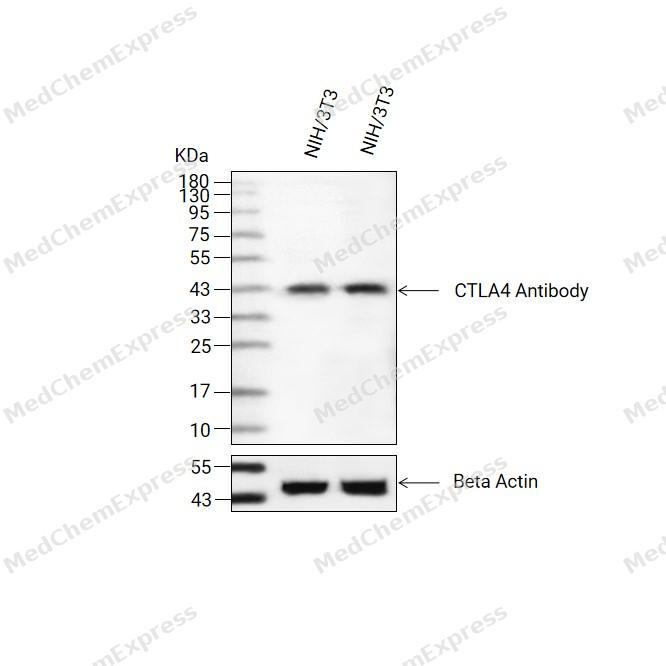 Western blot analysis of extracts from NIH/3T3(lane 2(20ug) and NIH/3T3(lane 3(40ug) using CTLA4 Antibody (HY-P81075) Rabbit mAb. Proteins were transferred to a PVDF membrane and blocked with 5% non-fat milk in TBST for 2 hour at room temperature. The primary antibody (1/1000) and Loading control antibody (Beta Actin, HY-P83730, 1/10000) was used in 5% non-fat milk in TBST at 4°C overnight. Goat Anti-Mouse/Rabbit IgG-HRP Secondary Antibody (1/10000) was used for 1 hour at room temperature.


Background
-
Function
Cytotoxic T-lymphocyte-associated protein 4 (CTLA-4), also known as CD152, is an inhibitory receptor belonging to the CD28 immunoglobulin subfamily. CTLA-4 is expressed primarily by T cells. The ligands of CTLA-4, CD80 and CD86, are typically found on the surface of antigen-presenting cells and can either bind CD28 or CTLA-4. The interactions of the ligands with CTLA-4 serve to inhibit T cell responses. Because of its dampening effect, CTLA-4 is a crucial regulator of T-cell homeostasis and self-tolerance. The mechanisms by which CTLA-4 exerts its inhibitory function can be categorized as either cell-intrinsic (affects the CTLA-4 expressing T-cell) or cell-extrinsic (affects secondary cells). CTLA-4 is well recognized as a key immune checkpoint and has gained significant momentum as a therapeutic target in the field of autoimmunity and cancer.
-
Subcellular Localization
Cell membrane
-
Expression
Tissue_Specificity: Widely expressed with highest levels in lymphoid tissues. Detected in activated T-cells where expression levels are 30- to 50-fold less than CD28, the stimulatory coreceptor, on the cell surface following activation -
Isoforms & Post-Translational Modification
CD152 (CTLA-4) has 5 isomers: P16410-1: 24656 Da (predicted); P16410-2: 6560 Da (predicted); P16410-3: 6745 Da (predicted); P16410-4: 8855 Da (predicted); P16410-5: 19145 Da (predicted).
N-glycosylation is important for dimerization. Phosphorylation at Tyr-201 prevents binding to the AP-2 adapter complex, blocks endocytosis, and leads to retention of CTLA4 on the cell surface -
Subunit
Homodimer; disulfide-linked
-
SwissProt ID
-
Synonyms
CD 152; CD152; CD152 antigen; Celiac disease 3; CELIAC3; CTLA 4; CTLA-4; Cytotoxic T cell associated 4; Cytotoxic T lymphocyte associated 4; Cytotoxic T lymphocyte associated antigen 4; Cytotoxic T lymphocyte associated protein 4; Cytotoxic T lymphocyte associated serine esterase 4; Cytotoxic T lymphocyte protein 4; Cytotoxic T-lymphocyte-associated antigen 4; Cytotoxic T-lymphocyte-associated protein 4; GSE; IDDM12; CD152 isoform; CTLA4_HUMAN; GRD4; ICOS; Ligand and transmembrane spliced cytotoxic T lymphocyte associated antigen 4.


Documentation
-
Data Sheet (232 KB)
-
SDS (254 KB)
- English - EN (254 KB)
- Français - FR (254 KB)
- Deutsch - DE (254 KB)
- Norwegian - NO (254 KB)
- Español - ES (254 KB)
- Swedish - SV (254 KB)
- Italian - IT (254 KB)
- Korean - KR (254 KB)
- Portuguese - PT (254 KB)
-
User Guide for Antibodies (1077 KB)

 Powered by Bioz
