



Dynamin 2 Antibody (YA2464)
(Synonyms: DNM2; DYN2; Dynamin-2)
Based on 1 Customer Validation
Dynamin 2 Antibody (YA2464) is a Rabbit-derived and non-conjugated IgG monoclonal antibody, targeting to Dynamin 2.
-
Host:
Rabbit
-
Isotype:
IgG
-
Application:
WB, IHC-P, ICC/IF, FC
-
Reactivity :
Human, Mouse, Rat
-
Formulation:
Supplied in 10mM PBS, pH 7.4, 150mM sodium chloride, 0.05% BSA, 0.02% sodium azide and 50% glycerol.
-
Conjugation:
Non-conjugated


To place orders, for customer services and technical support, please contact: MedChemExpress USA
Tel: 609-228-6898 E-mail: [email protected] [email protected]





Applications
| Application |
WB

WB: Western Blot
|
IHC-P
IHC-P: Immunohistochemistry-Paraffin
|
ICC/IF
ICC/IF: Immunocytochemistry/
Immunofluorescence |
FC
FC: Flow Cytometry
|
|---|---|---|---|---|
| Dilution Ratio | 1:500-1:1000 | 1:50-1:100 | 1:50-1:200 | 1:50-1:100 |


Product Details
Dynamin 2 Antibody (YA2464) is a Rabbit-derived and non-conjugated IgG monoclonal antibody, targeting to Dynamin 2.
-
Host Rabbit

-
Clonality Recombinant, Monoclonal

-
Species ReactivityHuman, Mouse, Rat
-
Observed Molecular WeightObserved band size: 98 kDa
Note: Due to possible protein modifications or aggregation, the molecular weight should be confirmed by actual measurement, and the predicted value is for reference only.

-
Calculated Molecular Weight Predicted band size: 98 kDa

Entrez Gene: 1785 Human ; 13430 Mouse ; 25751 Rat
SwissProt: P50570 Human ; P39054 Mouse ; P39052 Rat
OMIM: 160150 Human
A synthesized peptide derived from human Dynamin 2 aa750-800/870.
Endogenous
Affinity Chromatography
Non-conjugated
Unmodified
IgG


Product Properties
-
Appearance
Liquid
-
Formulation
Supplied in 10mM PBS, pH 7.4, 150mM sodium chloride, 0.05% BSA, 0.02% sodium azide and 50% glycerol.
-
Concentration
Batch-dependent, Please check the COA for the concentration of each lot. Check Lot Concentration
-
Storage & Stability
Stored at -20°C for 1 year. Avoid repeated freeze / thaw cycles.
-
Shipping
Shipping with blue ice.


Verification Images
-
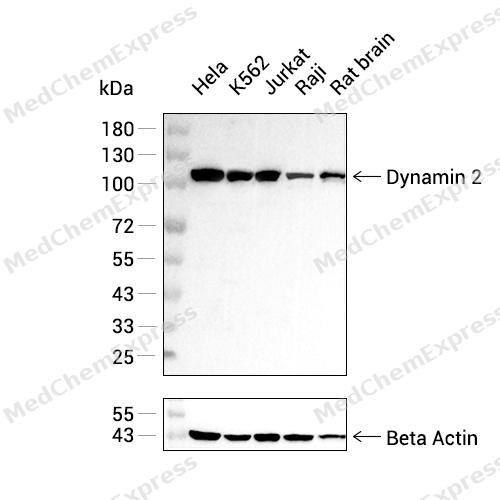 Western blot analysis was performed on extracts from Hela (lane 1, 20 μg), K562 (lane 2, 20 μg),Jurkat (lane 3, 20 μg), Raji (lane 4, 20 μg) and Rat brain (lane 5, 20 μg) using Dynamin 2 Rabbit mAb.Proteins were transferred to a PVDF membrane and blocked with 5% non - fat milk in TBST at 4°C overnight.The primary antibody (1:1000 dilution) and the loading control antibody (beta-Actin, HY-P83730, 1:5000 dilution) were incubated in 5% non-fat milk in TBST for 1 hour at 37°C.Goat Anti - Mouse/Rabbit IgG - HRP Secondary Antibody (1:20000 dilution) was then applied for 40 minutes at 37°C.
 -
 Immunohistochemical analysis of paraffin-embedded human epididymis tissue using Dynamin 2 Antibody (HY-P82719, 1/100). The section was pretreated using heat mediated antigen retrieval with sodium citrate buffer (pH 6.0) for 8 minutes. The tissues were blocked with quick block buffer for 0.5 hours at room temperature, washed with PBS and PBST, and then incubated with the primary antibody overnight at 4℃. The detection was performed using an HRP conjugated compact polymer system. DAB was used as the chromogen. Tissues were counterstained with hematoxylin and mounted with DPX.
 -
 Immunohistochemical analysis of paraffin-embedded human kidney tissue using Dynamin 2 Antibody (HY-P82719, 1/100). The section was pretreated using heat mediated antigen retrieval with sodium citrate buffer (pH 6.0) for 8 minutes. The tissues were blocked with quick block buffer for 0.5 hours at room temperature, washed with PBS and PBST, and then incubated with the primary antibody overnight at 4℃. The detection was performed using an HRP conjugated compact polymer system. DAB was used as the chromogen. Tissues were counterstained with hematoxylin and mounted with DPX.
 -
 Immunohistochemical analysis of paraffin-embedded human placenta tissue using Dynamin 2 Antibody (HY-P82719, 1/100). The section was pretreated using heat mediated antigen retrieval with sodium citrate buffer (pH 6.0) for 8 minutes. The tissues were blocked with quick block buffer for 0.5 hours at room temperature, washed with PBS and PBST, and then incubated with the primary antibody overnight at 4℃. The detection was performed using an HRP conjugated compact polymer system. DAB was used as the chromogen. Tissues were counterstained with hematoxylin and mounted with DPX.
 -
 Immunohistochemical analysis of paraffin-embedded human bronchus tissue using Dynamin 2 Antibody (HY-P82719, 1/100). The section was pretreated using heat mediated antigen retrieval with sodium citrate buffer (pH 6.0) for 8 minutes. The tissues were blocked with quick block buffer for 0.5 hours at room temperature, washed with PBS and PBST, and then incubated with the primary antibody overnight at 4℃. The detection was performed using an HRP conjugated compact polymer system. DAB was used as the chromogen. Tissues were counterstained with hematoxylin and mounted with DPX.
 -
 Immunohistochemical analysis of paraffin-embedded human salivary gland tissue using Dynamin 2 Antibody (HY-P82719, 1/100). The section was pretreated using heat mediated antigen retrieval with sodium citrate buffer (pH 6.0) for 8 minutes. The tissues were blocked with quick block buffer for 0.5 hours at room temperature, washed with PBS and PBST, and then incubated with the primary antibody overnight at 4℃. The detection was performed using an HRP conjugated compact polymer system. DAB was used as the chromogen. Tissues were counterstained with hematoxylin and mounted with DPX.
 -
 Immunohistochemical analysis of paraffin-embedded human small intestine tissue using Dynamin 2 Antibody (HY-P82719, 1/100). The section was pretreated using heat mediated antigen retrieval with sodium citrate buffer (pH 6.0) for 8 minutes. The tissues were blocked with quick block buffer for 0.5 hours at room temperature, washed with PBS and PBST, and then incubated with the primary antibody overnight at 4℃. The detection was performed using an HRP conjugated compact polymer system. DAB was used as the chromogen. Tissues were counterstained with hematoxylin and mounted with DPX.
 -
 Immunohistochemical analysis of paraffin-embedded human oral mucosa tissue using Dynamin 2 Antibody (HY-P82719, 1/100). The section was pretreated using heat mediated antigen retrieval with sodium citrate buffer (pH 6.0) for 8 minutes. The tissues were blocked with quick block buffer for 0.5 hours at room temperature, washed with PBS and PBST, and then incubated with the primary antibody overnight at 4℃. The detection was performed using an HRP conjugated compact polymer system. DAB was used as the chromogen. Tissues were counterstained with hematoxylin and mounted with DPX.
 -
 Immunohistochemical analysis of paraffin-embedded rat cervix tissue using Dynamin 2 Antibody (HY-P82719, 1/100). The section was pretreated using heat mediated antigen retrieval with sodium citrate buffer (pH 6.0) for 8 minutes. The tissues were blocked with quick block buffer for 0.5 hours at room temperature, washed with PBS and PBST, and then incubated with the primary antibody overnight at 4℃. The detection was performed using an HRP conjugated compact polymer system. DAB was used as the chromogen. Tissues were counterstained with hematoxylin and mounted with DPX.
 -
 Immunohistochemical analysis of paraffin-embedded rat spleen tissue using Dynamin 2 Antibody (HY-P82719, 1/100). The section was pretreated using heat mediated antigen retrieval with sodium citrate buffer (pH 6.0) for 8 minutes. The tissues were blocked with quick block buffer for 0.5 hours at room temperature, washed with PBS and PBST, and then incubated with the primary antibody overnight at 4℃. The detection was performed using an HRP conjugated compact polymer system. DAB was used as the chromogen. Tissues were counterstained with hematoxylin and mounted with DPX.


Background
-
Function
Dynamin 2 catalyzes the hydrolysis of GTP and utilizes this energy to mediate vesicle scission at plasma membrane during endocytosis and filament remodeling at many actin structures during organization of the actin cytoskeleton. Plays an important role in vesicular trafficking processes, namely clathrin-mediated endocytosis (CME), exocytic and clathrin-coated vesicle from the trans-Golgi network, and PDGF stimulated macropinocytosis. During vesicular trafficking process, associates to the membrane, through lipid binding, and self-assembles into ring-like structure through oligomerization to form a helical polymer around the vesicle membrane and leading to vesicle scission. Plays a role in organization of the actin cytoskeleton by mediating arrangement of stress fibers and actin bundles in podocytes. During organization of the actin cytoskeleton, self-assembles into ring-like structure that directly bundles actin filaments to form typical membrane tubules decorated with dynamin spiral polymers. Self-assembly increases GTPase activity and the GTP hydrolysis causes the rapid depolymerization of dynamin spiral polymers, and results in dispersion of actin bundles. Remodels, through its interaction with CTTN, bundled actin filaments in a GTPase-dependent manner and plays a role in orchestrating the global actomyosin cytoskeleton. The interaction with CTTN stabilizes the interaction of DNM2 and actin filaments and stimulates the intrinsic GTPase activity that results in actin filament-barbed ends and increases the sensitivity of filaments in bundles to the actin depolymerizing factor, CFL1. Plays a role in the autophagy process, by participating in the formation of ATG9A vesicles destined for the autophagosomes through its interaction with SNX18, by mediating recycling endosome scission leading to autophagosome release through MAP1LC3B interaction. Also regulates maturation of apoptotic cell corpse-containing phagosomes by recruiting PIK3C3 to the phagosome membrane. Also plays a role in cytokinesis. May participate in centrosome cohesion through its interaction with TUBG1. Plays a role in the regulation of neuron morphology, axon growth and formation of neuronal growth cones. Involved in membrane tubulation[1][2][3][4][5][6][7][8][9][10].
-
Subcellular Localization
Cytoplasm, cytoskeleton; Cytoplasmic vesicle, clathrin-coated vesicle; Cell projection, uropodium; Endosome; Cytoplasm, cytoskeleton, microtubule organizing center, centrosome; Cytoplasm, cytoskeleton, microtubule organizing center, centrosome, centriole; Recycling endosome; Cell projection, phagocytic cup; Cytoplasmic vesicle, phagosome membrane; Peripheral membrane protein; Cell projection, podosome; Cytoplasm; Cell junction; Postsynaptic density; Synapse, synaptosome; Midbody; Membrane, clathrin-coated pit
-
Expression
Tissue_specificity:Widely expressed (PubMed: 7590285) . Expressed in skeletal muscle and peripheral nerves (PubMed: 19623537) . -
Isoforms & Post-Translational Modification
P50570 has 5 isomers: P50570-1: 98064 Da (predicted); P50570-2: 97652 Da (predicted); P50570-3: 97554 Da (predicted); P50570-4: 97966 Da (predicted); P50570-5: 97977 Da (predicted).
Phosphorylation at Ser-848 by GSK3-alpha relieves the inhibition of BIN1 and promotes endocytosis (PubMed:36445308). Phosphorylation at Ser-764 by CDK1 is greatly increased upon mitotic entry (PubMed:20496096). It regulates cytokinesis downstream of calcineurin, and does not affect clathrin-mediated endocytosis (By similarity). Dephosphorylated by calcineurin/PP2 during cytokinesis in a Ca(2+)- and calmodulin-dependent manner (PubMed:20496096). Phosphorylated on tyrosine residues by EGFR and after activation of SRC (By similarity) -
Subunit
Oligomerizes into a helical polymer that self-assembles around the vesicle membrane, when associated to the menbrane through lipid binding (PubMed:34744632, PubMed:36445308). Interacts with SHANK1 and SHANK2 (PubMed:11583995). Interacts with SNX9 (PubMed:15703209). Interacts (via C-terminal proline-rich domain (PRD)) with SNX18 (via SH3 domain); this interaction regulates ATG9A and ATG16L1 trafficking from recycling endosomes to sites of autophagosome formation (PubMed:29437695, PubMed:32315611). Interacts with SNX33 (via SH3 domain) (PubMed:18353773). Interacts with MYO1E (via SH3 domain) (PubMed:17257598). Interacts with PSTPIP1 (via SH3 domain) (PubMed:18480402). Interacts with CTNND2 (PubMed:22022388). Interacts (via C-terminal proline-rich domain (PRD)) with BIN1 (via SH3 domain); this interaction allows the recruitment of DNM2 to the membrane tubules and inhibits self-assembly-stimulated GTPase activity on the membrane (PubMed:17676042, PubMed:36445308). Interacts with GABARAP, GABARAPL1 and GABARAPL2 (PubMed:32315611). Interacts with MAP1LC3B (the lipidate and non-lipidated LC3 form); this interaction mediates recycling endosome scission leading to autophagosome release (PubMed:32315611). Interacts with ITSN1 (PubMed:32315611). Interacts (via C-terminal proline-rich domain (PRD)) with SH3BP4 (via SH3 domain); this interaction controls the GTPase activity and is prevented by EGFR-induced tyrosine phosphorylation of either DNM2 or SH3BP4 (PubMed:16325581). May interact with PIK3C3. May be a component of a complex composed of RAB5A (in GDP-bound form), DYN2 and PIK3C3. Interacts with SDC4; this interaction is markedly enhanced at focal ahesion site upon induction of focal adhesions and stress-fiber formation (By similarity). Interacts with ACTN1. Interacts with CTTN; this interaction stimulates the intrinsic GTPase activity of DNM2 and stabilizes the association of DNM2 and actin filaments; in addition this interaction is stimulated by ligand binding to the receptor, leading to the recruitment of the DNM2-CTTN complex to the sequestered receptor-ligand complex to its internalization. Interacts with NOSTRIN (via SH3 domain); this interaction allows the recruitment of NOS3 to dynamin-positive structures. Interacts with TUBG1; this interaction may participate in centrosome cohesion (By similarity)
-
SwissProt ID
-
Synonyms
DNM2; DYN2; Dynamin-2
-
Research Field
Signal Transduction


Documentation
-
Data Sheet (234 KB)
-
SDS (251 KB)
- English - EN (251 KB)
- Français - FR (251 KB)
- Deutsch - DE (251 KB)
- Norwegian - NO (251 KB)
- Español - ES (251 KB)
- Swedish - SV (251 KB)
- Italian - IT (251 KB)
- Korean - KR (251 KB)
- Portuguese - PT (251 KB)
-
User Guide for Antibodies (1077 KB)

 Powered by Bioz
