



FGF21 Antibody (YA3276)
(Synonyms: Fgf21; FGFL; Fibroblast growth factor 21; PRO10196; UNQ3115)
Based on 1 Customer Validation
FGF21 Antibody (YA3276) is a Rabbit-derived and non-conjugated IgG monoclonal antibody, targeting to FGF21.
-
Host:
Rabbit
-
Isotype:
IgG
-
Application:
WB, IHC-P
-
Reactivity :
Human, Mouse, Rat
-
Formulation:
1.Supplied in 50mM Tris-Glycine(pH 7.4), 0.15M NaCl, 40%Glycerol, 0.01% sodium azide and 0.05% BSA.
2.Supplied in 10mM PBS, pH 7.4, 150mM sodium chloride, 0.05% BSA, 0.02% sodium azide and 50% glycerol.
Please refer to the lot-specific COA for specific buffer information.
-
Conjugation:
Non-conjugated


To place orders, for customer services and technical support, please contact: MedChemExpress USA
Tel: 609-228-6898 E-mail: [email protected] [email protected]





Applications
| Application |
WB

WB: Western Blot
|
IHC-P
IHC-P: Immunohistochemistry-Paraffin
|
|---|---|---|
| Dilution Ratio | 1:1000-1:2000 | 1:50-1:100 |


Product Details
FGF21 Antibody (YA3276) is a Rabbit-derived and non-conjugated IgG monoclonal antibody, targeting to FGF21.
-
Host Rabbit

-
Clonality Recombinant,Monoclonal

-
Species ReactivityHuman, Mouse, Rat
-
Observed Molecular WeightObserved band size: 22 kDa
Note: Due to possible protein modifications or aggregation, the molecular weight should be confirmed by actual measurement, and the predicted value is for reference only.

-
Calculated Molecular Weight Predicted band size: 22 kDa

Entrez Gene: 26291 Human ; 56636 Mouse ; 170580 Rat
SwissProt: Q9NSA1 Human ; Q9JJN1 Mouse ;
OMIM: 609436 Human
A synthesized peptide derived from human FGF21 aa5-61.
Endogenous
Affinity Chromatography
Non-conjugated
Unmodified
IgG


Product Properties
-
Appearance
Solution
-
Formulation
1.Supplied in 50mM Tris-Glycine(pH 7.4), 0.15M NaCl, 40%Glycerol, 0.01% sodium azide and 0.05% BSA.
2.Supplied in 10mM PBS, pH 7.4, 150mM sodium chloride, 0.05% BSA, 0.02% sodium azide and 50% glycerol.
Please refer to the lot-specific COA for specific buffer information. -
Concentration
Batch-dependent, Please check the COA for the concentration of each lot. Check Lot Concentration
-
Storage & Stability
Stored at -20°C for 1 year. Avoid repeated freeze / thaw cycles.
-
Shipping
Shipping with blue ice.


Verification Images
-
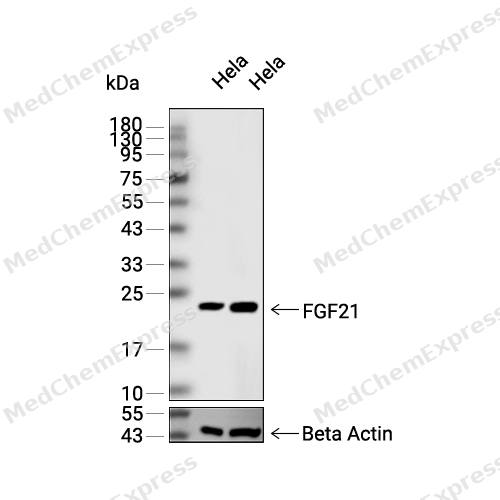 Western blot analysis of extracts from Hela (lane 2(20μg), Hela (lane 3(40μg), using FGF21 Antibody. Proteins were transferred to a PVDF membrane and blocked with 5% BSA in TBST for 2 hour at room temperature. The primary antibody and Loading control antibody (Beta Actin, HY-P80438, 1/3000) was used in 5% BSA in TBST at 4°C overnight. Goat Anti-Mouse/Rabbit IgG-HRP Secondary Antibody (HY-P8004/HY-P8001, 1/10,000) was used for 1 hour at room temperature.
 -
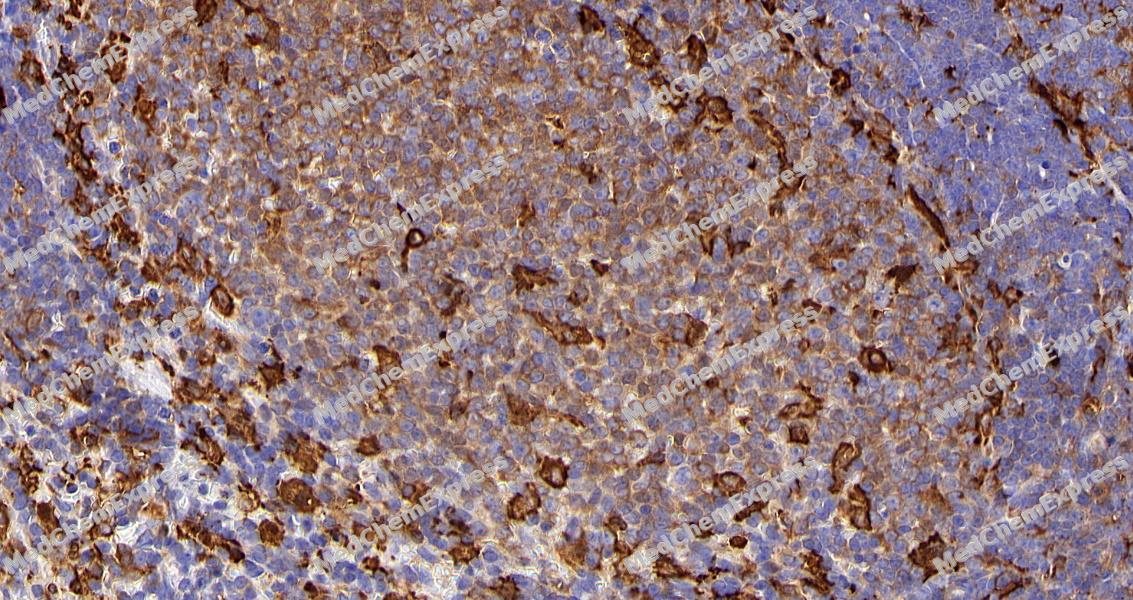 Immunohistochemical analysis of paraffin-embedded rat liver tissue using FGF21 Antibody. The section was pre-treated using heat mediated antigen retrieval with sodium citrate buffer (pH 6.0) for 8 minutes. The tissues were blocked in QuickBlock for 20 minutes at room temperature, washed with ddH2O and PBS, and then probed with the primary antibody at 1/100 dilution in 4℃ overnight. The detection was performed using an HRP conjugated compact polymer system. DAB was used as the chromogen. Tissues were counterstained with hematoxylin and mounted with DPX.
 -
Immunohistochemical analysis of paraffin-embedded rat liver tissue using FGF21 Antibody. The section was pre-treated using heat mediated antigen retrieval with sodium citrate buffer (pH 6.0) for 8 minutes. The tissues were blocked in QuickBlock for 20 minutes at room temperature, washed with ddH2O and PBS, and then probed with the primary antibody at 1/100 dilution in 4℃ overnight. The detection was performed using an HRP conjugated compact polymer system. DAB was used as the chromogen. Tissues were counterstained with hematoxylin and mounted with DPX.


Background
-
Function
FGF21 (fibroblast growth factor 21) is an endocrine member of the FGF19 subfamily that functions as a systemic metabolic hormone regulating energy balance, glucose homeostasis, and lipid metabolism through fibroblast growth factor receptor (FGFR) signaling pathways.[1][2] Mechanistically, FGF21 signals through a receptor complex composed of FGFR1 and β-Klotho (KLB), and β-Klotho is required for efficient activation of specific FGFR isoforms by FGF21.[3][4][5] Activation of the FGF21-FGFR1/β-Klotho axis enhances insulin sensitivity, promotes energy expenditure, regulates lipid utilization, and coordinates metabolic communication among liver, adipose tissue, and other metabolic organs.[2][6][7] In metabolic disease models, FGF21 improves glucose and lipid handling, stimulates hepatic fatty acid oxidation, reduces hepatic lipid accumulation, and is closely linked to obesity, type 2 diabetes, and fatty liver disease.[8][9][10] Compared with related endocrine FGFs, FGF21 is distinguished from FGF23, which utilizes α-Klotho-dependent signaling, whereas FGF21 preferentially activates β-Klotho-associated receptor complexes and primarily regulates systemic metabolic homeostasis.[4][5][3] FGF21 also differs functionally from FGF19, although both hormones require β-Klotho for receptor engagement and participate in endocrine metabolic regulation.[11][12] For experimental applications, recombinant FGF21 proteins, FGF21 analogs, and β-Klotho-targeting agonists are widely used to investigate metabolic signaling mechanisms and therapeutic responses in obesity, diabetes, and nonalcoholic fatty liver disease models.[11][13][14]
-
Subcellular Localization
Secreted
-
Subunit
Interacts (via C-terminus) with KLB; this interaction is direct. Interacts with FGFR4
-
SwissProt ID
-
Synonyms
Fgf21; FGFL; Fibroblast growth factor 21; PRO10196; UNQ3115
-
Research Field
Cardiovascular


Documentation
-
Data Sheet (262 KB)
-
SDS (252 KB)
- English - EN (252 KB)
- Français - FR (252 KB)
- Deutsch - DE (252 KB)
- Norwegian - NO (252 KB)
- Español - ES (252 KB)
- Swedish - SV (252 KB)
- Italian - IT (252 KB)
- Korean - KR (252 KB)
- Portuguese - PT (252 KB)
-
User Guide for Antibodies (1077 KB)
References
[2]. Fisher FM, et al. Understanding the Physiology of FGF21. Annu Rev Physiol. 2016;78:223-41. [Content Brief]
[4]. Chen L, et al. Structural basis for FGF hormone signalling. Nature. 2023;618:862-870.
[5]. Lee S, et al. Structures of β-klotho reveal a 'zip code'-like mechanism for endocrine FGF signalling. Nature. 2018 Jan 25;553(7689):501-505. [Content Brief]
[7]. Kaur N, et al. Multi-organ FGF21-FGFR1 signaling in metabolic health and disease. Front Cardiovasc Med. 2022 Aug 2;9:962561. [Content Brief]
[8]. Szczepańska E, et al. FGF21: A Novel Regulator of Glucose and Lipid Metabolism and Whole-Body Energy Balance. Horm Metab Res. 2022 Apr;54(4):203-211. [Content Brief]
[9]. Ye M, et al. FGF21-FGFR1 Coordinates Phospholipid Homeostasis, Lipid Droplet Function, and ER Stress in Obesity. Endocrinology. 2016 Dec;157(12):4754-4769. [Content Brief]
[10]. Dushay J, et al. Increased fibroblast growth factor 21 in obesity and nonalcoholic fatty liver disease. Gastroenterology. 2010 Aug;139(2):456-63. [Content Brief]
[11]. Aaldijk AS, et al. Biological and pharmacological functions of the FGF19- and FGF21-coreceptor beta klotho. Front Endocrinol (Lausanne). 2023 May 16;14:1150222. [Content Brief]
[12]. Dolegowska K, et al. FGF19 subfamily members: FGF19 and FGF21. J Physiol Biochem. 2019 Jun;75(2):229-240. [Content Brief]
[13]. Henriksson E, et al. FGF19 and FGF21 for the Treatment of NASH-Two Sides of the Same Coin? Differential and Overlapping Effects of FGF19 and FGF21 From Mice to Human. Front Endocrinol (Lausanne). 2020 Dec 22;11:601349. [Content Brief]
[14]. Min X, et al. Agonistic β-Klotho antibody mimics fibroblast growth factor 21 (FGF21) functions. J Biol Chem. 2018 Sep 21;293(38):14678-14688. [Content Brief]

 Powered by Bioz
