



IGF2BP1 Antibody (YA3071)
(Synonyms: insulin-like growth factor 2 mRNA binding protein 1; IMP1; ZBP1; CRDBP; IMP-1; CRD-BP; VICKZ1)
Based on 1 Customer Validation
IGF2BP1 Antibody (YA3071) is a Rabbit-derived and non-conjugated IgG monoclonal antibody, targeting to IGF2BP1.
-
Host:
Rabbit
-
Isotype:
IgG
-
Application:
WB, IHC-P, IP
-
Reactivity :
Human, Mouse
-
Formulation:
Supplied in 50mM Tris-Glycine(pH 7.4), 0.15M NaCl, 40% Glycerol, 0.01% Sodium azide and 0.05% BSA
-
Conjugation:
Non-conjugated


To place orders, for customer services and technical support, please contact: MedChemExpress USA
Tel: 609-228-6898 E-mail: [email protected] [email protected]





Applications
| Application |
WB

WB: Western Blot
|
IHC-P
IHC-P: Immunohistochemistry-Paraffin
|
IP
IP: Immunoprecipitation
|
|---|---|---|---|
| Dilution Ratio | 1:500-1:1000 | 1:50-1:100 | 1:20 |


Product Details
IGF2BP1 Antibody (YA3071) is a Rabbit-derived and non-conjugated IgG monoclonal antibody, targeting to IGF2BP1.
-
Host Rabbit

-
Clonality Recombinant, Monoclonal

-
Species ReactivityHuman, Mouse
-
Observed Molecular WeightObserved band size: 63 kDa
Note: Due to possible protein modifications or aggregation, the molecular weight should be confirmed by actual measurement, and the predicted value is for reference only.

-
Calculated Molecular Weight Predicted band size: 63 kDa

Entrez Gene: 10642 Human ; 140486 Mouse ;
SwissProt: Q9NZI8 Human ; O88477 Mouse ;
OMIM: 608288 Human
Recombinant protein of human IGF2BP1
Endogenous
Affinity Purified
Non-conjugated
Unmodified
IgG


Product Properties
-
Appearance
Liquid
-
Formulation
Supplied in 50mM Tris-Glycine(pH 7.4), 0.15M NaCl, 40% Glycerol, 0.01% Sodium azide and 0.05% BSA
-
Concentration
Batch-dependent, Please check the COA for the concentration of each lot. Check Lot Concentration
-
Storage & Stability
Stored at -20°C for 1 year. Avoid repeated freeze / thaw cycles.
-
Shipping
Shipping with blue ice.


Verification Images
-
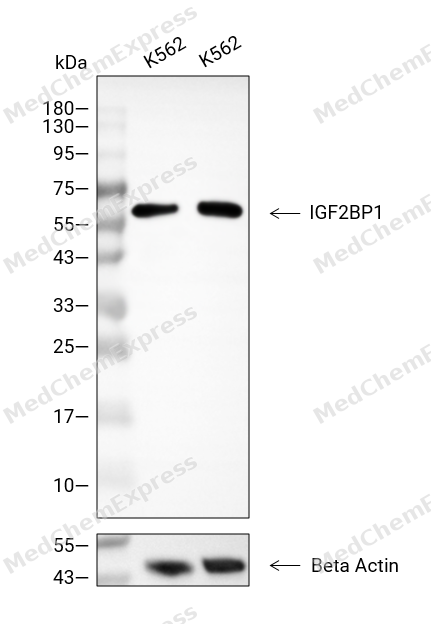 Western blot analysis of extracts from K562 (lane 2(20μg), K562 (lane 3(40μg), using IGF2BP1 Antibody. Proteins were transferred to a PVDF membrane and blocked with 5% BSA in TBST for 2 hour at room temperature. The primary antibody and Loading control antibody (Beta Actin, HY-P80438, 1/3000) was used in 5% BSA in TBST at 4°C overnight. Goat Anti-Mouse/Rabbit IgG-HRP Secondary Antibody (HY-P8004/HY-P8001, 1/10,000) was used for 1 hour at room temperature.
 -
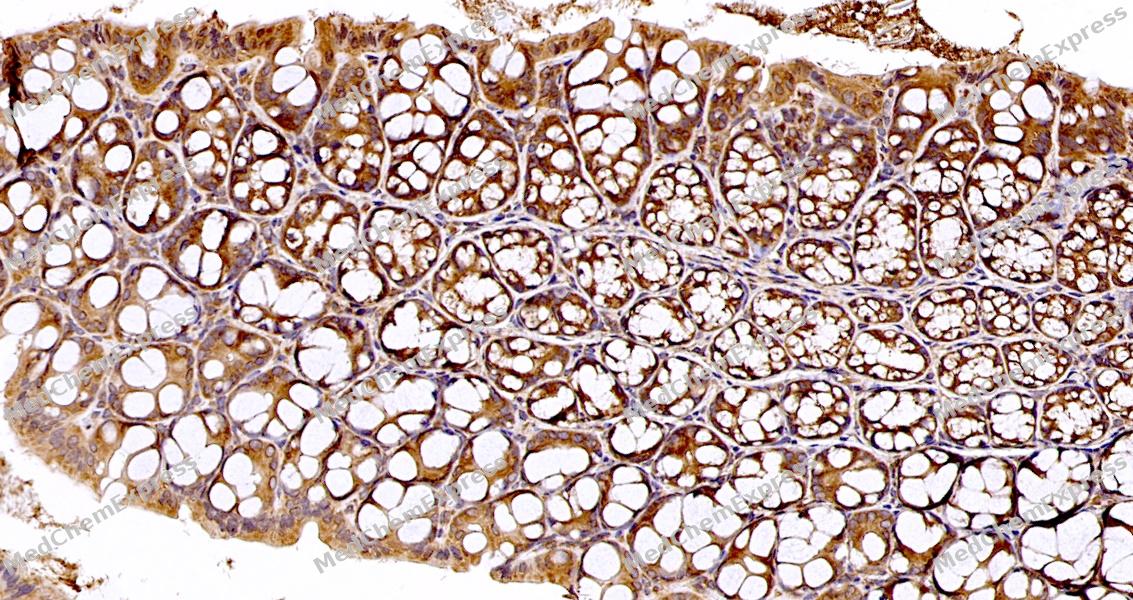 Immunohistochemical analysis of paraffin-embedded mouse colon tissue using IGF2BP1 Antibody. The section was pre-treated using heat mediated antigen retrieval with sodium citrate buffer (pH 6.0) for 8 minutes. The tissues were blocked in QuickBlock for 20 minutes at room temperature, washed with ddH2O and PBS, and then probed with the primary antibody at 1/100 dilution in 4℃ overnight. The detection was performed using an HRP conjugated compact polymer system. DAB was used as the chromogen. Tissues were counterstained with hematoxylin and mounted with DPX.
 -
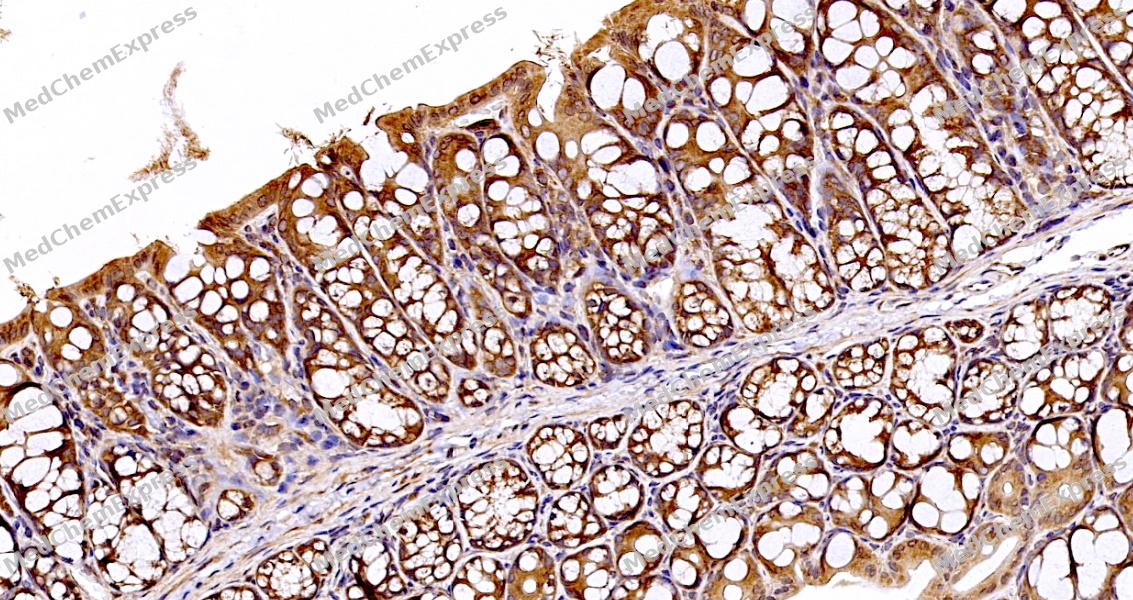 Immunohistochemical analysis of paraffin-embedded mouse colon tissue using IGF2BP1 Antibody. The section was pre-treated using heat mediated antigen retrieval with sodium citrate buffer (pH 6.0) for 8 minutes. The tissues were blocked in QuickBlock for 20 minutes at room temperature, washed with ddH2O and PBS, and then probed with the primary antibody at 1/100 dilution in 4℃ overnight. The detection was performed using an HRP conjugated compact polymer system. DAB was used as the chromogen. Tissues were counterstained with hematoxylin and mounted with DPX.


Background
-
Function
IGF2BP1 is a RNA-binding factor that recruits target transcripts to cytoplasmic protein-RNA complexes (mRNPs). This transcript 'caging' into mRNPs allows mRNA transport and transient storage. It also modulates the rate and location at which target transcripts encounter the translational apparatus and shields them from endonuclease attacks or microRNA-mediated degradation. Preferentially binds to N6-methyladenosine (m6A)-containing mRNAs and increases their stability. Plays a direct role in the transport and translation of transcripts required for axonal regeneration in adult sensory neurons. Regulates localized beta-actin/ACTB mRNA translation, a crucial process for cell polarity, cell migration and neurite outgrowth. Co-transcriptionally associates with the ACTB mRNA in the nucleus. This binding involves a conserved 54-nucleotide element in the ACTB mRNA 3'-UTR, known as the 'zipcode'. The RNP thus formed is exported to the cytoplasm, binds to a motor protein and is transported along the cytoskeleton to the cell periphery. During transport, prevents ACTB mRNA from being translated into protein. When the RNP complex reaches its destination near the plasma membrane, IGF2BP1 is phosphorylated. This releases the mRNA, allowing ribosomal 40S and 60S subunits to assemble and initiate ACTB protein synthesis. Monomeric ACTB then assembles into the subcortical actin cytoskeleton. During neuronal development, key regulator of neurite outgrowth, growth cone guidance and neuronal cell migration, presumably through the spatiotemporal fine tuning of protein synthesis, such as that of ACTB. May regulate mRNA transport to activated synapses. Binds to and stabilizes ABCB1/MDR-1 mRNA. During interstinal wound repair, interacts with and stabilizes PTGS2 transcript. PTGS2 mRNA stabilization may be crucial for colonic mucosal wound healing. Binds to the 3'-UTR of IGF2 mRNA by a mechanism of cooperative and sequential dimerization and regulates IGF2 mRNA subcellular localization and translation. Binds to MYC mRNA, in the coding region instability determinant (CRD) of the open reading frame (ORF), hence preventing MYC cleavage by endonucleases and possibly microRNA targeting to MYC-CRD. Binding to MYC mRNA is enhanced by m6A-modification of the CRD. Binds to the 3'-UTR of CD44 mRNA and stabilizes it, hence promotes cell adhesion and invadopodia formation in cancer cells. Binds to the oncofetal H19 transcript and to the neuron-specific TAU mRNA and regulates their localizations. Binds to and stabilizes BTRC/FBW1A mRNA. Binds to the adenine-rich autoregulatory sequence (ARS) located in PABPC1 mRNA and represses its translation. PABPC1 mRNA-binding is stimulated by PABPC1 protein. Prevents BTRC/FBW1A mRNA degradation by disrupting microRNA-dependent interaction with AGO2. Promotes the directed movement of tumor-derived cells by fine-tuning intracellular signaling networks. Binds to MAPK4 3'-UTR and inhibits its translation. Interacts with PTEN transcript open reading frame (ORF) and prevents mRNA decay. This combined action on MAPK4 (down-regulation) and PTEN (up-regulation) antagonizes HSPB1 phosphorylation, consequently it prevents G-actin sequestration by phosphorylated HSPB1, allowing F-actin polymerization. Hence enhances the velocity of cell migration and stimulates directed cell migration by PTEN-modulated polarization. Interacts with Hepatitis C virus (HCV) 5'-UTR and 3'-UTR and specifically enhances translation at the HCV IRES, but not 5'-cap-dependent translation, possibly by recruiting eIF3. Interacts with HIV-1 GAG protein and blocks the formation of infectious HIV-1 particles. Reduces HIV-1 assembly by inhibiting viral RNA packaging, as well as assembly and processing of GAG protein on cellular membranes. During cellular stress, such as oxidative stress or heat shock, stabilizes target mRNAs that are recruited to stress granules, including CD44, IGF2, MAPK4, MYC, PTEN, RAPGEF2 and RPS6KA5 transcripts[1][2].
-
Subcellular Localization
Nucleus; Cytoplasm; Cytoplasm, perinuclear region; Cytoplasm, P-body; Cytoplasm, Stress granule; Cell projection, lamellipodium; Cell projection, dendrite; Cell projection, dendritic spine; Cell projection, growth cone; Cell projection, filopodium; Cell projection, axon
-
Expression
Tissue_specificity:Mainly expressed in the embryo, including in fetal liver, fetal lung, fetal kidney, fetal thymus (at protein level) . Also expressed follicles of ovary, as well as in gonocytes of testis, spermatogonia, semen, oocytes and placenta (at protein level) . Expressed in various cancers, including testis and lung cancers (at protein level) , as well as kidney, prostate and trachea cancers
Induction:May be up-regulated in response to CTNNB1/beta-catenin activation -
Isoforms & Post-Translational Modification
Q9NZI8 has 2 isomers: Q9NZI8-1: 63481 Da (predicted); Q9NZI8-2: 48598 Da (predicted).
Phosphorylated at Ser-181 by mTORC2 cotranslationally, promoting binding to the 3'-UTR of IGF2 mRNA -
Subunit
Can form homodimers and heterodimers with IGF2BP1 and IGF2BP3. Component of the coding region determinant (CRD)-mediated complex, composed of DHX9, HNRNPU, IGF2BP1, SYNCRIP and YBX1. During HCV infection, identified in a HCV IRES-mediated translation complex, at least composed of EIF3C, IGF2BP1, RPS3 and HCV RNA-replicon. Interacts (via the KH domains) with HIV-1 GAG (via the second zinc finger motif of NC). Associates (via the RRM domains and KH domains) with HIV-1 particles. Identified in a mRNP complex, composed of at least DHX9, DDX3X, ELAVL1, HNRNPU, IGF2BP1, ILF3, PABPC1, PCBP2, PTBP2, STAU1, STAU2, SYNCRIP and YBX1. Identified in a IGF2BP1-dependent mRNP granule complex containing untranslated mRNAs. Interacts with DHX9, ELAVL2, HNRNPA2B1, HNRNPC, HNRNPH1, HNRNPU, IGF2BP2, ILF2, and YBX1. Interacts with FMR1. Component of a multisubunit autoregulatory RNP complex (ARC), at least composed of IGF2BP1, PABPC1 and CSDE1/UNR. Directly interacts with PABPC1 (PubMed:17212783, PubMed:29476152, PubMed:32245947). Component of a TAU mRNP complex, at least composed of IGF2BP1, ELAVL4 and G3BP. Interacts with ELAVL4 in an RNA-dependent manner. Associates with microtubules and polysomes. Interacts with AGO1 and AGO2. Interacts with ELAVL1 and MATR3 (PubMed:29476152, PubMed:32245947). Interacts (via KH3 and KH4 domains) with SEPIN14P20 peptide RBRP; the interaction results in increased binding of IGF2BP1 to N6-methyladenosine (m6A)-containing mRNAs (PubMed:32245947)
-
SwissProt ID
-
Synonyms
insulin-like growth factor 2 mRNA binding protein 1; IMP1; ZBP1; CRDBP; IMP-1; CRD-BP; VICKZ1
-
Research Field
Epigenetics and Nuclear Signaling


Documentation
-
Data Sheet (258 KB)
-
SDS (252 KB)
- English - EN (252 KB)
- Français - FR (252 KB)
- Deutsch - DE (252 KB)
- Norwegian - NO (252 KB)
- Español - ES (252 KB)
- Swedish - SV (252 KB)
- Italian - IT (252 KB)
- Korean - KR (252 KB)
- Portuguese - PT (252 KB)
-
User Guide for Antibodies (1077 KB)

 Powered by Bioz
