



OTUB1 Antibody (YA1483)
(Synonyms: OTUB1; OTB1; OTU1; HSPC263; Ubiquitin thioesterase OTUB1; Deubiquitinating enzyme OTUB1; OTU domain-containing ubiquitin aldehyde-binding protein 1; Otubain-1; hOTU1; Ubiquitin-specific-processing protease OTUB1)
Based on 1 Customer Validation
OTUB1 Antibody (YA1483) is a Rabbit-derived and non-conjugated IgG monoclonal antibody, targeting to OTUB1.
-
Host:
Rabbit
-
Isotype:
IgG
-
Application:
WB, IP
-
Reactivity :
Human, Mouse, Rat
-
Formulation:
Supplied in 50mM Tris-Glycine(pH 7.4), 0.15M NaCl, 40% Glycerol, 0.01% Sodium azide and 0.05% BSA
-
Conjugation:
Non-conjugated


To place orders, for customer services and technical support, please contact: MedChemExpress USA
Tel: 609-228-6898 E-mail: [email protected] [email protected]





Applications
| Application |
WB

WB: Western Blot
|
IP
IP: Immunoprecipitation
|
|---|---|---|
| Dilution Ratio | 1:500-1:1000 | 1:20 |


Product Details
OTUB1 Antibody (YA1483) is a Rabbit-derived and non-conjugated IgG monoclonal antibody, targeting to OTUB1.
-
Host Rabbit

-
Clonality Recombinant,Monoclonal

-
Species ReactivityHuman, Mouse, Rat
-
Observed Molecular WeightObserved band size: 31 kDa
Note: Due to possible protein modifications or aggregation, the molecular weight should be confirmed by actual measurement, and the predicted value is for reference only.

-
Calculated Molecular Weight Predicted band size: 31 kDa

Entrez Gene: 55611 Human ; 107260 Mouse ; 293705 Rat
SwissProt: Q96FW1 Human ; Q7TQI3 Mouse ; B2RYG6 Rat
OMIM: 608337 Human
A synthetic peptide of human OTUB1
Endogenous
Affinity Purified
Non-conjugated
Unmodified
IgG


Product Properties
-
Appearance
Solution
-
Formulation
Supplied in 50mM Tris-Glycine(pH 7.4), 0.15M NaCl, 40% Glycerol, 0.01% Sodium azide and 0.05% BSA
-
Concentration
Batch-dependent, Please check the COA for the concentration of each lot. Check Lot Concentration
-
Storage & Stability
Stored at -20°C for 1 year. Avoid repeated freeze / thaw cycles.
-
Shipping
Shipping with blue ice.


Verification Images
-
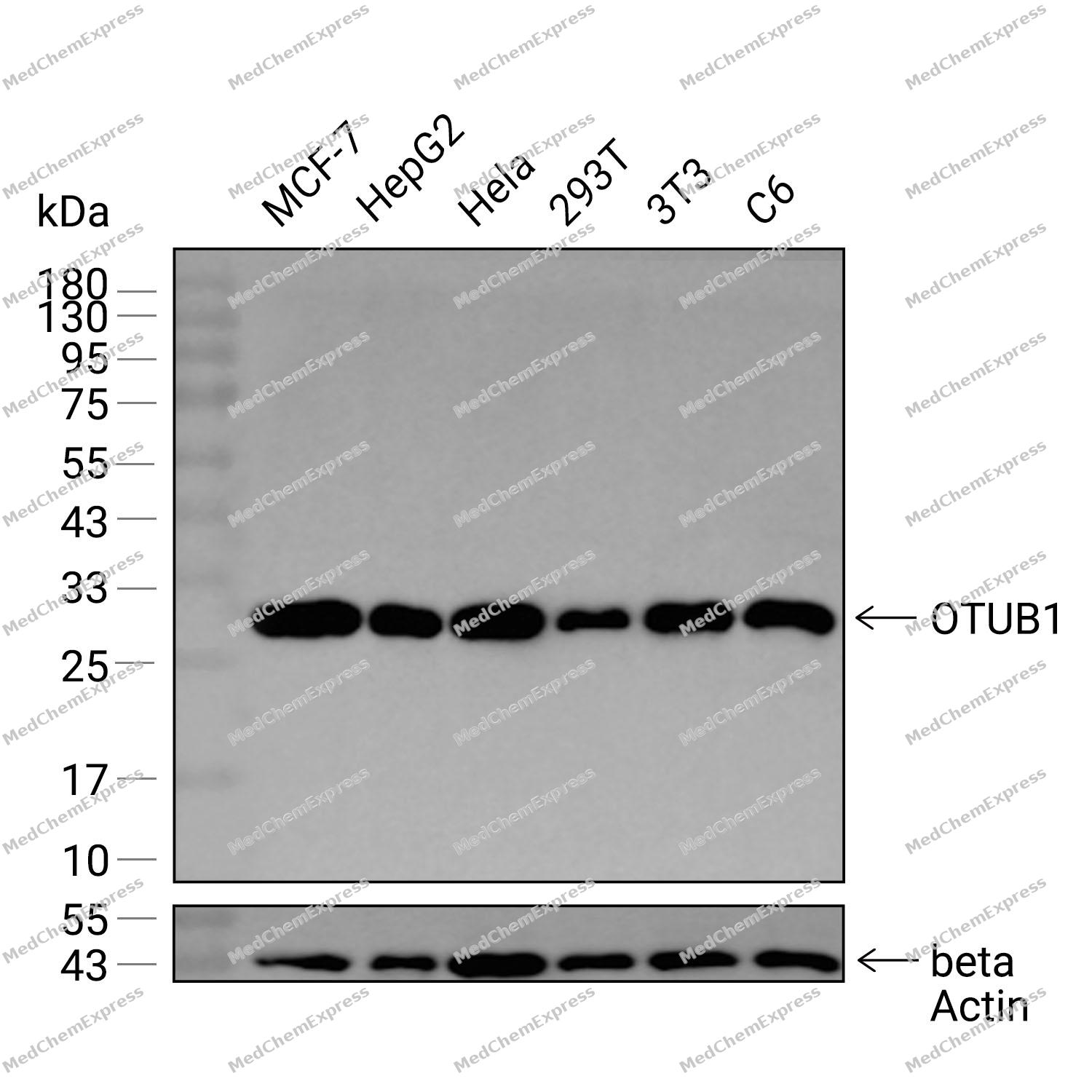 Western blot analysis was performed on extracts from MCF-7 (lane 1, 15 μg), HepG2 (lane 2, 15 μg), Hela (lane 3, 15 μg), 293T (lane 4, 15 μg), 3T3 (lane 5, 15 μg), and C6 (lane 6, 15 μg) using OTUB1 Rabbit mAb.Proteins were transferred to a PVDF membrane and blocked with 5% non-fat milk in TBST at 4°C overnight.The primary antibody (1:1000 dilution) and the loading control antibody (beta-Actin, HY-P80438, 1:20000 dilution) were incubated in 5% non-fat milk in TBST for 1 hour at 37°C.Goat Anti-Rabbit IgG-HRP Secondary Antibody (1:20000 dilution) was then applied for 40 minutes at 37°C.
 -
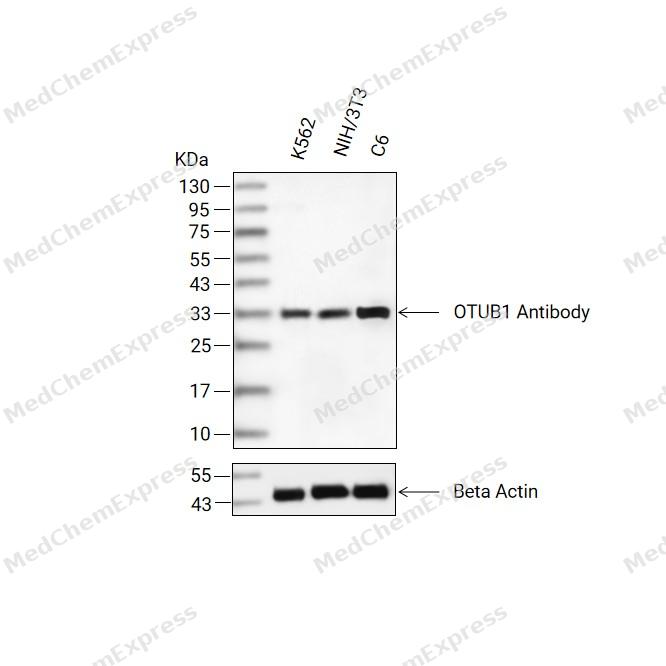 Western blot analysis of extracts from K562(lane 2(20ug) , NIH/3T3(lane 3(20ug) and C6(lane 4(20ug) using OTUB1 Antibody (HY-P81738) Rabbit mAb. Proteins were transferred to a PVDF membrane and blocked with 5% non-fat milk in TBST for 2 hour at room temperature. The primary antibody (1/1000) and Loading control antibody (Beta Actin, HY-P83730, 1/10000) was used in 5% non-fat milk in TBST at 4°C overnight. Goat Anti-Mouse/Rabbit IgG-HRP Secondary Antibody (1/10000) was used for 1 hour at room temperature.


Background
-
Function
OTUB1 is a Hydrolase that can specifically remove 'Lys-48'-linked conjugated ubiquitin from proteins and plays an important regulatory role at the level of protein turnover by preventing degradation. Regulator of T-cell anergy, a phenomenon that occurs when T-cells are rendered unresponsive to antigen rechallenge and no longer respond to their cognate antigen. Acts via its interaction with RNF128/GRAIL, a crucial inductor of CD4 T-cell anergy. Isoform 1 destabilizes RNF128, leading to prevent anergy. In contrast, isoform 2 stabilizes RNF128 and promotes anergy. Surprisingly, it regulates RNF128-mediated ubiquitination, but does not deubiquitinate polyubiquitinated RNF128. Deubiquitinates estrogen receptor alpha (ESR1). Mediates deubiquitination of 'Lys-48'-linked polyubiquitin chains, but not 'Lys-63'-linked polyubiquitin chains. Not able to cleave di-ubiquitin. Also capable of removing NEDD8 from NEDD8 conjugates, but with a much lower preference compared to 'Lys-48'-linked ubiquitin; Plays a key non-catalytic role in DNA repair regulation by inhibiting activity of RNF168, an E3 ubiquitin-protein ligase that promotes accumulation of 'Lys-63'-linked histone H2A and H2AX at DNA damage sites. Inhibits RNF168 independently of ubiquitin thioesterase activity by binding and inhibiting UBE2N/UBC13, the E2 partner of RNF168, thereby limiting spreading of 'Lys-63'-linked histone H2A and H2AX marks. Inhibition occurs by binding to free ubiquitin: free ubiquitin acts as an allosteric regulator that increases affinity for UBE2N/UBC13 and disrupts interaction with UBE2V1. The OTUB1-UBE2N/UBC13-free ubiquitin complex adopts a configuration that mimics a cleaved 'Lys48'-linked di-ubiquitin chain. Acts as a regulator of mTORC1 and mTORC2 complexes. When phosphorylated at Tyr-26, acts as an activator of the mTORC1 complex by mediating deubiquitination of RPTOR via a non-catalytic process: acts by binding and inhibiting the activity of the ubiquitin-conjugating enzyme E2 (UBE2D1/UBCH5A, UBE2W/UBC16 and UBE2N/UBC13), thereby preventing ubiquitination of RPTOR. Can also act as an inhibitor of the mTORC1 and mTORC2 complexes in response to amino acids by mediating non-catalytic deubiquitination of DEPTOR[1][2][3][4][5][6][7][8][9][10][11].
-
Subcellular Localization
Cytoplasm
-
Expression
Tissue_specificity:Isoform 1 is ubiquitous. Isoform 2 is expressed only in lymphoid tissues such as tonsils, lymph nodes and spleen, as well as peripheral blood mononuclear cells -
Isoforms & Post-Translational Modification
Q96FW1 has 2 isomers: Q96FW1-1: 31284 Da (predicted); Q96FW1-2: 35285 Da (predicted).
Phosphorylation at Tyr-26 by SRC and SRMS promotes deubiquitination of RPTOR via a non-catalytic process -
Subunit
Interacts with FUS and RACK1 (PubMed:18954305). Interacts with UBE2D1/UBCH5A, UBE2W/UBC16 and UBE2N/UBC13 (PubMed:20725033, PubMed:22325355, PubMed:22367539, PubMed:35927303)
-
SwissProt ID
-
Synonyms
OTUB1; OTB1; OTU1; HSPC263; Ubiquitin thioesterase OTUB1; Deubiquitinating enzyme OTUB1; OTU domain-containing ubiquitin aldehyde-binding protein 1; Otubain-1; hOTU1; Ubiquitin-specific-processing protease OTUB1
-
Research Field
Epigenetics and Nuclear Signaling


Documentation
-
Data Sheet (262 KB)
-
SDS (252 KB)
- English - EN (252 KB)
- Français - FR (252 KB)
- Deutsch - DE (252 KB)
- Norwegian - NO (252 KB)
- Español - ES (252 KB)
- Swedish - SV (252 KB)
- Italian - IT (252 KB)
- Korean - KR (252 KB)
- Portuguese - PT (252 KB)
-
User Guide for Antibodies (1077 KB)
References
[1]. Borodovsky A, et al. Chemistry-based functional proteomics reveals novel members of the deubiquitinating enzyme family. Chem Biol. 2002 Oct;9(10):1149-59. [Content Brief]
[2]. Balakirev MY, et al. Otubains: a new family of cysteine proteases in the ubiquitin pathway. EMBO Rep. 2003 May;4(5):517-22. [Content Brief]
[3]. Soares L, et al. Two isoforms of otubain 1 regulate T cell anergy via GRAIL. Nat Immunol. 2004 Jan;5(1):45-54. [Content Brief]
[4]. Mevissen TE, et al. OTU deubiquitinases reveal mechanisms of linkage specificity and enable ubiquitin chain restriction analysis. Cell. 2013 Jul 3;154(1):169-84. [Content Brief]
[5]. Stanišić V, et al. OTU Domain-containing ubiquitin aldehyde-binding protein 1 (OTUB1) deubiquitinates estrogen receptor (ER) alpha and affects ERalpha transcriptional activity. J Biol Chem. 2009 Jun 12;284(24):16135-16145. [Content Brief]
[6]. Edelmann MJ, et al. Structural basis and specificity of human otubain 1-mediated deubiquitination. Biochem J. 2009 Mar 1;418(2):379-90. [Content Brief]
[7]. Wang T, et al. Evidence for bidentate substrate binding as the basis for the K48 linkage specificity of otubain 1. J Mol Biol. 2009 Mar 6;386(4):1011-23. [Content Brief]
[8]. Nakada S, et al. Non-canonical inhibition of DNA damage-dependent ubiquitination by OTUB1. Nature. 2010 Aug 19;466(7309):941-6. [Content Brief]
[9]. Juang YC, et al. OTUB1 co-opts Lys48-linked ubiquitin recognition to suppress E2 enzyme function. Mol Cell. 2012 Feb 10;45(3):384-97. [Content Brief]
[10]. Zhao L, et al. OTUB1 protein suppresses mTOR complex 1 (mTORC1) activity by deubiquitinating the mTORC1 inhibitor DEPTOR. J Biol Chem. 2018 Mar 30;293(13):4883-4892. [Content Brief]
[11]. Seo SU, et al. Phosphorylation of OTUB1 at Tyr 26 stabilizes the mTORC1 component, Raptor. Cell Death Differ. 2023 Jan;30(1):82-93. [Content Brief]

 Powered by Bioz
