



Phospho-MEK1 (Thr292) Antibody (YA177)
(Synonyms: MAP2K1; MEK1; PRKMK1; Dual specificity mitogen-activated protein kinase kinase 1; MAP kinase kinase 1; MAPKK 1; MKK1; ERK activator kinase 1; MAPK/ERK kinase 1; MEK 1)
Based on 1 Customer Validation
Phospho-MEK1 (Thr292) Antibody (YA177) is a Rabbit-derived and non-conjugated IgG monoclonal antibody, targeting to Phospho-MEK1 (Thr292).
-
Host:
Rabbit
-
Isotype:
IgG
-
Application:
WB
-
Reactivity :
Mouse, Rat
-
Formulation:
Supplied in 50 mM Tris-Glycine (pH 7.4), 0.15 M NaCl, 40% Glycerol and 0.05% BSA. Preservative: 0.01% Sodium azide
-
Conjugation:
Non-conjugated


To place orders, for customer services and technical support, please contact: MedChemExpress USA
Tel: 609-228-6898 E-mail: [email protected] [email protected]





Applications
| Application |
WB

WB: Western Blot
|
|---|---|
| Dilution Ratio | 1:500-1:1000 |


Product Details
Phospho-MEK1 (Thr292) Antibody (YA177) is a Rabbit-derived and non-conjugated IgG monoclonal antibody, targeting to Phospho-MEK1 (Thr292).
-
Host Rabbit

-
Clonality Recombinant,Monoclonal

-
Species ReactivityMouse, Rat
-
Observed Molecular WeightObserved band size: 43 kDa
Note: Due to possible protein modifications or aggregation, the molecular weight should be confirmed by actual measurement, and the predicted value is for reference only.

-
Calculated Molecular Weight Predicted band size: 43 kDa

Entrez Gene: 5604 Human ; 26395 Mouse ; 170851 Rat
SwissProt: Q02750 Human ; P31938 Mouse ; Q01986 Rat
OMIM: 615279 Human
Synthetic phosphopeptide corresponding to residues surrounding Thr292 of Human MEK1.The exact sequence is proprietary to MCE.
Endogenous
affinity purified
Non-conjugated
Phosphorylated
IgG


Product Properties
-
Appearance
Solution
-
Formulation
Supplied in 50 mM Tris-Glycine (pH 7.4), 0.15 M NaCl, 40% Glycerol and 0.05% BSA. Preservative: 0.01% Sodium azide
-
Concentration
Batch-dependent, Please check the COA for the concentration of each lot. Check Lot Concentration
-
Storage & Stability
Stored at -20°C for 1 year. Avoid repeated freeze / thaw cycles.
-
Shipping
Shipping with blue ice.


Verification Images
-
 Western blot analysis was performed on protein extracts (25 μg) from NIH/3T3 (lane 2), RAW264.7 (lane 3), Mouse bladder (lane 4), and Rat lymph node (lane 5, 40 μg) using Phospho-MEK1 (Thr292) antibody. Proteins were transferred onto a 0.45 μm PVDF membrane using the Trans-Blot® Turbo™ system for 13 min. The membrane was then blocked with 5% nonfat milk in TBST (HY-K1025) for 1 h at room temperature. The primary antibody (1:1000) and loading control antibody GAPDH Antibody (HRP) (HY-P80954A) (1:5000) were diluted in 5% nonfat milk in TBST and incubated with the membrane overnight at 4°C. After washing, the membrane of primary antibody was incubated with HRP-conjugated goat anti-rabbit/mouse IgG secondary antibody (HY-P8001/HY-P8004) (1:5000) diluted in 5% nonfat milk in TBST for 1 h at room temperature. Protein bands were visualized using an Ultra High Sensitivity ECL detection kit (HY-K1005).
 -
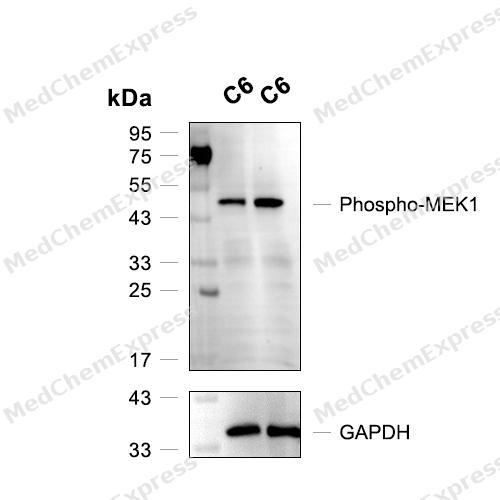 Western blot analysis of extracts from C6(lane 2(20μg) or lane 3(40μg)), using Phospho-MEK1 (HY-P80833) Rabbit mAb. Proteins were transferred to a PVDF membrane and blocked with 5% BSA in TBST for 2 hour at room temperature. The primary antibody (HY-P80833, 1/1000) and Loading control antibody (GAPDH, HY-P80954, 1/3000) was used in 5% BSA in TBST at 4°C overnight. Goat Anti-Mouse/Rabbit IgG-HRP Secondary Antibody (HY-P8004/HY-P8001, 1/10,000) was used for 1 hour at room temperature.


Background
-
Function
MEK1 is a MAP kinase or ERK kinase that phosphorylates the ERK gene product and acts as an immediate upstream activator of ERK signaling[1][2]. Mechanistically, MEK1 and MEK2 phosphorylate and activate ERK1/ERK2, positioning MEK proteins as pathway gatekeepers in the RAS-RAF-MEK-ERK cascade[3][4]. This cascade regulates cell proliferation, differentiation, survival, invasion, and other ERK-dependent cellular responses[3][5]. In disease models, ERK pathway activation is prominent in cancers driven by receptor tyrosine kinase, RAS, BRAF, CRAF, MEK1, or MEK2 alterations, which promote growth factor-independent ERK1/2 activation[5]. Compared with MEK2, MEK1 shares the same ERK substrates, but Mek1- embryos die from placental defects whereas Mek2- mice survive, indicating isoform-related developmental differences and functional redundancy controlled by total MEK protein level[4]. Structurally, MEK1 and MEK2 are closely related dual-specificity tyrosine/threonine kinases with a hydrophobic allosteric pocket adjacent to the ATP-binding site[6][5]. For experimental applications, PD098059 selectively inhibited MEK without significant inhibition of MAPK itself, and allosteric MEK blockade suppressed colon tumor growth in vivo[7][8].
-
Subcellular Localization
Cytoplasm, cytoskeleton, microtubule organizing center, centrosome; Cytoplasm, cytoskeleton, microtubule organizing center, spindle pole body; Cytoplasm; Nucleus; Membrane; Peripheral membrane protein
-
Expression
Tissue_specificity:It is widely expressed, but present in extremely low concentrations in the brain. -
Isoforms & Post-Translational Modification
Q02750 has 2 isomers: Q02750-1: 43439 Da (predicted); Q02750-2: 40764 Da (predicted).
Phosphorylation at Ser-218 and Ser-222 by MAP kinase kinase kinases (BRAF or MEKK1) positively regulates kinase activity (PubMed:29433126, PubMed:8131746). Also phosphorylated at Thr-292 by MAPK1/ERK2 and at Ser-298 by PAK (PubMed:16129686). MAPK1/ERK2 phosphorylation of Thr-292 occurs in response to cellular adhesion and leads to inhibition of Ser-298 phosphorylation by PAK (PubMed:16129686). Autophosphorylated at Ser-218 and Ser-222, autophosphosphorylation is promoted by NEK10 following UV irradiation (PubMed:20956560);(Microbial infection) Acetylation by Yersinia YopJ prevents phosphorylation and activation, thus blocking the MAPK signaling pathway -
Subunit
Found in a complex with at least BRAF, HRAS, MAP2K1, MAPK3/ERK1 and RGS14 (By similarity). Forms a heterodimer with MAP2K2/MEK2 (By similarity). Forms heterodimers with KSR2 which further dimerize to form tetramers (By similarity). Interacts with KSR1 or KSR2 and BRAF; the interaction with KSR1 or KSR2 mediates KSR1-BRAF or KSR2-BRAF dimerization (PubMed:10409742, PubMed:29433126). Interacts with ARBB2, LAMTOR3 and RAF1 (By similarity). Interacts with MAPK1/ERK2 (PubMed:32721402). Interacts with MORG1 (By similarity). Interacts with PPARG (PubMed:17101779). Interacts with isoform 1 of VRK2 (PubMed:20679487). Interacts with SGK1 (PubMed:19447520). Interacts with BIRC6/bruce (PubMed:18329369). Interacts with KAT7; the interaction promotes KAT7 phosphorylation (By similarity). Interacts with RAF1 and NEK10; the interaction is required for ERK1/2-signaling pathway activation in response to UV irradiation (PubMed:20956560). Interacts with TRAF3IP3 (PubMed:26195727). Interacts with MOS (PubMed:34779126, PubMed:35670744)
-
SwissProt ID
-
Synonyms
MAP2K1; MEK1; PRKMK1; Dual specificity mitogen-activated protein kinase kinase 1; MAP kinase kinase 1; MAPKK 1; MKK1; ERK activator kinase 1; MAPK/ERK kinase 1; MEK 1
-
Research Field
Signal Transduction


Documentation
-
Data Sheet (262 KB)
-
SDS (252 KB)
- English - EN (252 KB)
- Français - FR (252 KB)
- Deutsch - DE (252 KB)
- Norwegian - NO (252 KB)
- Español - ES (252 KB)
- Swedish - SV (252 KB)
- Italian - IT (252 KB)
- Korean - KR (252 KB)
- Portuguese - PT (252 KB)
-
User Guide for Antibodies (1077 KB)
References
[1]. Crews CM, et al. The primary structure of MEK, a protein kinase that phosphorylates the ERK gene product. Science. 1992 Oct 16;258(5081):478-80. [Content Brief]
[2]. Zheng CF, et al. Properties of MEKs, the kinases that phosphorylate and activate the extracellular signal-regulated kinases. J Biol Chem. 1993 Nov 15;268(32):23933-9. [Content Brief]
[3]. Shaul YD, et al. The MEK/ERK cascade: from signaling specificity to diverse functions. Biochim Biophys Acta. 2007 Aug;1773(8):1213-26. [Content Brief]
[4]. Aoidi R, et al. Functional redundancy of the kinases MEK1 and MEK2: Rescue of the Mek1 mutant phenotype by Mek2 knock-in reveals a protein threshold effect. Sci Signal. 2016 Jan 26;9(412):ra9. [Content Brief]
[5]. Caunt CJ, et al. MEK1 and MEK2 inhibitors and cancer therapy: the long and winding road. Nat Rev Cancer. 2015 Oct;15(10):577-92. [Content Brief]
[6]. Ohren JF, et al. Structures of human MAP kinase kinase 1 (MEK1) and MEK2 describe novel noncompetitive kinase inhibition. Nat Struct Mol Biol. 2004 Dec;11(12):1192-7. [Content Brief]
[7]. Dudley DT, et al. A synthetic inhibitor of the mitogen-activated protein kinase cascade. Proc Natl Acad Sci U S A. 1995 Aug 15;92(17):7686-9. [Content Brief]
[8]. Sebolt-Leopold JS, et al. Blockade of the MAP kinase pathway suppresses growth of colon tumors in vivo. Nat Med. 1999 Jul;5(7):810-6. [Content Brief]

 Powered by Bioz
