



Phospho-SMad2 (S465+467)Antibody (YA3568)
(Synonyms: Drosophila, homolog of, MADR2 antibody; hMAD-2 antibody; HsMAD2 antibody; JV18 antibody; JV18-1 antibody; JV181 antibody; MAD antibody; MAD homolog 2 antibody; MAD Related Protein 2 antibody; Mad-related protein 2 antibody ; MADH2 antibody; MADR2 antibody; MGC22139 antibody; MGC34440 antibody)
Based on 1 Customer Validation
Phospho-SMad2 (S465+467)Antibody (YA3568) is a Rabbit-derived and non-conjugated IgG monoclonal antibody, targeting to Phospho-SMad2 (S465+467).
-
Host:
Rabbit
-
Isotype:
IgG
-
Application:
WB, ICC/IF, IHC-P
-
Reactivity :
Human, Mouse
-
Formulation:
Supplied in PBS (pH7.4), 0.1% BSA, 40% Glycerol. Preservative: 0.05% Sodium Azide.
-
Conjugation:
Non-conjugated


To place orders, for customer services and technical support, please contact: MedChemExpress USA
Tel: 609-228-6898 E-mail: [email protected] [email protected]





Applications
| Application |
WB

WB: Western Blot
|
ICC/IF
ICC/IF: Immunocytochemistry/
Immunofluorescence |
IHC-P
IHC-P: Immunohistochemistry-Paraffin
|
|---|---|---|---|
| Dilution Ratio | 1:1000 | 1:500 | 1:200 |


Product Details
Phospho-SMad2 (S465+467)Antibody (YA3568) is a Rabbit-derived and non-conjugated IgG monoclonal antibody, targeting to Phospho-SMad2 (S465+467).
-
Host Rabbit

-
Clonality Recombinant, Monoclonal

-
Species ReactivityHuman, Mouse
-
Observed Molecular WeightObserved band size: 60 kDa
Note: Due to possible protein modifications or aggregation, the molecular weight should be confirmed by actual measurement, and the predicted value is for reference only.

-
Calculated Molecular Weight Predicted band size: 52/48 kDa

Synthetic phospho-peptide corresponding to residues surrounding Ser465 and 467 of Human SMAD2.
Affinity Purified
Non-conjugated
Unmodified
IgG


Product Properties
-
Appearance
Liquid
-
Formulation
Supplied in PBS (pH7.4), 0.1% BSA, 40% Glycerol. Preservative: 0.05% Sodium Azide.
-
Concentration
Batch-dependent, Please check the COA for the concentration of each lot. Check Lot Concentration
-
Storage & Stability
Stored at -20°C for 1 year. Avoid repeated freeze / thaw cycles.
-
Shipping
Shipping with blue ice.


Verification Images
-
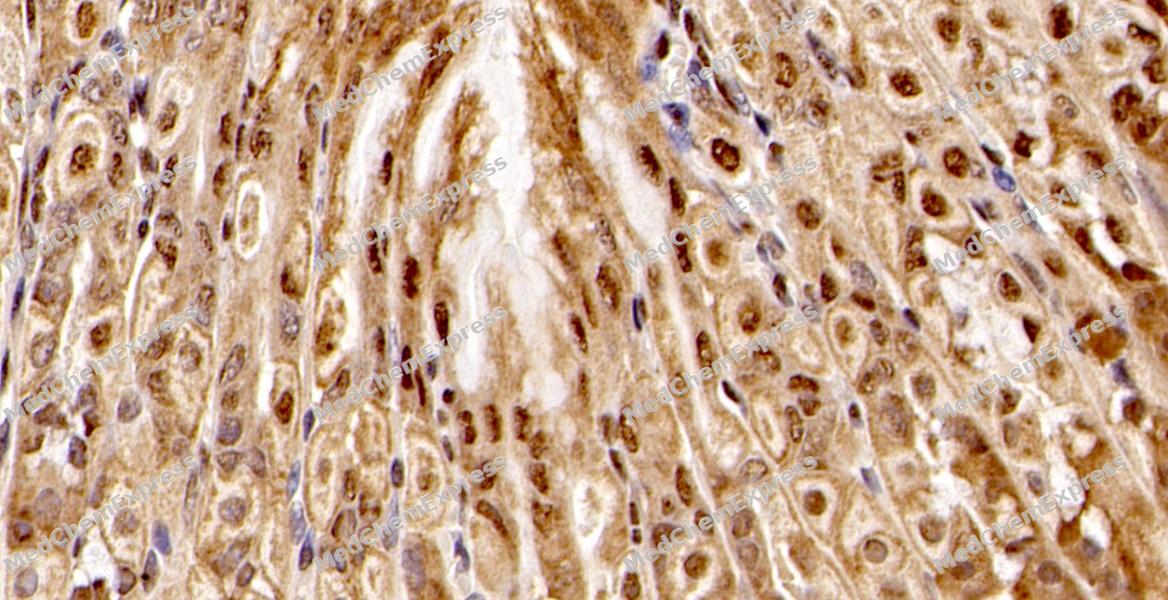 Immunohistochemical analysis of paraffin-embedded mouse stomach tissue using Phospho-SMad2 (S465+467) Antibody. The section was pre-treated using heat mediated antigen retrieval with sodium citrate buffer (pH 6.0) for 8 minutes. The tissues were blocked in QuickBlock for 20 minutes at room temperature, washed with ddH2O and PBS, and then probed with the primary antibody at 1/100 dilution in 4℃ overnight. The detection was performed using an HRP conjugated compact polymer system. DAB was used as the chromogen. Tissues were counterstained with hematoxylin and mounted with DPX.
 -
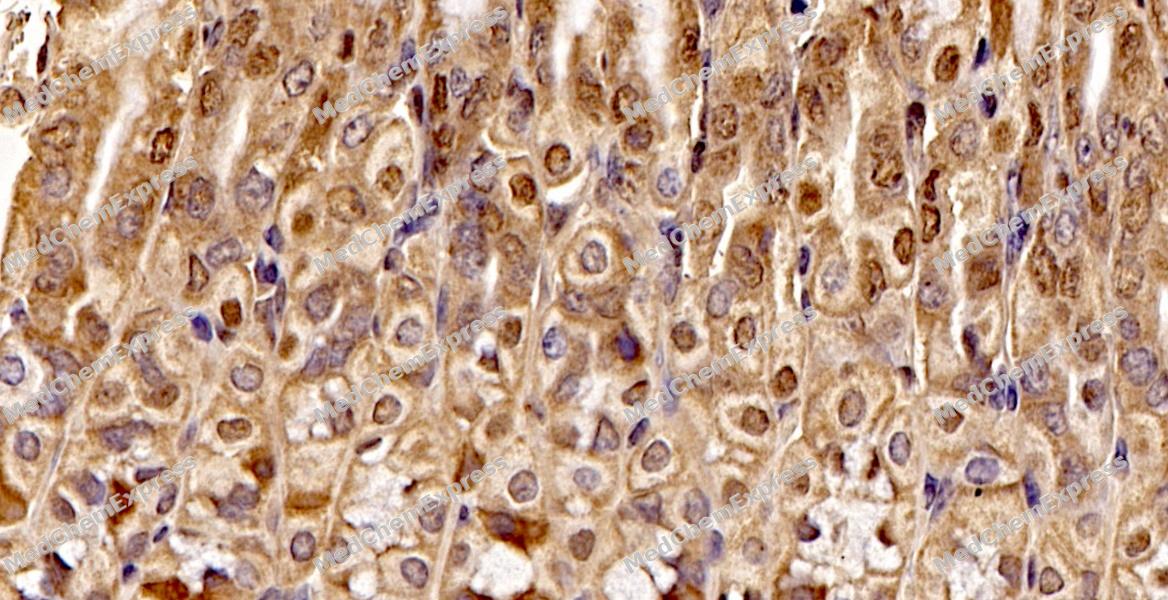 Immunohistochemical analysis of paraffin-embedded mouse stomach tissue using Phospho-SMad2 (S465+467) Antibody. The section was pre-treated using heat mediated antigen retrieval with sodium citrate buffer (pH 6.0) for 8 minutes. The tissues were blocked in QuickBlock for 20 minutes at room temperature, washed with ddH2O and PBS, and then probed with the primary antibody at 1/100 dilution in 4℃ overnight. The detection was performed using an HRP conjugated compact polymer system. DAB was used as the chromogen. Tissues were counterstained with hematoxylin and mounted with DPX.


Background
-
Function
SMad2 is a Receptor-regulated SMAD (R-SMAD) that is an intracellular signal transducer and transcriptional modulator activated by TGF-beta (transforming growth factor) and activin type 1 receptor kinases. Binds the TRE element in the promoter region of many genes that are regulated by TGF-beta and, on formation of the SMAD2/SMAD4 complex, activates transcription. Promotes TGFB1-mediated transcription of odontoblastic differentiation genes in dental papilla cells. Positively regulates PDPK1 kinase activity by stimulating its dissociation from the 14-3-3 protein YWHAQ which acts as a negative regulator. May act as a tumor suppressor in colorectal carcinoma[1].
-
Subcellular Localization
Cytoplasm; Nucleus
-
Expression
Tissue_specificity:Highly expressed in skeletal muscle, endothelial cells, heart, and placenta. -
Isoforms & Post-Translational Modification
Q15796 has 2 isomers: Q15796-1: 52306 Da (predicted); Q15796-2: 48956 Da (predicted).
Phosphorylated on one or several of Thr-220, Ser-245, Ser-250, and Ser-255. In response to TGF-beta, phosphorylated on Ser-465/467 by TGF-beta and activin type 1 receptor kinases. TGF-beta-induced Ser-465/467 phosphorylation declines progressively in a KMT5A-dependent manner. Able to interact with SMURF2 when phosphorylated on Ser-465/467, recruiting other proteins, such as SNON, for degradation. In response to decorin, the naturally occurring inhibitor of TGF-beta signaling, phosphorylated on Ser-240 by CaMK2. Phosphorylated by MAPK3 upon EGF stimulation; which increases transcriptional activity and stability, and is blocked by calmodulin. Phosphorylated by PDPK1;In response to TGF-beta, ubiquitinated by NEDD4L; which promotes its degradation. Monoubiquitinated, leading to prevent DNA-binding (By similarity). Deubiquitination by USP15 alleviates inhibition and promotes activation of TGF-beta target genes (PubMed:21947082). Ubiquitinated by RNF111, leading to its degradation: only SMAD2 proteins that are 'in use' are targeted by RNF111, RNF111 playing a key role in activating SMAD2 and regulating its turnover (By similarity);Acetylated on Lys-19 by coactivators in response to TGF-beta signaling, which increases transcriptional activity. Isoform short: Acetylation increases DNA binding activity in vitro and enhances its association with target promoters in vivo. Acetylation in the nucleus by EP300 is enhanced by TGF-beta -
Subunit
Monomer; in the absence of TGF-beta (PubMed:9670020). Heterodimer; in the presence of TGF-beta (PubMed:9670020). Forms a heterodimer with co-SMAD, SMAD4, in the nucleus to form the transactivation complex SMAD2/SMAD4 (PubMed:15350224, PubMed:24324267, PubMed:9670020). Found in a complex with SMAD3 and TRIM33 upon addition of TGF-beta (PubMed:16751102). Identified in a complex that contains at least ZNF451, SMAD2, SMAD3 and SMAD4 (PubMed:24324267). Interacts (via the MH2 domain) with ZFYVE9; may form trimers with the SMAD4 co-SMAD (PubMed:10615055). Interacts with TAZ/WWRT1 (PubMed:18568018). Interacts with FOXH1 (PubMed:9702198). Interacts with SNW1 (PubMed:11278756). Interacts with CREB-binding protein (CBP) and EP300 (PubMed:16862174). Interacts with SNON (PubMed:11389444). Interacts with ALK4/ACVR1B (PubMed:10615055, PubMed:9892009). Interacts with SKOR1 (PubMed:17292623). Interacts with SKOR2 (PubMed:16200078). Interacts with PRDM16 (PubMed:19049980). Interacts (via MH2 domain) with LEMD3 (PubMed:15601644, PubMed:15647271). Interacts with RBPMS (PubMed:17099224). Interacts with WWP1. Interacts (dephosphorylated form, via the MH1 and MH2 domains) with RANBP3 (via its C-terminal R domain); the interaction results in the export of dephosphorylated SMAD3 out of the nucleus and termination of the TGF-beta signaling (PubMed:19289081). Interacts with PDPK1 (via PH domain) (PubMed:17327236). Interacts with DAB2; the interactions are enhanced upon TGF-beta stimulation (PubMed:11387212). Interacts with USP15 (PubMed:21947082). Interacts with PPP5C (PubMed:22781750). Interacts with LDLRAD4 (via the SMAD interaction motif) (PubMed:24627487). Interacts (via MH2 domain) with PMEPA1 (via the SMAD interaction motif) (PubMed:20129061). Interacts with ZFHX3 (PubMed:25105025). Interacts with ZNF451 (PubMed:24324267). Interacts with SMURF2 when phosphorylated on Ser-465/467 (PubMed:11389444). Interacts with PPM1A (PubMed:16751101). Interacts with TGF-beta (PubMed:8980228). Interacts with TGFBR1 (PubMed:9865696). Interacts with TGIF (PubMed:10835638). Interacts with SMAD3 and TRIM33 (PubMed:16751102). Interacts with ZNF580 (PubMed:21599657). Interacts with NEDD4L in response to TGF-beta (By similarity). Interacts with HGS (By similarity). Interacts with AIP1 (By similarity). Interacts with WWP1 (By similarity). Interacts with PML (By similarity). Interacts weakly with ZNF8 (By similarity). Interacts (when phosphorylated) with RNF111; RNF111 acts as an enhancer of the transcriptional responses by mediating ubiquitination and degradation of SMAD2 inhibitors (By similarity). Interacts with YAP1 (when phosphorylated at 'Ser-127') (By similarity). Interacts when phosphorylated with IPO7; the interaction facilitates translocation of SMAD2 to the nucleus (By similarity). Interacts with MTMR4; negatively regulates TGF-beta signaling through SMAD2 dephosphorylation and retention in endosomes (Probable)
-
SwissProt ID
-
Synonyms
Drosophila, homolog of, MADR2 antibody; hMAD-2 antibody; HsMAD2 antibody; JV18 antibody; JV18-1 antibody; JV181 antibody; MAD antibody; MAD homolog 2 antibody; MAD Related Protein 2 antibody; Mad-related protein 2 antibody ; MADH2 antibody; MADR2 antibody; MGC22139 antibody; MGC34440 antibody


Documentation
-
Data Sheet (236 KB)
-
SDS (252 KB)
- English - EN (252 KB)
- Français - FR (252 KB)
- Deutsch - DE (252 KB)
- Norwegian - NO (252 KB)
- Español - ES (252 KB)
- Swedish - SV (252 KB)
- Italian - IT (252 KB)
- Korean - KR (252 KB)
- Portuguese - PT (252 KB)
-
User Guide for Antibodies (1077 KB)

 Powered by Bioz
