



PPHLN1 Antibody
(Synonyms: HSPC206, HSPC232, PPHLN1, Periphilin-1, CDC7 expression repressor, Gastric cancer antigen Ga50, CR)PPHLN1 Antibody is a Rabbit-derived and non-conjugated IgG Polyclonal antibody, targeting to PPHLN1.
-
Host:
Rabbit
-
Isotype:
IgG
-
Application:
WB, IHC-P, ICC/IF
-
Reactivity :
Human, Mouse, Rat
-
Formulation:
Supplied in PBS (pH 7.4), containing 30% glycerol, and 0.01% sodium azide.
-
Conjugation:
Non-conjugated


To place orders, for customer services and technical support, please contact: MedChemExpress USA
Tel: 609-228-6898 E-mail: [email protected] [email protected]





Applications
| Application |
WB

WB: Western Blot
|
IHC-P
IHC-P: Immunohistochemistry-Paraffin
|
ICC/IF
ICC/IF: Immunocytochemistry/
Immunofluorescence |
|---|---|---|---|
| Dilution Ratio | 1:1000-2000 | 1:100-200 | 1:100-500 |


Product Details
PPHLN1 Antibody is a Rabbit-derived and non-conjugated IgG Polyclonal antibody, targeting to PPHLN1.
-
Host Rabbit

-
Clonality Polyclonal

-
Species ReactivityHuman, Mouse, Rat
-
Observed Molecular WeightObserved band size: 53 kDa
Note: Due to possible protein modifications or aggregation, the molecular weight should be confirmed by actual measurement, and the predicted value is for reference only.

-
Calculated Molecular Weight Predicted band size: 52 kDa

Synthetic peptide corresponding to the center region of human PPHLN1.
Endogenous
affinity purified.
Non-conjugated
Unmodified
IgG


Product Properties
-
Appearance
Solution
-
Formulation
Supplied in PBS (pH 7.4), containing 30% glycerol, and 0.01% sodium azide.
-
Storage & Stability
Stored at -20°C for 1 year. Avoid repeated freeze / thaw cycles.
-
Shipping
Shipping with blue ice.


Verification Images
-
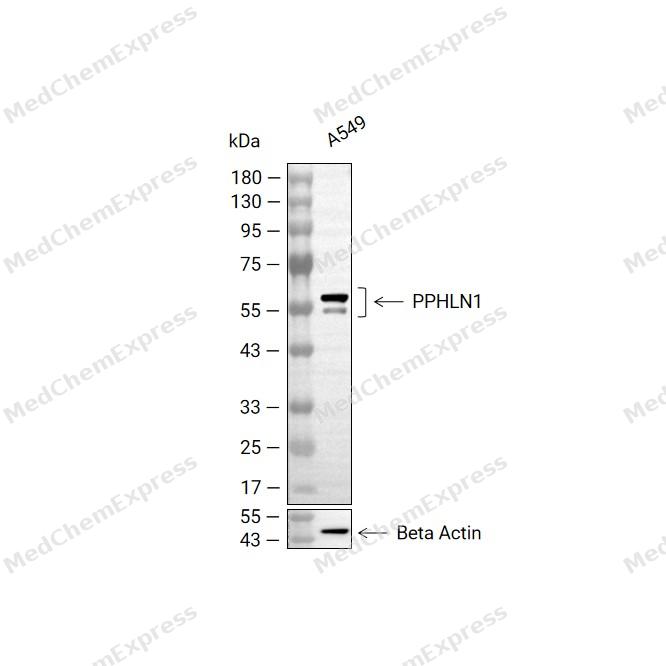 Western blot analysis of extracts from A549 (lane 2, 20ug) using PPHLN1 Antibody (HY-P810985). Proteins were transferred to a PVDF membrane and blocked with 5% BSA in TBST for 2 hour at room temperature. The primary antibody (1/1000) and Loading control antibody (Beta Actin, HY-P80993, 1/10,000) was used in 5% BSA in TBST at 4°C overnight. Goat Anti-Rabbit IgG-HRP Secondary Antibody (HY-P8001,1/10,000) was used for 1 hour at room temperature.


Background
-
Function
PPHLN1 is a RNA-binding component of the HUSH complex, a multiprotein complex that mediates epigenetic repression of mobile genetic elements, such as retroviruses and transposable elements. The HUSH complex mainly represses LINE-1 (L1) retrotransposons that are still capable of transposition. The HUSH complex is recruited to genomic loci rich in H3K9me3 and is probably required to maintain transcriptional silencing by promoting recruitment of SETDB1, a histone methyltransferase that mediates further deposition of H3K9me3, as well as MORC2, a chromatin remodeler that compacts chromatin. The HUSH complex is also involved in the silencing of unintegrated retroviral DNA: some part of the retroviral DNA formed immediately after infection remains unintegrated in the host genome and is transcriptionally repressed. Within the HUSH complex, PPHLN1 acts as a mRNA-binding component, which specifically binds nascent transcripts of mobile genetic elements, enabling HUSH-dependent silencing of transcripts. Contributes to the maintenance of the HUSH complex at chromatin. As part of the HUSH2 complex, promotes epigenetic repression of interferon-stimulated genes. May be involved in epithelial differentiation by contributing to epidermal integrity and barrier formation[1][2][3][4][5][6][7][8][9].
-
Subcellular Localization
Nucleus; Cytoplasm; Chromosome
-
Expression
Tissue_Specificity: Ubiquitous. -
Isoforms & Post-Translational Modification
PPHLN1 has 8 isoforms, Q8NEY8-1: amino acid length is 458, molecular weight is 52737 Da (predicted); Q8NEY8-2: amino acid length is 374, molecular weight is 43397 Da (predicted); Q8NEY8-3: amino acid length is 434, molecular weight is 49655 Da (predicted); Q8NEY8-5: amino acid length is 258, molecular weight is 29784 Da (predicted); Q8NEY8-6: amino acid length is 319, molecular weight is 36952 Da (predicted); Q8NEY8-7: amino acid length is 122, molecular weight is 13452 Da (predicted); Q8NEY8-8: amino acid length is 367, molecular weight is 42475 Da (predicted); Q8NEY8-9: amino acid length is 348, molecular weight is 40319 Da (predicted).
Substrate of transglutaminase (in vitro). -
Subunit
Homodimer.
-
SwissProt ID
-
Synonyms
HSPC206, HSPC232, PPHLN1, Periphilin-1, CDC7 expression repressor, Gastric cancer antigen Ga50, CR


Documentation
References
[1]. Kurita M, et al. Overexpression of CR/periphilin downregulates Cdc7 expression and induces S-phase arrest. Biochem Biophys Res Commun. 2004 Nov 12;324(2):554-61. [Content Brief]
[2]. Kurita M, et al. CR/periphilin is a transcriptional co-repressor involved in cell cycle progression. Biochem Biophys Res Commun. 2007 Dec 28;364(4):930-6. [Content Brief]
[3]. Tchasovnikarova IA, et al. GENE SILENCING. Epigenetic silencing by the HUSH complex mediates position-effect variegation in human cells. Science. 2015 Jun 26;348(6242):1481-1485. [Content Brief]
[4]. Prigozhin DM, et al. Periphilin self-association underpins epigenetic silencing by the HUSH complex. Nucleic Acids Res. 2020 Oct 9;48(18):10313-10328. [Content Brief]
[5]. Bloor S, et al. RNA binding by Periphilin plays an essential role in initiating silencing by the HUSH complex. Nucleic Acids Res. 2025 Jan 11;53(2):. [Content Brief]
[6]. Zhu Y, et al. NP220 mediates silencing of unintegrated retroviral DNA. Nature. 2018 Dec;564(7735):278-282. [Content Brief]
[7]. Danac JMC, et al. Competition between two HUSH complexes orchestrates the immune response to retroelement invasion. Mol Cell. 2024 Aug 8;84(15):2870-2881.e5. [Content Brief]
[8]. Tunbak H, et al. The HUSH complex is a gatekeeper of type I interferon through epigenetic regulation of LINE-1s. Nat Commun. 2020 Nov 3;11(1):5387. [Content Brief]
[9]. Kazerounian S, et al. Characterization of periphilin, a widespread, highly insoluble nuclear protein and potential constituent of the keratinocyte cornified envelope. J Biol Chem. 2003 Sep 19;278(38):36707-17. [Content Brief]

 Powered by Bioz
