



S100A10 Antibody (YA675)
(Synonyms: S100A10; 42C; ANX2L; ANX2LG; CAL1L; CLP11; Ca[1]; GP11; P11; p10)Based on 1 publication(s) in Google Scholar
S100A10 Antibody (YA675) is a Mouse-derived and non-conjugated IgG2a monoclonal antibody, targeting to S100A10.
-
Host:
Mouse
-
Isotype:
IgG
-
Application:
WB, ICC/IF, IP
-
Reactivity :
Human, Mouse, Rat
-
Formulation:
Supplied in 1*PBS (pH 7.3), 50% glycerol and 0.5% BSA. Preservative: 0.02% sodium azide.
-
Conjugation:
Non-conjugated


To place orders, for customer services and technical support, please contact: MedChemExpress USA
Tel: 609-228-6898 E-mail: [email protected] [email protected]



Publications Citing Use of MedChemExpress (MCE) S100A10 Antibody (YA675)
More

Applications
| Application |
WB

WB: Western Blot
|
ICC/IF
ICC/IF: Immunocytochemistry/
Immunofluorescence |
IP
IP: Immunoprecipitation
|
|---|---|---|---|
| Dilution Ratio | 1:500-1:1000 | 1:50-1:200 | 1:20 |


Product Details
S100A10 Antibody (YA675) is a Mouse-derived and non-conjugated IgG2a monoclonal antibody, targeting to S100A10.
-
Host Mouse

-
Clonality Monoclonal

-
Species ReactivityHuman, Mouse, Rat
-
Observed Molecular WeightObserved band size: 11 kDa
Note: Due to possible protein modifications or aggregation, the molecular weight should be confirmed by actual measurement, and the predicted value is for reference only.

-
Calculated Molecular Weight Predicted band size: 11 kDa

Synthetic peptide corresponding to Mouse S100A10.The exact sequence is proprietary to MCE.
Endogenous
affinity purified
Non-conjugated
Unmodified
IgG


Product Properties
-
Appearance
Solution
-
Formulation
Supplied in 1*PBS (pH 7.3), 50% glycerol and 0.5% BSA. Preservative: 0.02% sodium azide.
-
Concentration
Batch-dependent, Please check the COA for the concentration of each lot. Check Lot Concentration
-
Storage & Stability
Stored at -20°C for 1 year. Avoid repeated freeze / thaw cycles.
-
Shipping
Shipping with blue ice.


Publications (1)
-
Journal Impact Factor
-
Most Recent
-
Neuron
BST2 expression at astrocyte borders promotes microglial recruitment via the C3/C3aR signaling. [Abstract]2025 Oct 24:S0896-6273(25)00751-2. PMID: 41138733


Verification Images
-
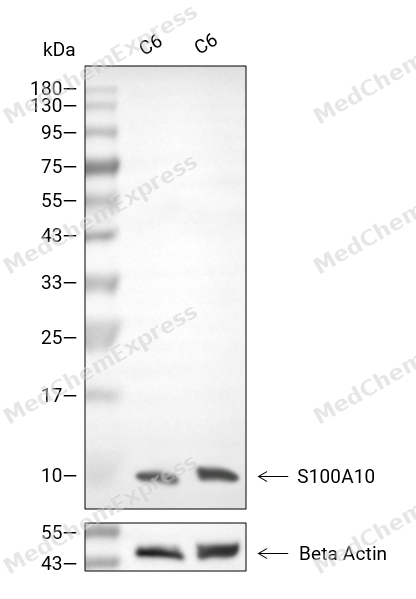 Western blot analysis of extracts from C6 (lane 2(20μg), C6 (lane 3(40μg), using S100A10 Antibody. Proteins were transferred to a PVDF membrane and blocked with 5% BSA in TBST for 2 hour at room temperature. The primary antibody and Loading control antibody (Beta Actin, HY-P80438, 1/3000) was used in 5% BSA in TBST at 4°C overnight. Goat Anti-Mouse/Rabbit IgG-HRP Secondary Antibody (HY-P8004/HY-P8001, 1/10,000) was used for 1 hour at room temperature.


Background
-
Function
S100A10, also known as p11, functions as a membrane-associated scaffold that forms a heterotetrameric complex with annexin A2 and regulates localization and function of receptors, ion channels, and plasminogen-activation machinery[1]. Mechanistically, annexin A2 stabilizes and anchors S100A10 at the plasma membrane, where S100A10 supports plasminogen binding, plasmin generation, fibrinolysis, and extracellular matrix invasion[2][3]. In macrophage models, S100A10 loss reduced plasmin generation, impaired Matrigel invasion, decreased pro-MMP-9 activation, and limited macrophage recruitment during inflammatory stimulation[4]. In tumor models, S100A10 was essential for tumor-promoting macrophage migration into tumor sites, linking the S100A10-plasmin axis to cancer microenvironment research[5]. In neural models, p11 increased 5-HT1B receptor localization at the cell surface and altered depression-like behavioral states, supporting its use in serotonin receptor trafficking studies[6]. Compared with related S100 isoforms, S100A10 is distinguished by Ca2+-insensitive EF-hand mutations and a constitutively exposed target-binding surface[7]. For experimental applications, S100A10 inhibition or genetic deletion provides a practical strategy to test plasmin-dependent invasion, fibrinolysis, macrophage recruitment, and receptor-trafficking mechanisms[3][4][6].
-
Subunit
Interacts with TASOR (PubMed:31112734)
-
SwissProt ID
-
Synonyms
S100A10; 42C; ANX2L; ANX2LG; CAL1L; CLP11; Ca[1]; GP11; P11; p10
-
Research Field
Signal Transduction
Documentation
-
Data Sheet (261 KB)
-
SDS (252 KB)
- English - EN (252 KB)
- Français - FR (252 KB)
- Deutsch - DE (252 KB)
- Norwegian - NO (252 KB)
- Español - ES (252 KB)
- Swedish - SV (252 KB)
- Italian - IT (252 KB)
- Korean - KR (252 KB)
- Portuguese - PT (252 KB)
-
User Guide for Antibodies (1077 KB)
References
[1]. Liu L, et al. Structure-Based Virtual Screening Accelerates GPCR Drug Discovery. Trends Pharmacol Sci. 2020 Jun;41(6):382-384. [Content Brief]
[2]. Réty S, et al. The crystal structure of a complex of p11 with the annexin II N-terminal peptide. Nat Struct Biol. 1999 Jan;6(1):89-95. [Content Brief]
[3]. Surette AP, et al. Regulation of fibrinolysis by S100A10 in vivo. Blood. 2011 Sep 15;118(11):3172-81. [Content Brief]
[4]. O'Connell PA, et al. S100A10 regulates plasminogen-dependent macrophage invasion. Blood. 2010 Aug 19;116(7):1136-46. [Content Brief]
[5]. Phipps KD, et al. Plasminogen receptor S100A10 is essential for the migration of tumor-promoting macrophages into tumor sites. Cancer Res. 2011 Nov 1;71(21):6676-83. [Content Brief]
[6]. Svenningsson P, et al. Alterations in 5-HT1B receptor function by p11 in depression-like states. Science. 2006 Jan 6;311(5757):77-80. [Content Brief]
[7]. Hermann A, et al. S100 calcium binding proteins and ion channels. Front Pharmacol. 2012 Apr 25;3:67. [Content Brief]

 Powered by Bioz
