



Shh Antibody
(Synonyms: Sonic hedgehog; Vhh-1; Sonic hedgehog protein; SHH; HHG 1; HHG1; HLP 3; HLP3; Holoprosencephaly 3; HPE 3; HPE3; MCOPCB5; SMMC I; SMMCI; Sonic Hedgehog (Drosophila) homolog; sonic hedgehog homolog (Drosophila); Sonic hedgehog homolog; Sonic hedgehog protein; TPT; TPTPS; Sonic hedgehog protein N-product; SHH_HUMAN.)
Based on 1 Customer Validation
Shh Antibody is a Rabbit-derived and non-conjugated IgG polyclonal antibody, targeting to Shh.
-
Host:
Rabbit
-
Isotype:
IgG
-
Application:
WB, ELISA, IHC-P, IHC-F, ICC/IF
-
Reactivity :
Human, Mouse, Rat
-
Formulation:
Supplied in 0.01M TBS(pH7.4) with 1% BSA, 0.03% Proclin300 and 50% Glycerol.
-
Conjugation:
Non-conjugated


To place orders, for customer services and technical support, please contact: MedChemExpress USA
Tel: 609-228-6898 E-mail: [email protected] [email protected]





Applications
| Application |
WB

WB: Western Blot
|
ELISA
ELISA: Enzyme Linked Immunosorbent Assay
|
IHC-P
IHC-P: Immunohistochemistry-Paraffin
|
IHC-F
IHC-F: Immunohistochemistry-Frozen
|
ICC/IF
ICC/IF: Immunocytochemistry/
Immunofluorescence |
|---|---|---|---|---|---|
| Dilution Ratio | 1:500-2000 | 1:5000-10000 | 1:100-500 | 1:100-500 | 1:100-500 |


Product Details
Shh Antibody is a Rabbit-derived and non-conjugated IgG polyclonal antibody, targeting to Shh.
-
Host Rabbit

-
Clonality Polyclonal

-
Species ReactivityHuman, Mouse, Rat Predicted Reactivity: Chicken,Cow,Horse,Rabbit
Note: The predicted reactivity is for reference only and should not be considered a guarantee of product performance.
-
Observed Molecular WeightObserved band size: 49 kDa
Note: Due to possible protein modifications or aggregation, the molecular weight should be confirmed by actual measurement, and the predicted value is for reference only.

-
Calculated Molecular Weight Predicted band size: 19/47 kDa

Entrez Gene: 6469 Human ; 20423 Mouse ; 29499 Rat
SwissProt: Q15465 Human ; Q62226 Mouse ; Q63673 Rat
OMIM: 611638 Human
KLH conjugated synthetic peptide derived from human Shh: 21-120/462
Endogenous
affinity purified
Non-conjugated
Unmodified
IgG


Product Properties
-
Appearance
Solution
-
Formulation
Supplied in 0.01M TBS(pH7.4) with 1% BSA, 0.03% Proclin300 and 50% Glycerol.
-
Concentration
Batch-dependent, Please check the COA for the concentration of each lot. Check Lot Concentration
-
Storage & Stability
Stored at -20°C for 1 year. Avoid repeated freeze / thaw cycles.
-
Shipping
Shipping with blue ice.


Verification Images
-
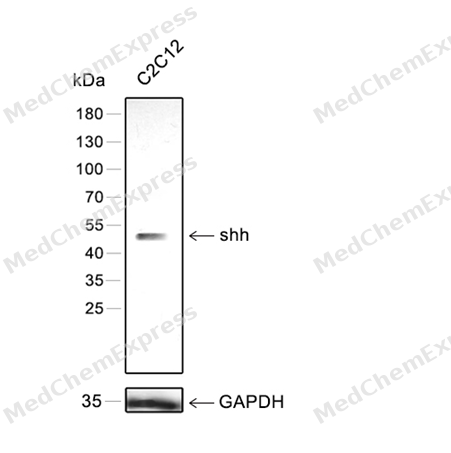 Western blot analysis of extracts from C2C12 using Shh antibody. Proteins were transferred to a PVDF membrane and blocked with 5% nonfat powdered milk in PBST for 2 hour at room temperature. The primary antibody (1/1000) and Loading control antibody (GAPDH, 1/3000) was diluted with 5% nonfat powdered milk in PBST at 4°C overnight. Goat Anti-Rabbit IgG-HRP Secondary Antibody (1/8,000) was incubated for 45min at room temperature.
 -
 Immunocytochemistry analysis of A549 cells labeling Shh with Shh Antibody (HY-P81157) at 1/100 dilution. Cells were fixed in 4% paraformaldehyde for 15 minutes at room temperature, permeabilized with 0.1% Triton X-100 in PBS for 15 minutes at room temperature, then blocked with quick block buffer for 10 minutes at room temperature. Cells were then incubated with Shh Antibody (HY-P81157) at 1/100 dilution in quick block buffer overnight at 4 ℃. AF488-conjugated Goat Anti-Rabbit IgG H&L (HY-P8002, Green) was used as the secondary antibody at 1/1,000 dilution. PBS instead of the primary antibody was used as the secondary antibody only control. The Nuclear counterstain was DAPI (Blue).
 -
 Immunocytochemistry analysis of Hela cells labeling Shh with Shh Antibody (HY-P81157) at 1/100 dilution. Cells were fixed in 4% paraformaldehyde for 15 minutes at room temperature, permeabilized with 0.1% Triton X-100 in PBS for 15 minutes at room temperature, then blocked with quick block buffer for 10 minutes at room temperature. Cells were then incubated with Shh Antibody (HY-P81157) at 1/100 dilution in quick block buffer overnight at 4 ℃. AF488-conjugated Goat Anti-Rabbit IgG H&L (HY-P8002, Green) was used as the secondary antibody at 1/1,000 dilution. PBS instead of the primary antibody was used as the secondary antibody only control. The Nuclear counterstain was DAPI (Blue).


Background
-
Function
Shh is a The C-terminal part of the sonic hedgehog protein precursor displays an autoproteolysis and a cholesterol transferase activity. Both activities result in the cleavage of the full-length protein into two parts (ShhN and ShhC) followed by the covalent attachment of a cholesterol moiety to the C-terminal of the newly generated ShhN. Both activities occur in the endoplasmic reticulum. Once cleaved, ShhC is degraded in the endoplasmic reticulum; The dually lipidated sonic hedgehog protein N-product (ShhNp) is a morphogen which is essential for a variety of patterning events during development. Induces ventral cell fate in the neural tube and somites. Involved in the patterning of the anterior-posterior axis of the developing limb bud. Essential for axon guidance. Binds to the patched (PTCH1) receptor, which functions in association with smoothened (SMO), to activate the transcription of target genes. In the absence of SHH, PTCH1 represses the constitutive signaling activity of SMO[1][2].
-
Subcellular Localization
Endoplasmic reticulum membrane; Golgi apparatus membrane; Secreted; Cell membrane; Lipid-anchor
-
Subunit
Multimer
-
SwissProt ID
-
Synonyms
Sonic hedgehog; Vhh-1; Sonic hedgehog protein; SHH; HHG 1; HHG1; HLP 3; HLP3; Holoprosencephaly 3; HPE 3; HPE3; MCOPCB5; SMMC I; SMMCI; Sonic Hedgehog (Drosophila) homolog; sonic hedgehog homolog (Drosophila); Sonic hedgehog homolog; Sonic hedgehog protein; TPT; TPTPS; Sonic hedgehog protein N-product; SHH_HUMAN.


Documentation
-
Data Sheet (260 KB)
-
SDS (252 KB)
- English - EN (252 KB)
- Français - FR (252 KB)
- Deutsch - DE (252 KB)
- Norwegian - NO (252 KB)
- Español - ES (252 KB)
- Swedish - SV (252 KB)
- Italian - IT (252 KB)
- Korean - KR (252 KB)
- Portuguese - PT (252 KB)
-
User Guide for Antibodies (1077 KB)
References
[1]. Pal K, et al. Primary cilium and sonic hedgehog signaling during neural tube patterning: role of GPCRs and second messengers. Dev Neurobiol. 2015 Apr;75(4):337-48. [Content Brief]
[2]. Pepinsky RB, et al. Mapping sonic hedgehog-receptor interactions by steric interference. J Biol Chem. 2000 Apr 14;275(15):10995-1001. [Content Brief]

 Powered by Bioz
