



SUZ12 Antibody (YA044)
(Synonyms: CHET9, JJAZ1, KIAA0160, SUZ12, Polycomb protein SUZ12, Chromatin precipitated E2F target 9 protein, Joined to JAZF1 protein, Suppressor of zeste 12 protein homolog, ChET 9 protein)
Based on 1 Customer Validation
SUZ12 Antibody (YA044) is a Rabbit-derived and non-conjugated IgG monoclonal antibody, targeting to SUZ12.
-
Host:
Rabbit
-
Isotype:
IgG
-
Application:
WB, ICC/IF, IP
-
Reactivity :
Human, Mouse, Rat
-
Formulation:
Supplied in 1*TBS (pH7.4), 0.05% BSA and 40% Glycerol. Preservative: 0.05% Sodium Azide.
-
Conjugation:
Non-conjugated


To place orders, for customer services and technical support, please contact: MedChemExpress USA
Tel: 609-228-6898 E-mail: [email protected] [email protected]





Applications
| Application |
WB

WB: Western Blot
|
ICC/IF
ICC/IF: Immunocytochemistry/
Immunofluorescence |
IP
IP: Immunoprecipitation
|
|---|---|---|---|
| Dilution Ratio | 1:1000-1:2000 | 1:50-1:200 | Use at an assay dependent concentration. |


Product Details
SUZ12 Antibody (YA044) is a Rabbit-derived and non-conjugated IgG monoclonal antibody, targeting to SUZ12.
-
Host Rabbit

-
Clonality Recombinant,Monoclonal

-
Species ReactivityHuman, Mouse, Rat
-
Observed Molecular WeightObserved band size: 83 kDa
Note: Due to possible protein modifications or aggregation, the molecular weight should be confirmed by actual measurement, and the predicted value is for reference only.

-
Calculated Molecular Weight Predicted band size: 83 kDa

Entrez Gene: 23512 Human ; 52615 Mouse ; 688041 Rat
SwissProt: Q15022 Human ; Q80U70 Mouse
OMIM: 618786 Human
Synthetic peptide corresponding to Human SUZ12.AA range:1-150.
Endogenous
Protein A affinity purified.
Non-conjugated
Unmodified
IgG


Product Properties
-
Appearance
Solution
-
Formulation
Supplied in 1*TBS (pH7.4), 0.05% BSA and 40% Glycerol. Preservative: 0.05% Sodium Azide.
-
Concentration
Batch-dependent, Please check the COA for the concentration of each lot. Check Lot Concentration
-
Storage & Stability
Stored at -20°C for 1 year. Avoid repeated freeze / thaw cycles.
-
Shipping
Shipping with blue ice.


Verification Images
-
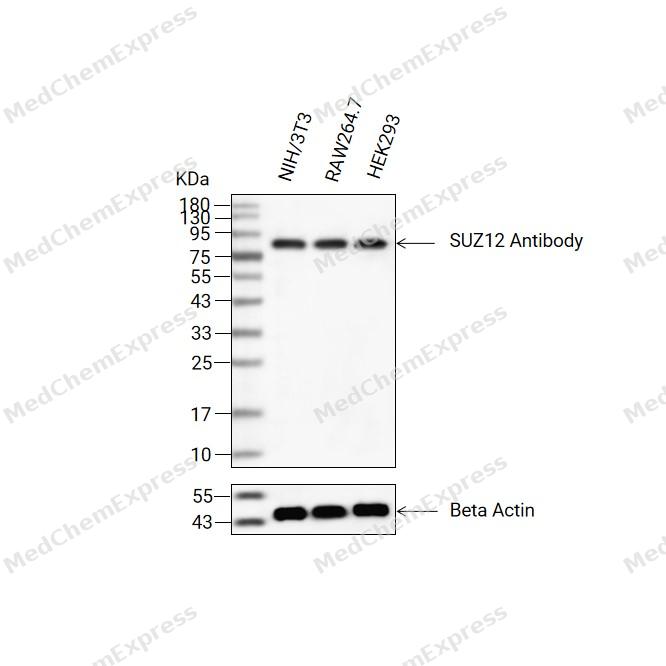 Western blot analysis of extracts from NIH/3T3(lane 2(20ug) , RAW264.7(lane 3(20ug) and HEK293(lane 4(20ug) using SUZ12 Antibody (HY-P80353) Rabbit mAb. Proteins were transferred to a PVDF membrane and blocked with 5% non-fat milk in TBST for 2 hour at room temperature. The primary antibody (1/1000) and Loading control antibody (Beta Actin, HY-P83730, 1/10000) was used in 5% non-fat milk in TBST at 4°C overnight. Goat Anti-Mouse/Rabbit IgG-HRP Secondary Antibody (1/10000) was used for 1 hour at room temperature.
 -
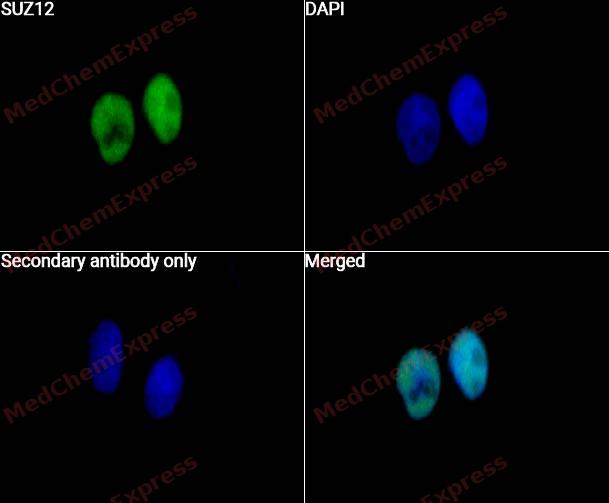 Immunocytochemistry analysis of Hela cells labeling SUZ12 with SUZ12 Antibody (HY-P80353) at 1/50 dilution. Cells were fixed in 4% paraformaldehyde for 15 minutes at room temperature, permeabilized with 0.1% Triton X-100 for 10 minutes at room temperature, then blocked with QuickBlock™ Blocking Buffer for Immunol Staining for 10 min at room temperature. Cells were then incubated with SUZ12 Antibody (HY-P80353) at 1/50 dilution in QuickBlock™ Blocking Buffer for Immunol Staining at 4 ℃. Alexa Fluor® 488-conjugated AffiniPure Goat Anti-Rabbit IgG H&L(HY-P8002, Green) was used as the secondary antibody at 1/1,000 dilution. PBS instead of the primary antibody was used as the secondary antibody only control. The Nuclear counterstain was DAPI (Blue).
 -
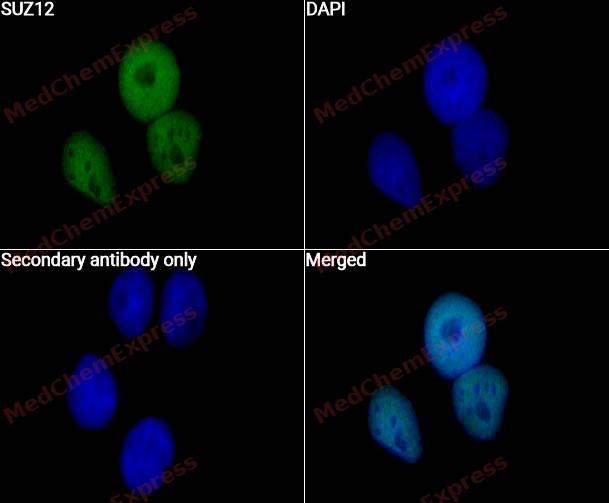 Immunocytochemistry analysis of SKOV-3 cells labeling SUZ12 with SUZ12 Antibody (HY-P80353) at 1/50 dilution. Cells were fixed in 4% paraformaldehyde for 15 minutes at room temperature, permeabilized with 0.1% Triton X-100 for 10 minutes at room temperature, then blocked with QuickBlock™ Blocking Buffer for Immunol Staining for 10 min at room temperature. Cells were then incubated with SUZ12 Antibody (HY-P80353) at 1/50 dilution in QuickBlock™ Blocking Buffer for Immunol Staining at 4 ℃. Alexa Fluor® 488-conjugated AffiniPure Goat Anti-Rabbit IgG H&L(HY-P8002, Green) was used as the secondary antibody at 1/1,000 dilution. PBS instead of the primary antibody was used as the secondary antibody only control. The Nuclear counterstain was DAPI (Blue).


Background
-
Function
SUZ12 is a Polycomb group (PcG) protein. Component of the PRC2 complex, which methylates 'Lys-9' (H3K9me) and 'Lys-27' (H3K27me) of histone H3, leading to transcriptional repression of the affected target gene. The PRC2 complex may also serve as a recruiting platform for DNA methyltransferases, thereby linking two epigenetic repression systems. Genes repressed by the PRC2 complex include HOXC8, HOXA9, MYT1 and CDKN2A[1][2][3][4][5][6][7][8][9][10][11][12][13][14][15][16].
-
Subcellular Localization
Nucleus
-
Expression
Tissue_specificity:Overexpressed in breast and colon cancer
Induction:Expression is induced by E2F1, E2F2 and E2F3 -
Subunit
Component of the PRC2 complex, which consists of the core subunits EED, EZH1 or EZH2, SUZ12, and RBBP4, and various combinations of accessory subunits including AEBP2, JARID2, PHF19, MTF2 and EPOP (PubMed:12351676, PubMed:12435631, PubMed:15099518, PubMed:15225548, PubMed:15385962, PubMed:15684044, PubMed:16224021, PubMed:18285464, PubMed:19026781, PubMed:29499137, PubMed:31959557). Within the complex, interacts (via C2H2 zinc finger domain) with JARID2 and EPOP; JARID2 and EPOP compete for SUZ12 binding (PubMed:29499137). Also interacts with AEBP2 and PHF19 (PubMed:29499137). Forms a monomeric PRC2.2 (class 2) complex consisting of at least SUZ12, RBBP4, AEBP2 and JARID2 (PubMed:29499137). Forms a dimeric PRC2.1 (class 1, PRC-PCL) complex consisting of at least SUZ12, RBBP4, and PHF19 or MTF2; PHF19 and MTF2 stabilize the dimeric structure which enhances PRC2 interaction with chromatin (PubMed:31959557). The minimum components required for methyltransferase activity of the PRC2/EZH2 complex are EED, EZH2 and SUZ12 (PubMed:12351676, PubMed:12435631, PubMed:15099518, PubMed:15225548, PubMed:15385962, PubMed:15684044, PubMed:16431907, PubMed:18086877, PubMed:18285464). The PRC2 complex may also interact with DNMT1, DNMT3A, DNMT3B and PHF1 via the EZH2 subunit and with SIRT1 via the SUZ12 subunit (PubMed:15684044, PubMed:18285464). Interacts with WDR77 (PubMed:16712789). Interacts with histone H1 (PubMed:16431907). Interacts with CDYL (PubMed:22009739). Interacts with BMAL1 (By similarity). Interacts with EZHIP (via C-terminal region) (PubMed:30923826). Interacts with ARMC12 (PubMed:30026490). Interacts with DDX18; this interaction inhibits the PRC2 complex (By similarity)
-
SwissProt ID
-
Synonyms
CHET9, JJAZ1, KIAA0160, SUZ12, Polycomb protein SUZ12, Chromatin precipitated E2F target 9 protein, Joined to JAZF1 protein, Suppressor of zeste 12 protein homolog, ChET 9 protein
-
Research Field
Epigenetics and Nuclear Signaling


Documentation
-
Data Sheet (263 KB)
-
SDS (251 KB)
- English - EN (251 KB)
- Français - FR (251 KB)
- Deutsch - DE (251 KB)
- Norwegian - NO (251 KB)
- Español - ES (251 KB)
- Swedish - SV (251 KB)
- Italian - IT (251 KB)
- Korean - KR (251 KB)
- Portuguese - PT (251 KB)
-
User Guide for Antibodies (1077 KB)
References
[1]. Cao R, et al. SUZ12 is required for both the histone methyltransferase activity and the silencing function of the EED-EZH2 complex. Mol Cell. 2004 Jul 2;15(1):57-67. [Content Brief]
[2]. Kirmizis A, et al. Silencing of human polycomb target genes is associated with methylation of histone H3 Lys 27. Genes Dev. 2004 Jul 1;18(13):1592-605. [Content Brief]
[3]. Pasini D, et al. Suz12 is essential for mouse development and for EZH2 histone methyltransferase activity. EMBO J. 2004 Oct 13;23(20):4061-71. [Content Brief]
[4]. Bracken AP, et al. Genome-wide mapping of Polycomb target genes unravels their roles in cell fate transitions. Genes Dev. 2006 May 1;20(9):1123-36. [Content Brief]
[5]. Bracken AP, et al. The Polycomb group proteins bind throughout the INK4A-ARF locus and are disassociated in senescent cells. Genes Dev. 2007 Mar 1;21(5):525-30. [Content Brief]
[6]. Sarma K, et al. Ezh2 requires PHF1 to efficiently catalyze H3 lysine 27 trimethylation in vivo. Mol Cell Biol. 2008 Apr;28(8):2718-31. [Content Brief]
[7]. Imagawa E, et al. Mutations in genes encoding polycomb repressive complex 2 subunits cause Weaver syndrome. Hum Mutat. 2017 Jun;38(6):637-648. [Content Brief]
[8]. Chen S, et al. Unique Structural Platforms of Suz12 Dictate Distinct Classes of PRC2 for Chromatin Binding. Mol Cell. 2018 Mar 1;69(5):840-852.e5. [Content Brief]
[9]. Chen S, et al. A Dimeric Structural Scaffold for PRC2-PCL Targeting to CpG Island Chromatin. Mol Cell. 2020 Mar 19;77(6):1265-1278.e7. [Content Brief]
[10]. Cao R, et al. Role of histone H3 lysine 27 methylation in Polycomb-group silencing. Science. 2002 Nov 1;298(5595):1039-43. [Content Brief]
[11]. Kuzmichev A, et al. Histone methyltransferase activity associated with a human multiprotein complex containing the Enhancer of Zeste protein. Genes Dev. 2002 Nov 15;16(22):2893-905. [Content Brief]
[12]. Kuzmichev A, et al. Different EZH2-containing complexes target methylation of histone H1 or nucleosomal histone H3. Mol Cell. 2004 Apr 23;14(2):183-93. [Content Brief]
[13]. Kuzmichev A, et al. Composition and histone substrates of polycomb repressive group complexes change during cellular differentiation. Proc Natl Acad Sci U S A. 2005 Feb 8;102(6):1859-64. [Content Brief]
[14]. Martin C, et al. Substrate preferences of the EZH2 histone methyltransferase complex. J Biol Chem. 2006 Mar 31;281(13):8365-70. [Content Brief]
[15]. Cao R, et al. Role of hPHF1 in H3K27 methylation and Hox gene silencing. Mol Cell Biol. 2008 Mar;28(5):1862-72. [Content Brief]
[16]. Schlesinger Y, et al. Polycomb-mediated methylation on Lys27 of histone H3 pre-marks genes for de novo methylation in cancer. Nat Genet. 2007 Feb;39(2):232-6. [Content Brief]

 Powered by Bioz
