



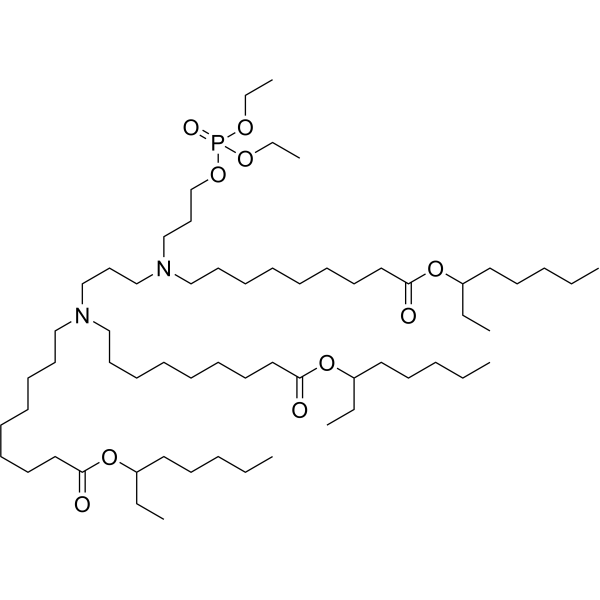
Phospholipid PL1
Phospholipid PL1 is a phospholipid-derived nanoparticle, can deliver costimulatory receptor mRNA (CD137 or OX40) to T cells. Phospholipid PL1 could induce the activation of various immune cells, including T cells and dendritic cells (DCs) in order to boost antitumor immunity.
Nur für Forschungszwecke. Wir verkaufen nicht an Patienten.
- CAS. Nr.: 2274812-94-9
- Formel: C61H121N2O10P
- Molecular Weight:1073.59
-
Speicherung:
Please store the product under the recommended conditions in the Certificate of Analysis.

To place orders, for customer services and technical support, please contact: MedChemExpress USA
Tel: 609-228-6898 E-mail: [email protected] [email protected]


-
 Biologische Aktivität
-
Chemical Information
- Protokoll
- Reinheit & Dokumentation
- Verweise
-
 Help & FAQs




Biologische Aktivität
Beschreibung
In Vivo
MedChemExpress (MCE) has not independently confirmed the accuracy of these methods. They are for reference only.
-
Animal Model:B16F10 melanoma mouse model and A20 lymphoma mouse model (C57BL/6 mice)[1]
-
Dosage:Administration of PL1-CD137 + anti-CD137 Ab; PL1-CD137 (10 µg mRNA/mouse), and anti-CD137 Ab (16 µg/mouse)
-
Administration:Intratumoral injection; 6 times every other day; 60 days
-
Result:Dramatically decreased the tumor growth rate by 5-fold (18 days after inoculation), and increased the overall survival time in B16F10 melanoma model.
Resulted in a 2-fold decrease in the tumor growth rate (18d after inoculation) in A20 lymphoma model, without significant extension in the overall survival time.
-
Animal Model:B16F10 melanoma mouse model and CT26 colon carcinoma mouse model (C57BL/6 mice)[1]
-
Dosage:Administration of PL1-OX40 + anti-OX40 Ab; PL1-OX40 (10 µg mRNA/mouse), and anti-OX40 Ab (8 µg/mouse)
-
Administration:Intratumoral injection; 6 times every other day; 60 days
-
Result:Significantly decreased the tumor growth and prolonged survival in comparison to treatment with PBS and PL1-OX40 + anti-OX40 Ab in both tumor models.


Chemical Information
-
CAS. Nr. 2274812-94-9
-
Molecular Weight 1073.59
-
Formel C61H121N2O10P
-
SMILES
O=C(CCCCCCCCN(CCCN(CCCCCCCCC(OC(CCCCC)CC)=O)CCCCCCCCC(OC(CCCCC)CC)=O)CCCOP(OCC)(OCC)=O)OC(CCCCC)CC
-
Versand
Room temperature in continental US; may vary elsewhere.
-
Speicherung
Please store the product under the recommended conditions in the Certificate of Analysis.

Protokoll
-
RNA extraction experimental
By lysing cells, releasing RNA, and removing impurities such as proteins and DNA, high-purity RNA products are finally obtained. The commonly used traditional method is the guanidine isothiocyanate/phenol/chloroform method (Trizol), which is suitable for a variety of animal materials including animal tissues, microorganisms, cultured cells, etc., and most plant materials.
-
Monocyte-derived dendritic cell differentiation
Human monocyte-derived dendritic cells are generated by isolating PBMC-derived monocytes and culturing them with GM-CSF plus IL-4, which produces cells with dendritic-cell antigen-presenting properties, reduced monocyte phenotype, and increased dendritic-cell functional readouts such as antigen uptake, allogeneic T-cell stimulation, and expression of markers including HLA-DR, CD80, CD86, CD83, CD1a, or CD209 depending on protocol and maturation state. The main readout is phenotypic and functional differentiation: immature MoDCs are commonly evaluated by loss or reduction of CD14 with acquisition of dendritic-cell markers and antigen uptake capacity, whereas mature MoDCs are evaluated by increased CD83, CD80, CD86, HLA-DR, and T-cell stimulatory function after exposure to maturation stimuli such as TNF-α or a cytokine/PGE2 cocktail.
-
Research Protocol for Cancer Immunology
Cancer immunology studies how the immune system recognizes, suppresses, edits, or fails to eliminate malignant cells through tumor antigen release, antigen presentation, T-cell priming, immune trafficking, tumor-cell killing, and feedback inhibition in the tumor microenvironment. The cancer-immunity cycle links tumor antigenicity, dendritic-cell priming, CD8+ T-cell infiltration, cytotoxic function, and immune-checkpoint regulation to tumor rejection or immune escape. Immune-checkpoint pathways such as PD-1/PD-L1 and CTLA-4 suppress antitumor T-cell activity and can be therapeutically blocked, but many tumors remain resistant because of poor antigen presentation, weak T-cell infiltration, suppressive myeloid cells, regulatory T cells, and tumor-intrinsic immune-exclusion programs. Unresolved questions include which immune-cell states predict response, how tumor-intrinsic pathways exclude immune cells, how myeloid suppression limits checkpoint blockade, and which combination strategies


Reinheit & Dokumentation
Verweise

Calculators
Konzentration (Stammlösung) × Volumen (Stammlösung) = Konzentration (Ziellösung) × Volumen (Ziellösung)


Phospholipid PL1 Related Classifications
HY-151506 Related Classifications
 Powered by Bioz