



AMP-PCP
Based on 2 publication(s) in Google Scholar
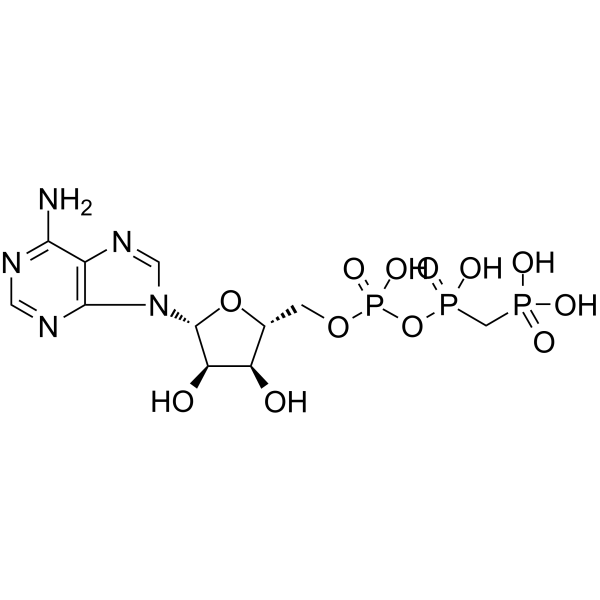
AMP-PCP is an ATP analogue and can bind to Hsp90 N-terminal domain with a Kd value of 3.8 μM. AMP-PCP binding favors the formation of the active homodimer of Hsp90.
For research use only. We do not sell to patients.
- CAS No.: 3469-78-1
- Formula: C11H18N5O12P3
- Molecular Weight:505.21
-
Storage:
Please store the product under the recommended conditions in the Certificate of Analysis.

To place orders, for customer services and technical support, please contact: MedChemExpress USA
Tel: 609-228-6898 E-mail: [email protected] [email protected]


-
 Biological Activity
-
Chemical Information
- Purity & Documentation
- References
-
 Help & FAQs


Publications Citing Use of MedChemExpress (MCE) AMP-PCP
More

Biological Activity
Description
IC50 & Target
[1]|
HSP90 3.8 μM (Kd) |
Cellular Effect
|
Cell Line

|
Type | Value | Description | References |
|---|---|---|---|---|
| Oocyte | EC50 |
9200 nM
Compound: beta,gamma-meATP
|
The compound was evaluated for antagonist activity against recombinant rat P2X purinoceptor 3 (P2X3) at 3 uM, expressed in Xenopus oocytes
The compound was evaluated for antagonist activity against recombinant rat P2X purinoceptor 3 (P2X3) at 3 uM, expressed in Xenopus oocytes
|
[PMID: 12213051] |
In Vitro
AMP-PCP binding favors the formation of the active homodimer of Hsp90 by enhancing the slow-motion featured conformational exchanges of those residues (A117-A141) within the lid segment (A111-G135) and around region. In total, 170 non-proline residues are identified for the triple-labeled Hsp90 bound with AMP-PCP[1].
MedChemExpress (MCE) has not independently confirmed the accuracy of these methods. They are for reference only.


Chemical Information
-
CAS No. 3469-78-1
-
Molecular Weight 505.21
-
Formula C11H18N5O12P3
-
SMILES
O[C@H]1[C@@H](O[C@H](COP(OP(CP(O)(O)=O)(O)=O)(O)=O)[C@H]1O)N2C3=C(C(N)=NC=N3)N=C2
-
Shipping
Room temperature in continental US; may vary elsewhere.
-
Storage
Please store the product under the recommended conditions in the Certificate of Analysis.


Publications (2)
-
Journal Impact Factor
-
Most Recent
-
Nat Commun
Nanomaterial signatures program biomolecular condensates via triphasic separation for chemoplasticity remodeling. [Abstract]2025 Oct 29;16(1):9554. PMID: 41162367 -
ACS Nano
Emerging of Ultrafine Membraneless Organelles as the Missing Piece of Nanostress: Mechanism of Biogenesis and Implications at Multilevels. [Abstract]2025 Feb 11;19(5):5659-5679. PMID: 39882824


Purity & Documentation
References

Calculators
Concentration (start) × Volume (start) = Concentration (final) × Volume (final)


AMP-PCP Related Classifications
HY-106723 Related Classifications
 Powered by Bioz