



Vasonatrin Peptide (VNP)
Vasonatrin Peptide (VNP) is a chimera of atrial natriuretic peptide (ANP) and C-type natriuretic peptide (CNP). Vasonatrin peptide possesses the venodilating actions of CNP, the natriuretic actions of ANP, and unique arterial vasodilating actions not associated with either ANP or CNP. Vasonatrin Peptide protects the diabetic heart against ischemia-reperfusion injury by inhibiting ER stress via the cGMP-PKG signaling pathway.
Nos produits utilisent uniquement pour la recherche. Nous ne vendons pas aux patients.
- CAS No.: 141676-35-9
- Formule: C123H198N36O36S3
- Masse moléculaire:2865.37
-
Stockage:
Please store the product under the recommended conditions in the Certificate of Analysis.

To place orders, for customer services and technical support, please contact: MedChemExpress USA
Tel: 609-228-6898 E-mail: [email protected] [email protected]


-
 Activité biologique
-
Chemical Information
-
Solvant et solubilité
- Pureté et documentation
- Références
-
 Help & FAQs




Activité biologique
Description
IC50 & Target
Natriuretic peptide receptors[1]
In Vitro
Vasonatrin Peptide (VNP) markedly enhances adiponectin mRNA expression, as well as protein secretion, however, suppresses IL-6 production in mature adipocytes. In addition, VNP significantly increases the intracellular levels of cGMP. The effects of VNP are mimicked by 8-br-cGMP, whereas inhibits by HS-142-1, or KT-5823[2].
MedChemExpress (MCE) has not independently confirmed the accuracy of these methods. They are for reference only. .
In Vivo
MedChemExpress (MCE) has not independently confirmed the accuracy of these methods. They are for reference only.
-
Animal Model:High-fat diet-fed streptozotocin-induced diabetic Sprague-Dawley rats[3]
-
Dosage:100 μg/kg
-
Administration:I.v. ; 10 min before reperfusion
-
Result:Significantly improved the instantaneous first derivation of left ventricle pressure (±LV dP/dtmax) and LV systolic pressure and reduced LV end-diastolic pressure, apoptosis index, caspase-3 activity, plasma creatine kinase (CK), and lactate dehydrogenase (LDH) activities. Inhibited endoplasmic reticulum (ER) stress by suppressing glucose-regulated protein 78 (GRP78) and C/EBP homologous protein (CHOP).


Chemical Information
-
CAS No. 141676-35-9
-
Masse moléculaire 2865.37
-
Formule C123H198N36O36S3
-
Sequence
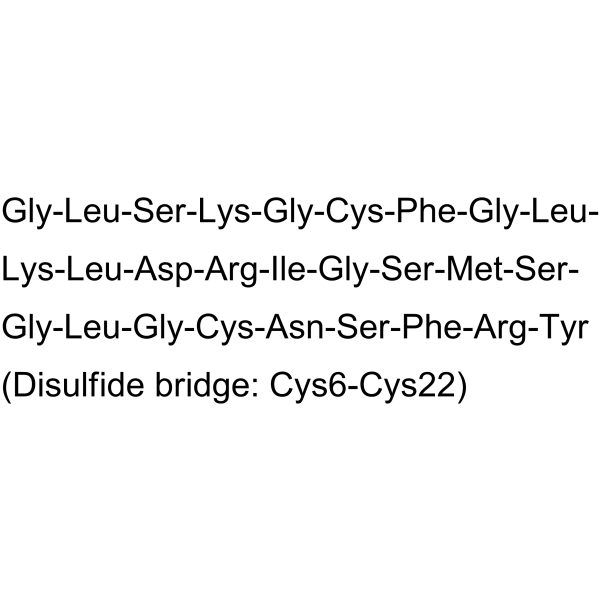
Gly-Leu-Ser-Lys-Gly-Cys-Phe-Gly-Leu-Lys-Leu-Asp-Arg-Ile-Gly-Ser-Met-Ser-Gly-Leu-Gly-Cys-Asn-Ser-Phe-Arg-Tyr (Disulfide bridge: Cys6-Cys22)
-
Sequence Shortening
GLSKGCFGLKLDRIGSMSGLGCNSFRY (Disulfide bridge: Cys6-Cys22)
-
Livraison
Room temperature in continental US; may vary elsewhere.
-
Stockage
Please store the product under the recommended conditions in the Certificate of Analysis.


Solvant et solubilité
In Vitro
H2O
Peptide Solubility and Storage Guidelines:
1. Calculate the length of the peptide.
2. Calculate the overall charge of the entire peptide according to the following table:
| Contents | Assign value | |
|---|---|---|
| Acidic amino acid | Asp (D), Glu (E), and the C-terminal -COOH. | -1 |
| Basic amino acid | Arg (R), Lys (K), His (H), and the N-terminal -NH2 | +1 |
| Neutral amino acid | Gly (G), Ala (A), Leu (L), Ile (I), Val (V), Cys (C), Met (M), Thr (T), Ser (S), Phe (F), Tyr (Y), Trp (W), Pro (P), Asn (N), Gln (Q) | 0 |
3. Recommended solution:
| Overall charge of peptide | Details |
|---|---|
| Negative (<0) |
1. Try to dissolve the peptide in water first. 2. If water fails, add NH4OH (<50 μL). 3. If the peptide still does not dissolve, add DMSO (50-100 μL) to solubilize the peptide. |
| Positive (>0) |
1. Try to dissolve the peptide in water first. 2. If water fails, try dissolving the peptide in a 10%-30% acetic acid solution. 3. If the peptide still does not dissolve, try dissolving the peptide in a small amount of DMSO. |
| Zero (=0) |
1. Try to dissolve the peptide in organic solvent (acetonitrile, methanol, etc.) first. 2. For very hydrophobic peptides, try dissolving the peptide in a small amount of DMSO, and then dilute the solution with water to the desired concentration. |


Pureté et documentation
Références
[1]. Wei CM, et al. Vasonatrin peptide: a unique synthetic natriuretic and vasorelaxing peptide. J Clin Invest. 1993;92(4):2048-2052. [Content Brief]
[2]. Chen BY, et al. Vasonatrin peptide, a new regulator of adiponectin and interleukin-6 production in adipocytes. J Endocrinol Invest. 2011;34(10):742-746. [Content Brief]
[3]. Shi Z, et al. Vasonatrin peptide attenuates myocardial ischemia-reperfusion injury in diabetic rats and underlying mechanisms. Am J Physiol Heart Circ Physiol. 2015;308(4):H281-H290. [Content Brief]

Calculators
Concentration (start) × Volume (start) = Concentration (final) × Volume (final)


Vasonatrin Peptide (VNP) Related Classifications
HY-P1556 Related Classifications
 Powered by Bioz