



Vm24-toxin
Vm24-toxin (Vaejovis mexicanus peptide 24), a 36-residue peptide, is a potent and selective Kv1.3 blocker with a Kd of ~3 pM in lymphocytes. Vm24-toxin shows >1500-fold affinity for Kv1.3 over other assayed potassium channels. Vm24-toxin folds into a distorted cystine-stabilized α/β motif consisting of a single-turn α-helix and a three-stranded antiparallel β-sheet, stabilized by four disulfide bridges. Vm24-toxin attenuates the CD4+ effector memory T cell response to T cell receptor (TCR) stimulation.
For research use only. We do not sell to patients.
- CAS No.: 1373890-79-9
- Formula: C157H253N51O45S9
- Molecular Weight:3863.59
-
Storage:
Please store the product under the recommended conditions in the Certificate of Analysis.

To place orders, for customer services and technical support, please contact: MedChemExpress USA
Tel: 609-228-6898 E-mail: [email protected] [email protected]


-
 Biological Activity
-
Chemical Information
- Protocols
- Purity & Documentation
- References
-
 Help & FAQs




Biological Activity
Description
IC50 & Target
[1]|
Kv1.3 3 pM (Kd) |


Chemical Information
-
CAS No. 1373890-79-9
-
Molecular Weight 3863.59
-
Formula C157H253N51O45S9
-
Synonyms
Vaejovis mexicanus peptide 24
-
Sequence
Ala-Ala-Ala-Ile-Ser-Cys-Val-Gly-Ser-Pro-Glu-Cys-Pro-Pro-Lys-Cys-Arg-Ala-Gln-Gly-Cys-Lys-Asn-Gly-Lys-Cys-Met-Asn-Arg-Lys-Cys-Lys-Cys-Tyr-Tyr-Cys-NH2 (Disulfide bridge: Cys6-Cys26, Cys12-Cys31, Cys16-Cys33, Cys21-Cys36)
-
Sequence Shortening
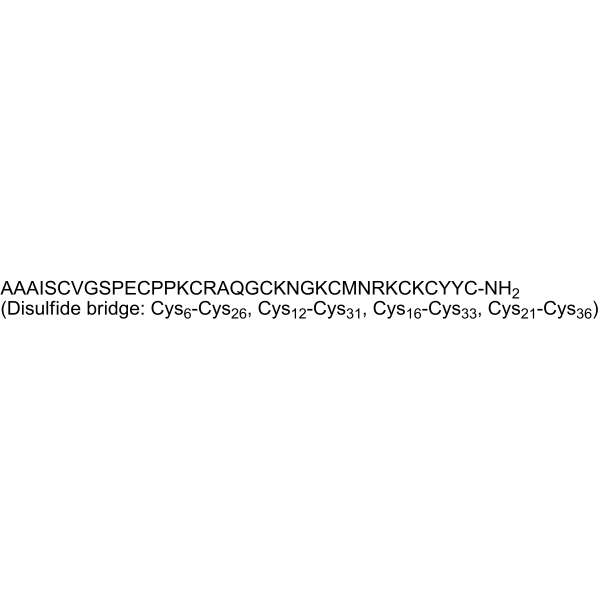
AAAISCVGSPECPPKCRAQGCKNGKCMNRKCKCYYC-NH2 (Disulfide bridge: Cys6-Cys26, Cys12-Cys31, Cys16-Cys33, Cys21-Cys36)
-
Shipping
Room temperature in continental US; may vary elsewhere.
-
Storage
Please store the product under the recommended conditions in the Certificate of Analysis.

Protocols
-
Research Protocol for Cancer Immunology
Cancer immunology studies how the immune system recognizes, suppresses, edits, or fails to eliminate malignant cells through tumor antigen release, antigen presentation, T-cell priming, immune trafficking, tumor-cell killing, and feedback inhibition in the tumor microenvironment. The cancer-immunity cycle links tumor antigenicity, dendritic-cell priming, CD8+ T-cell infiltration, cytotoxic function, and immune-checkpoint regulation to tumor rejection or immune escape. Immune-checkpoint pathways such as PD-1/PD-L1 and CTLA-4 suppress antitumor T-cell activity and can be therapeutically blocked, but many tumors remain resistant because of poor antigen presentation, weak T-cell infiltration, suppressive myeloid cells, regulatory T cells, and tumor-intrinsic immune-exclusion programs. Unresolved questions include which immune-cell states predict response, how tumor-intrinsic pathways exclude immune cells, how myeloid suppression limits checkpoint blockade, and which combination strategies


Purity & Documentation
References
[1]. Georgina B Gurrola, et al. Structure, function, and chemical synthesis of Vaejovis mexicanus peptide 24: a novel potent blocker of Kv1.3 potassium channels of human T lymphocytes. Biochemistry. 2012, 51, 19. [Content Brief]
[2]. Veytia-Bucheli JI, et al. Kv1.3 channel blockade with the Vm24 scorpion toxin attenuates the CD4+ effector memory T cell response to TCR stimulation. Cell Commun Signal. 2018 Aug 14;16(1):45. [Content Brief]

Calculators
Concentration (start) × Volume (start) = Concentration (final) × Volume (final)


Vm24-toxin Related Classifications
HY-P5917 Related Classifications
 Powered by Bioz