



DprE1-IN-4
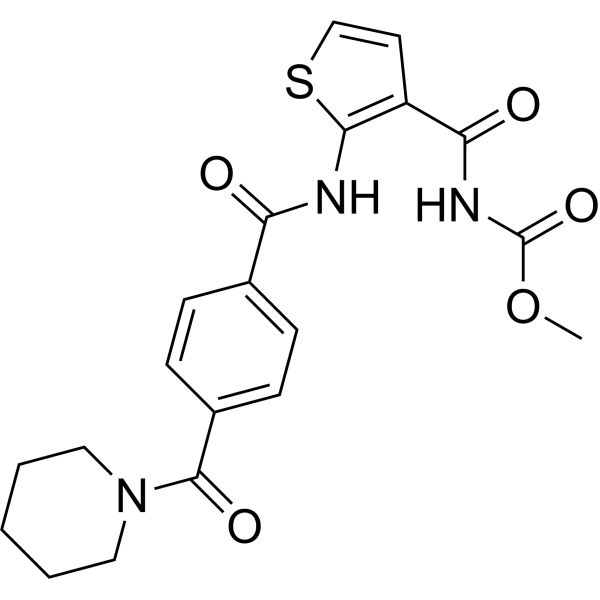
DprE1-IN-4 is a potent and orally active noncovalent DprE1 inhibitor with an IC50 of 0.90 μg/mL. DprE1-IN-4 exhibits potent in vitro activity against M. tuberculosis H37Rv and drug-resistant tuberculosis strain with MIC values of 0.12 μg/mL and 0.24 μg/mL, respectively. DprE1-IN-4 displays acceptable pharmacokinetic property and shows significant bactericidal activity in an acute mouse model of tuberculosis.
Nos produits utilisent uniquement pour la recherche. Nous ne vendons pas aux patients.
- CAS No.: 2419160-96-4
- Formule: C20H21N3O5S
- Masse moléculaire:415.46
-
Stockage:
Please store the product under the recommended conditions in the Certificate of Analysis.

To place orders, for customer services and technical support, please contact: MedChemExpress USA
Tel: 609-228-6898 E-mail: [email protected] [email protected]


-
 Activité biologique
-
Chemical Information
- Protocole
- Pureté et documentation
- Références
-
 Help & FAQs




Activité biologique
Description
IC50 & Target
IC50: 0.9±0.2 μg/mL (DprE1)
Cellular Effect
|
Cell Line

|
Type | Value | Description | References |
|---|---|---|---|---|
| HepG2 | IC50 |
>64 μg/mL
Compound: 25a
|
Cytotoxicity against human HepG2 cells assessed as reduction in cell viability measured after 48 hrs by MTT assay
Cytotoxicity against human HepG2 cells assessed as reduction in cell viability measured after 48 hrs by MTT assay
|
[PMID: 33852302] |
| Vero | IC50 |
>64 μg/mL
Compound: 25a
|
Cytotoxicity against African green monkey Vero cells assessed as reduction in cell viability measured after 48 hrs by MTT assay
Cytotoxicity against African green monkey Vero cells assessed as reduction in cell viability measured after 48 hrs by MTT assay
|
[PMID: 33852302] |
| Vero | IC50 |
>64 μg/mL
Compound: 25a
|
Cytotoxicity against African green monkey Vero cells measured by MTT assay
Cytotoxicity against African green monkey Vero cells measured by MTT assay
|
[PMID: 35101648] |
In Vitro
DprE1-IN-4 displays potent activity against?M. tuberculosis, it is against isolated clinical strains H37Rv, 13946a, 14862b and PBTZ169-resistant strain with MIC values of 0.12 μg/mL, 0.24 μg/mL, 0.24 μg/mL and 0.48 μg/mL, respectively[1].DprE1-IN-4 (0.76-16 μg/mL) shows a decrease in potency against only DprE1-overexpressing strains but not against DprE2-overexpressing and wild-type strains.?The IC50 value is 0.9±0.2 μg/mL for ?DprE1[1].
MedChemExpress (MCE) has not independently confirmed the accuracy of these methods. They are for reference only. Further protocols information, click here.
In Vivo
MedChemExpress (MCE) has not independently confirmed the accuracy of these methods. They are for reference only.


Chemical Information
-
CAS No. 2419160-96-4
-
Masse moléculaire 415.46
-
Formule C20H21N3O5S
-
SMILES
O=C(OC)NC(C1=C(NC(C2=CC=C(C(N3CCCCC3)=O)C=C2)=O)SC=C1)=O
-
Livraison
Room temperature in continental US; may vary elsewhere.
-
Stockage
Please store the product under the recommended conditions in the Certificate of Analysis.

Protocole
-
Cell Cytotoxicity Assay
Cytotoxicity assays are usually based on the assessment of cell membrane damage, which can also be indirectly detected by measuring cell viability. Detection methods include MTT assay, CKK-8 assay, LDH assay and ATP assay, etc.
-
Bacterial live/dead nucleic-acid viability staining
The LIVE/DEAD bacterial viability staining method is based on differential permeability of nucleic-acid-binding fluorescent dyes, most commonly SYTO 9 and propidium iodide (PI), which enables discrimination of bacterial populations with intact versus compromised cytoplasmic membranes. SYTO 9 penetrates both intact and damaged bacterial membranes and binds nucleic acids to produce green fluorescence, whereas propidium iodide penetrates only cells with compromised membranes and fluoresces red while also reducing SYTO 9 signal through competitive binding and fluorescence interactions. The resulting fluorescence pattern is interpreted as a proxy for membrane integrity, which is widely used as an indicator of bacterial viability in microscopy, flow cytometry, and spectroscopic platforms. However, mechanistic studies show that SYTO 9 and PI interactions involve displacement and fluorescence resonance energy transfer effects, which can influence signal interpretation depending on dye ratios a
-
How to Choose the Right Model Animal
Choosing the right model animal is a validity-driven decision in which the species, strain, sex, age, genetic background, disease-induction method, outcome measures, and welfare burden must match the scientific question rather than laboratory tradition or convenience. A model should be selected by judging face validity, construct validity, and predictive validity: whether it resembles the human phenotype, whether it reproduces relevant mechanisms, and whether results are likely to predict human biology or treatment response. Animal studies often fail to translate because of species differences, weak disease resemblance, poor experimental design, inadequate reporting, publication bias, and underuse of randomization, blinding, and sample-size justification. Unresolved questions include how to rank competing models objectively, how much human-disease complexity must be reproduced for a given objective, and when non-animal systems such as organoids, ex vivo tissue, or computational models


Pureté et documentation
Références

Calculators
Concentration (start) × Volume (start) = Concentration (final) × Volume (final)


DprE1-IN-4 Related Classifications
HY-138671 Related Classifications
 Powered by Bioz