



SIMR3030
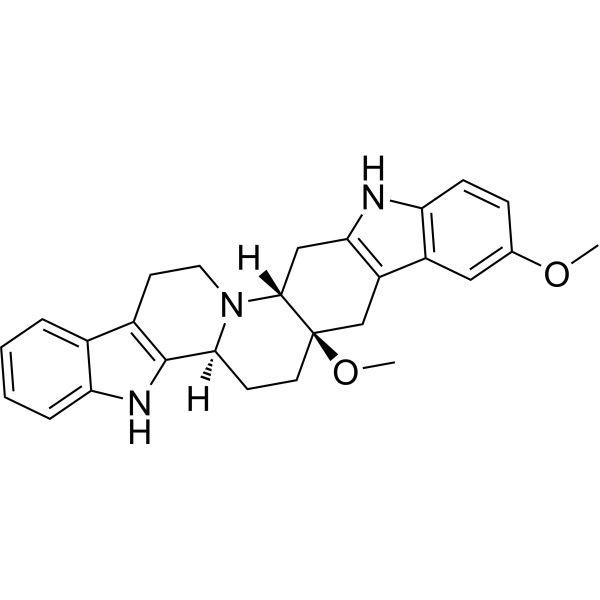
SIMR3030 is a potent SARS-CoV-2 PLpro inhibitor with an IC50 value of 0.0399 µg/mL. SIMR3030 shows antiviral activity. SIMR3030 decreases SARS-CoV spike, ORF1b, IFN-α, IL-6 mRNA expression. SIMR3030 exhibits a satisfactory safety profile in mice.
Nos produits utilisent uniquement pour la recherche. Nous ne vendons pas aux patients.
- CAS No.: 2708270-99-7
- Formule: C27H29N3O2
- Masse moléculaire:427.54
-
Stockage:
Please store the product under the recommended conditions in the Certificate of Analysis.

To place orders, for customer services and technical support, please contact: MedChemExpress USA
Tel: 609-228-6898 E-mail: [email protected] [email protected]


-
 Activité biologique
-
Chemical Information
- Protocole
- Pureté et documentation
- Références
-
 Help & FAQs




Activité biologique
Description
IC50 & Target
IC50: 0.0399 µg/mL (SARS-CoV-2 PLpro)[1]
Cellular Effect
|
Cell Line

|
Type | Value | Description | References |
|---|---|---|---|---|
| Vero C1008 | CC50 |
55.63 μg/mL
Compound: SIMR3030
|
Cytotoxicity against African green monkey Vero E6 cells measured after 72 hrs by crystal violet staining based analysis
Cytotoxicity against African green monkey Vero E6 cells measured after 72 hrs by crystal violet staining based analysis
|
[PMID: 37075625] |
In Vitro
SIMR3030 (0-100 µg/mL) shows antiviral activity with IC50 values of 12.1, 6.206 μg/mL for SARS-CoV-2 and MERS-CoV, respectively[1].
SIMR3030 (20 µg/mL; 1, 6, 12 h) decreases SARS-CoV spike, ORF1b, IFN-α, IL-6 mRNA expression levels in Caco-2 cells[1].
MedChemExpress (MCE) has not independently confirmed the accuracy of these methods. They are for reference only.
-
Cell Line:Caco-2 cells (SARS-CoV-2 RNA infected)
-
Concentration:20 μg/mL
-
Incubation Time:1, 6, 12 h
-
Result:Decreased SARS-CoV spike and ORF1b mRNA expression levels, reduced the mRNA expression of IFN-α at 1 and 3 h , IL-6 and OAS1 at 1, 3 and 12 h.
In Vivo
MedChemExpress (MCE) has not independently confirmed the accuracy of these methods. They are for reference only.
-
Animal Model:18-25 g, adult female Balb/c mice[1]
-
Dosage:25, 50, 100 mg/kg
-
Administration:I.p.; daily for 14 days
-
Result:Showed no signs of toxicity or weight loss were noticed during 12.5 and 25 mg/kg multiple-dose studies for 14 days, no signs of toxicity or weight loss were noticed during 12.5 and 25 mg/kg multiple-dose studies for 14 days.


Chemical Information
-
CAS No. 2708270-99-7
-
Masse moléculaire 427.54
-
Formule C27H29N3O2
-
SMILES
[H][C@@]12CC[C@]3(CC4=C(NC5=C4C=C(C=C5)OC)C[C@]3(N1CCC6=C2NC7=CC=CC=C76)[H])OC
-
Livraison
Room temperature in continental US; may vary elsewhere.
-
Stockage
Please store the product under the recommended conditions in the Certificate of Analysis.


Pureté et documentation
Références

Calculators
Concentration (start) × Volume (start) = Concentration (final) × Volume (final)


SIMR3030 Related Classifications
HY-149940 Related Classifications
 Powered by Bioz