



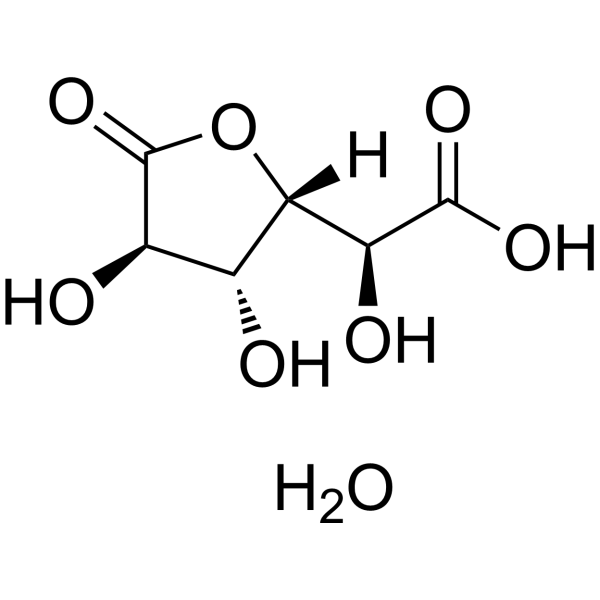
D-Saccharic acid 1,4-lactone hydrate
Based on 1 publication(s) in Google Scholar
D-Saccharic acid 1,4-lactone hydrate is an orally active β-glucuronidase inhibitor (IC50=48.4 μM). D-Saccharic acid 1,4-lactone hydrate can be used as a standard agent compared with novel β-glucuronidase inhibitors. D-Saccharic acid 1,4-lactone hydrate possesses anticarcinogenic, detoxifying, and antioxidant properties.
For research use only. We do not sell to patients.
- Purity : 99.96%
- CAS No.: 61278-30-6
- Formula: C6H10O8
- Molecular Weight:210.14
-
Storage:
-20°C, sealed storage, away from moisture
* In solvent : -80°C, 6 months; -20°C, 1 month (sealed storage, away from moisture)

To place orders, for customer services and technical support, please contact: MedChemExpress USA
Tel: 609-228-6898 E-mail: [email protected] [email protected]


-
 Biological Activity
-
Chemical Information
-
Solvent & Solubility
- Purity & Documentation
- References
-
 Help & FAQs



Publications Citing Use of MedChemExpress (MCE) D-Saccharic acid 1,4-lactone hydrate
More

Biological Activity
Description
In Vitro
D-Saccharic acid 1,4-lactone (1.5 mg/mL, 2 h) improves the viability of murine hepatocytes and effectively prevents the reduction in cell viability induced by tert-Butyl hydroperoxide[2]. D-Saccharic acid 1,4-lactone (1.5 mg/mL, 2 h) reduces cytotoxicity in murine hepatocytes and effectively inhibits oxidative stress-related cytotoxicity induced by tert-Butyl hydroperoxide[2]. D-Saccharic acid 1,4-lactone (1.5 mg/mL, 2 h) protects murine hepatocytes by modulating the expression levels of pro-apoptotic and anti-apoptotic proteins[2]. D-Saccharic acid 1,4-lactone (1.5 mg/mL, 2 h) enhances cell survival in murine hepatocytes by inhibiting apoptosis[2].
MedChemExpress (MCE) has not independently confirmed the accuracy of these methods. They are for reference only.
-
Cell Line:Murine hepatocytes
-
Concentration:1.5 mg/mL
-
Incubation Time:2 hours
-
Result:Prevented cell viability loss induced by tert-Butyl hydroperoxide.
-
Cell Line:Murine hepatocytes
-
Concentration:1.5 mg/mL
-
Incubation Time:2 hours
-
Result:Reduced pro-apoptotic proteins, increased anti-apoptotic proteins.
-
Cell Line:Murine hepatocytes
-
Concentration:1.5 mg/mL
-
Incubation Time:2 hours
-
Result:Reduced cytotoxicity induced by oxidative stress.
In Vivo
MedChemExpress (MCE) has not independently confirmed the accuracy of these methods. They are for reference only.
-
Animal Model:Alloxan hydrate (HY-W017227)-induced diabetes mellitus and oxidative stress model in Swiss albino male rats (4 weeks old, weighing approximately 120–130 g)[3]
-
Dosage:20, 40, 80, 120 mg/kg
-
Administration:Oral gavage (p.o.), once daily for 6 weeks
-
Result:Restored the abnormal elevation of blood glucose and insulin levels induced by Alloxan hydrate (HY-W017227). Inhibited pancreatic β-cell apoptosis through a mitochondrial-dependent pathway, as evidenced by the promotion of mitochondrial membrane potential decrease, increased cytochrome c release, regulation of Bcl-2 family protein interactions, and elevated levels of Apaf-1, caspase 9, and caspase 3, ultimately leading to β-cell apoptosis.


Chemical Information
-
CAS No. 61278-30-6
-
Appearance Solid
-
Molecular Weight 210.14
-
Formula C6H10O8
-
Color White to off-white
-
SMILES
OC([C@H]([C@]1([H])[C@@H]([C@H](C(O1)=O)O)O)O)=O.O
-
Shipping
Room temperature in continental US; may vary elsewhere.
-
Storage
-20°C, sealed storage, away from moisture
* In solvent : -80°C, 6 months; -20°C, 1 month (sealed storage, away from moisture)


Publications (1)
-
Journal Impact Factor
-
Most Recent
-
J Enzyme Inhib Med Chem
Design, synthesis, and biological evaluation of (thio)urea derivatives as potent Escherichia coli β-glucuronidase inhibitors. [Abstract]2024 Dec;39(1):2387415. PMID: 39140677


Solvent & Solubility
In Vitro:
DMSO : 100 mg/mL (475.87 mM; Need ultrasonic; Hygroscopic DMSO has a significant impact on the solubility of product, please use newly opened DMSO)
H2O : ≥ 100 mg/mL (475.87 mM)
* "≥" means soluble, but saturation unknown.
Please refer to the solubility information to select the appropriate solvent. Once prepared, please aliquot and store the solution to prevent product inactivation from repeated freeze-thaw cycles.
Storage method and period of stock solution: -80°C, 6 months; -20°C, 1 month (sealed storage, away from moisture). When stored at -80°C, please use it within 6 months. When stored at -20°C, please use it within 1 month.
* Note: If you choose water as the stock solution, please dilute it to the working solution, then filter and sterilize it with a 0.22 μm filter before use.
Please refer to the solubility information to select the appropriate solvent. Once prepared, please aliquot and store the solution to prevent product inactivation from repeated freeze-thaw cycles.
Storage method and period of stock solution: -80°C, 6 months; -20°C, 1 month (sealed storage, away from moisture). When stored at -80°C, please use it within 6 months. When stored at -20°C, please use it within 1 month.
* Note: If you choose water as the stock solution, please dilute it to the working solution, then filter and sterilize it with a 0.22 μm filter before use.
Concentration (start) × Volume (start) = Concentration (final) × Volume (final)
In Vivo:
Select the appropriate dissolution method based on your experimental animal and administration route.
- For the following dissolution methods, please ensure to first prepare a clear stock solution using an In Vitro approach and then sequentially add co-solvents:
- To ensure reliable experimental results, the clarified stock solution can be appropriately stored based on storage conditions. As for the working solution for In Vivo experiments, it is recommended to prepare freshly and use it on the same day.
- The percentages shown for the solvents indicate their volumetric ratio in the final prepared solution. If precipitation or phase separation occurs during preparation, heat and/or sonication can be used to aid dissolution.
Add each solvent one by one: 10% DMSO 40% PEG300 5% Tween-80 45% Saline
Solubility: ≥ 2.5 mg/mL (11.90 mM); Clear solution
This protocol yields a clear solution of ≥ 2.5 mg/mL (saturation unknown).
Taking 1 mL working solution as an example, add 100 μL DMSO stock solution (25.0 mg/mL) to 400 μL PEG300, and mix evenly; then add 50 μL Tween-80 and mix evenly; then add 450 μL Saline to adjust the volume to 1 mL.
Preparation of Saline: Dissolve 0.9 g sodium chloride in ddH₂O and dilute to 100 mL to obtain a clear Saline solution.
Add each solvent one by one: 10% DMSO 90% (20% SBE-β-CD in Saline)
Solubility: ≥ 2.5 mg/mL (11.90 mM); Clear solution
This protocol yields a clear solution of ≥ 2.5 mg/mL (saturation unknown).
Taking 1 mL working solution as an example, add 100 μL DMSO stock solution (25.0 mg/mL) to 900 μL 20% SBE-β-CD in Saline, and mix evenly.
Preparation of 20% SBE-β-CD in Saline (4°C, storage for one week): 2 g SBE-β-CD powder is dissolved in 10 mL Saline, completely dissolve until clear.
In Vivo Dissolution Calculator
Please enter the basic information of animal experiments:
-
-
-
-
Recommended: Prepare an additional quantity of animals to account for potential losses during experiments.
Working solution concentration: 0.22 mg/mL
This product has good water solubility, please refer to the measured solubility data in water/PBS/Saline for details.


Purity & Documentation
-
Data Sheet (283 KB)
-
SDS (394 KB)
- English - EN (394 KB)
- Français - FR (394 KB)
- Deutsch - DE (394 KB)
- Norwegian - NO (394 KB)
- Español - ES (394 KB)
- Swedish - SV (394 KB)
- Italian - IT (394 KB)
- Korean - KR (394 KB)
- Portuguese - PT (394 KB)
-
Handling Instructions (2659 KB)
References
[1]. Taha M, et al. Synthesis, β-glucuronidase inhibition and molecular docking studies of hybrid bisindole-thiosemicarbazides analogs. Bioorg Chem. 2016;68:56-63. [Content Brief]
[2]. Bhattacharya S, et al. Prophylactic role of D-Saccharic acid-1,4-lactone in tertiary butyl hydroperoxide induced cytotoxicity and cell death of murine hepatocytes via mitochondria-dependent pathways. J Biochem Mol Toxicol. 2011;25(6):341-354. [Content Brief]
[3]. Bhattacharya S, et al. D-saccharic acid-1,4-lactone ameliorates alloxan-induced diabetes mellitus and oxidative stress in rats through inhibiting pancreatic β-cells from apoptosis via mitochondrial dependent pathway. Toxicol Appl Pharmacol. 2011 Dec 1;257(2):272-83. [Content Brief]


Complete Stock Solution Preparation Table
Please refer to the solubility information to select the appropriate solvent. Once prepared, please aliquot and store the solution to prevent product inactivation from repeated freeze-thaw cycles.
Storage method and period of stock solution: -80°C, 6 months; -20°C, 1 month (sealed storage, away from moisture). When stored at -80°C, please use it within 6 months. When stored at -20°C, please use it within 1 month.
| Optional Solvent | Concentration Solvent Mass | 1 mg | 5 mg | 10 mg | 25 mg |
|---|---|---|---|---|---|
| DMSO / H2O | 1 mM | 4.7587 mL | 23.7937 mL | 47.5873 mL | 118.9683 mL |
| 5 mM | 0.9517 mL | 4.7587 mL | 9.5175 mL | 23.7937 mL | |
| 10 mM | 0.4759 mL | 2.3794 mL | 4.7587 mL | 11.8968 mL | |
| 15 mM | 0.3172 mL | 1.5862 mL | 3.1725 mL | 7.9312 mL | |
| 20 mM | 0.2379 mL | 1.1897 mL | 2.3794 mL | 5.9484 mL | |
| 25 mM | 0.1903 mL | 0.9517 mL | 1.9035 mL | 4.7587 mL | |
| 30 mM | 0.1586 mL | 0.7931 mL | 1.5862 mL | 3.9656 mL | |
| 40 mM | 0.1190 mL | 0.5948 mL | 1.1897 mL | 2.9742 mL | |
| 50 mM | 0.0952 mL | 0.4759 mL | 0.9517 mL | 2.3794 mL | |
| 60 mM | 0.0793 mL | 0.3966 mL | 0.7931 mL | 1.9828 mL | |
| 80 mM | 0.0595 mL | 0.2974 mL | 0.5948 mL | 1.4871 mL | |
| 100 mM | 0.0476 mL | 0.2379 mL | 0.4759 mL | 1.1897 mL |
* Note: If you choose water as the stock solution, please dilute it to the working solution, then filter and sterilize it with a 0.22 μm filter before use.


D-Saccharic acid 1,4-lactone hydrate Related Classifications
HY-134453A Related Classifications
 Powered by Bioz