



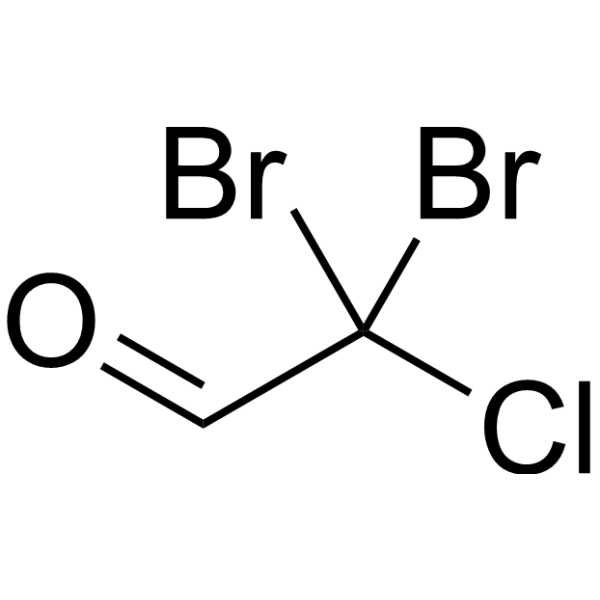
Dibromochloroacetaldehyde
Dibromochloroacetaldehyde belongs to trihalogenated acetaldehyde and is a byproduct in drinking water. Dibromochloroacetaldehyde has genotoxicity.
For research use only. We do not sell to patients.
- CAS No.: 64316-11-6
- Formula: C2HBr2ClO
- Molecular Weight:236.29
-
Storage:
Please store the product under the recommended conditions in the Certificate of Analysis.

To place orders, for customer services and technical support, please contact: MedChemExpress USA
Tel: 609-228-6898 E-mail: [email protected] [email protected]


-
 Biological Activity
-
Chemical Information
- Protocols
- Purity & Documentation
- References
-
 Help & FAQs




Biological Activity
Description
In Vitro
The rank order of haloacetaldehyde (HAL) cytotoxicity is tribromoacetaldehyde (TBAL)≈chloroacetaldehyde (CAL)>dibromoacetaldehyde (DBAL)≈bromochloroacetaldehyde (BCAL)≈ dibromochloroacetaldehyde (DBCAL)>IAL>bromoacetaldehyde (BAL)≈ bromodichloroacetaldehyde (BDCAL)>dichloroacetaldehyde (DCAL)> trichloroacetaldehyde (TCAL). The HALs are highly cytotoxic compared to other DBP chemical classes. The rank order of HAL genotoxicity is DBAL>CAL≈DBCAL>TBAL≈BAL>BDCAL>BCAL≈DCAL>IAL[1].
MedChemExpress (MCE) has not independently confirmed the accuracy of these methods. They are for reference only. Further protocols information, click here.


Chemical Information
-
CAS No. 64316-11-6
-
Molecular Weight 236.29
-
Formula C2HBr2ClO
-
SMILES
O=CC(Br)(Br)Cl
-
Shipping
Room temperature in continental US; may vary elsewhere.
-
Storage
Please store the product under the recommended conditions in the Certificate of Analysis.

Protocols
-
Genotoxicity/Mutagenicity Study
The bacterial reverse mutation assay detects point mutations that restore amino-acid prototrophy in auxotrophic Salmonella typhimurium or Escherichia coli tester strains; after exposure to a test article, mutagenic activity is read out as an increased number of revertant colonies on minimal agar compared with the vehicle control. The assay uses tester strains with different mutation targets so that base-substitution and frameshift mutagens can be detected, and testing is performed with and without exogenous mammalian metabolic activation because some chemicals require biotransformation to become mutagenic.


Purity & Documentation
References

Calculators
Concentration (start) × Volume (start) = Concentration (final) × Volume (final)


Dibromochloroacetaldehyde Related Classifications
HY-133649 Related Classifications
 Powered by Bioz