



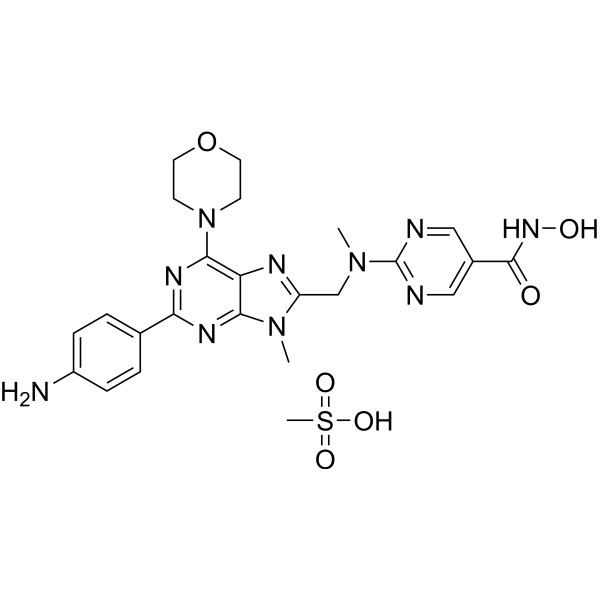
Puzerinostat mesylate

Based on 1 Customer Validation
Puzerinostat mesylate (Purinostat mesylate) is a highly selective class I/IIb histone deacetylase (HDAC) inhibitor, with IC50 values of 0.81 nM, 1.4 nM, 1.7 nM, 3.8 nM, 11.5 nM, and 1.1 nM against HDAC1, HDAC2, HDAC3, HDAC8, HDAC6, and HDAC10, respectively. Puzerinostat mesylate enhances glutamine metabolism by upregulating GLS1. Puzerinostat mesylate induces cell Apoptosis and downregulates the expression of BCR-ABL and c-MYC. Puzerinostat mesylate delays the progression of Ph+ B-cell acute lymphoblastic leukemia and prolongs the survival of relevant mouse models. Puzerinostat mesylate regulates the immune microenvironment. Puzerinostat mesylate can be used in research related to chronic myeloid leukemia, Philadelphia chromosome-positive B-cell acute lymphoblastic leukemia, relapsed/refractory multiple myeloma, relapsed/refractory lymphoma, diffuse large B-cell lymphoma, and double-expression lymphoma.
For research use only. We do not sell to patients.
- Purity: 99.45%
- CAS No.: 2650188-32-0
- Formula: C24H30N10O6S
- Molecular Weight:586.62
-
Storage:
-20°C, sealed storage, away from moisture
* In solvent : -80°C, 6 months; -20°C, 1 month (sealed storage, away from moisture)

To place orders, for customer services and technical support, please contact: MedChemExpress USA
Tel: 609-228-6898 E-mail: [email protected] [email protected]


-
 Biological Activity
-
Chemical Information
-
Solvent & Solubility
- Purity & Documentation
- References
-
 Help & FAQs




Biological Activity
|
HDAC1 0.81 nM (IC50) |
HDAC2 1.4 nM (IC50) |
HDAC3 1.7 nM (IC50) |
HDAC8 3.8 nM (IC50) |
HDAC6 11.5 nM (IC50) |
HDAC10 1.1 nM (IC50) |
Puzerinostat (20 nM; 0-48 h) mesylate induces time-dependent hyperacetylation of α-tubulin and histone H3 in LAMA84 Ph+ chronic myeloid leukemia cells[1].
Puzerinostat mesylate is a highly selective class I/IIb HDAC inhibitor with favorable cardiac safety profiles due to its weak inhibitory effect on hERG channels[3].
Puzerinostat (10-200 nM; 24-72 h) mesylate potently reduces the viability of LAMA84 and K562 Ph+ chronic myeloid leukemia cells, with an IC50 of less than 10 nM, and its effect is dose- and time-dependent[1].
Puzerinostat (72 h) mesylate potently inhibits the proliferation of multiple myeloma (MM) and lymphoma cell lines, with all IC50 values below 5 nM[3].
Treatment with Puzerinostat (5-150 nM; 24 h) mesylate induces dose-dependent G0/G1 cell cycle arrest in LAMA84 and K562 Ph+ chronic myeloid leukemia cells[1].
Puzerinostat (0.25-0.5 nM; 24 h) mesylate upregulates the expression of MHC-I and MHC-II on MM1S cells in a concentration-dependent manner[3].
MedChemExpress (MCE) has not independently confirmed the accuracy of these methods. They are for reference only.
-
Cell Line:LAMA84 Ph+ chronic myelogenous leukemia cells
-
Concentration:20 nM
-
Incubation Time:0 h, 12 h, 24 h, 36 h, 48 h
-
Result:Increased acetylation of α-tubulin and histone H3 (Ac-α-tubulin and Ac-H3) in a time-dependent manner, with visible increases starting at 12 h and peaking at 48 h, relative to unacetylated α-tubulin, histone H3, and GAPDH loading controls.\nIncreased levels of pro-apoptotic proteins P53 and BAD, decreased anti-apoptotic protein BCL-XL, and induced cleavage of caspase-8, caspase-9, caspase-3, and PARP in a time-dependent manner.
Suppressed phosphorylation of RAF, MEK, ERK, and AKT (the RAF-MEK-ERK-AKT signaling axis) in a time-dependent manner.
Reduced protein levels of BCR-ABL, c-MYC, ALOX5, EZH2, p-STAT5, and p-FAK, while increasing levels of ALOX15 and β-CATENIN, all in a time-dependent manner.
-
Cell Line:Luciferase-tagged LAMA84 and K562 Ph+ chronic myelogenous leukemia cells
-
Concentration:10-100 nM (LAMA84); 150-200 nM (K562)
-
Incubation Time:24 h, 36 h, 48 h, 60 h, 72 h
-
Result:Reduced cell viability in a dose- and time-dependent manner for both cell lines.
Caused near-complete viability loss in LAMA84 cells at 100 nM by 48 h, and near-complete viability loss in K562 cells at 200 nM by 48 h.
Achieved an IC50 of less than 10 nM against Ph+ cell lines.
-
Cell Line:LAMA84 and K562 Ph+ chronic myelogenous leukemia cells
-
Concentration:5-20 nM (LAMA84); 20-150 nM (K562)
-
Incubation Time:24 h
-
Result:Arrested LAMA84 and K562 cells in the G0/G1 phase in a dose-dependent manner.
Increased G0/G1 phase proportion in LAMA84 cells from 47.3% (control) to 84.0% at 20 nM; increased G0/G1 phase proportion in K562 cells from 31.5% (control) to 90.3% at 150 nM, with corresponding decreases in S and G2/M phases.
Puzerinostat (5-10 mg/kg; i.p., i.v.; three times per week; for 5 consecutive weeks) mesylate significantly prolongs survival and eliminates leukemia cells in BL-2 secondary transplanted Ph+ B-ALL mouse models, with 60% of mice surviving up to day 100 at the dose of 10 mg/kg[2].
Puzerinostat (2.5-10 mg/kg) mesylate significantly prolongs survival and reduces tumor burden in PDX models of Ph+ B-ALL relapsed after tyrosine kinase inhibitor treatment, with a median overall survival (OS) of 73 days in the 10 mg/kg dose group[2].
Puzerinostat (10 mg/kg) mesylate significantly extends the median survival to 86 days, reduces serum calcium levels, ameliorates osteolytic lesions, and enhances innate and adaptive anti-tumor immune responses in the 5TMM mouse model[3].
MedChemExpress (MCE) has not independently confirmed the accuracy of these methods. They are for reference only.
-
Animal Model:donor mice (treated with fluorouracil); recipient mice (γ-ray irradiated)[1]
-
Dosage:5 mg/kg; 10 mg/kg
-
Administration:i.v.; three times a week
-
Result:Maintained 71.4% survival (10/14 mice) at day 90 post-BMT for 5 mg/kg dose, and 87.5% survival (7/8 mice) at day 90 post-BMT for 10 mg/kg dose, compared to 0% survival in placebo group by day 40.
Reduced peripheral blood leukemia cell (GFP+Gr-1+) burden to 1.21% (5 mg/kg) and 0.62% (10 mg/kg) by day 40.
Reduced bone marrow GFP+LSC counts to ~200 (5 mg/kg) and ~100 (10 mg/kg), compared to ~700 in placebo group.
Increased GFP+LSC apoptosis to ~38% (5 mg/kg) and ~45% (10 mg/kg), compared to ~22% in placebo group.
Reduced residual bone marrow GFP+LSC percentages to 2.0% (5 mg/kg) and 1.0% (10 mg/kg) by day 90 post-BMT, down from ~7.2% at day 14.
Reduced myeloid leukemia cell infiltration in lungs and spleens, with tissue structure comparable to healthy mice after long-term treatment.
Reduced leukemia cells in peripheral blood again upon retreatment after relapse following treatment suspension.
-
Animal Model:C57BL/6 (7-8-week female; secondary transplantation model via intravenous injection of 1×10⁶ BL-2 cells)[2]
-
Dosage:5 mg/kg; 10 mg/kg
-
Administration:i.p.; three times a week; five weeks; i.v.; three times a week
-
Result:Prolonged median overall survival to 25.5 days in the 5 mg/kg group.
Achieved 60% (6/10) survival rate to 100 days in the 10 mg/kg group.
Nearly eliminated GFP+B220+ cells in peripheral blood of surviving mice after five weeks of treatment, with no tumor cells detected one week after treatment cessation.
Completely eliminated GFP+B220+ cells in spleens of a separate cohort after two doses of 10 mg/kg, maintaining inhibition for 26 days.
Decreased spleen weights significantly, reaching levels identical to healthy mice by day 19.
Significantly reduced GFP+B220+ cell proportions in bone marrow.
Increased Ac-H3 and Ac-H4 levels and decreased BCR-ABL, HSP90, HCK, p-SRC, and c-MYC levels in bone marrow cells.
Restored normal organ morphology in mice after three weeks of treatment.
| NCT Number | Sponsor | Condition | Start Date |
Phase

|
|---|---|---|---|---|
| NCT01329991 | Plexxikon| | 2011-05 | PHASE1 |


Chemical Information
-
CAS No. 2650188-32-0
-
Appearance Solid
-
Molecular Weight 586.62
-
Formula C24H30N10O6S
-
Color Off-white to light yellow
-
SMILES
O=C(C1=CN=C(N(CC2=NC3=C(N4CCOCC4)N=C(C5=CC=C(N)C=C5)N=C3N2C)C)N=C1)NO.O=S(O)(C)=O
-
Synonyms
Purinostat mesylate
-
Shipping
Room temperature in continental US; may vary elsewhere.
-
Storage
-20°C, sealed storage, away from moisture
* In solvent : -80°C, 6 months; -20°C, 1 month (sealed storage, away from moisture)


Solvent & Solubility
DMSO : 35 mg/mL (59.66 mM; Need ultrasonic; Hygroscopic DMSO has a significant impact on the solubility of product, please use newly opened DMSO)
Please refer to the solubility information to select the appropriate solvent. Once prepared, please aliquot and store the solution to prevent product inactivation from repeated freeze-thaw cycles.
Storage method and period of stock solution: -80°C, 6 months; -20°C, 1 month (sealed storage, away from moisture). When stored at -80°C, please use it within 6 months. When stored at -20°C, please use it within 1 month.
Please refer to the solubility information to select the appropriate solvent. Once prepared, please aliquot and store the solution to prevent product inactivation from repeated freeze-thaw cycles.
Storage method and period of stock solution: -80°C, 6 months; -20°C, 1 month (sealed storage, away from moisture). When stored at -80°C, please use it within 6 months. When stored at -20°C, please use it within 1 month.
Concentration (start) × Volume (start) = Concentration (final) × Volume (final)
Select the appropriate dissolution method based on your experimental animal and administration route.
- For the following dissolution methods, please ensure to first prepare a clear stock solution using an In Vitro approach and then sequentially add co-solvents:
- To ensure reliable experimental results, the clarified stock solution can be appropriately stored based on storage conditions. As for the working solution for In Vivo experiments, it is recommended to prepare freshly and use it on the same day.
- The percentages shown for the solvents indicate their volumetric ratio in the final prepared solution. If precipitation or phase separation occurs during preparation, heat and/or sonication can be used to aid dissolution.
Add each solvent one by one: 5% PEG300 95% Saline
Solubility: 3.33 mg/mL (5.68 mM); Suspended solution; Need ultrasonic
Please enter the basic information of animal experiments:
-
-
-
-
Recommended: Prepare an additional quantity of animals to account for potential losses during experiments.
Please enter your animal formula composition:
-
%DMSO +
Recommended: Keep the proportion of DMSO in working solution below 2% if your animal is weak.
-
%+
-
+%Tween-80 + +
-
%Saline +
The co-solvents required include: DMSO, . All of co-solvents are available by MedChemExpress (MCE). , Tween 80. All of co-solvents are available by MedChemExpress (MCE).
Working solution concentration: 0.22 mg/mL
Method for preparing stock solution: mg drug dissolved in μL DMSO. Stock solution concentration: mg/mL. * In solvent : -80°C, 6 months; -20°C, 1 month (sealed storage, away from moisture)
1. Take μL DMSO stock solution;
2. Add μL .
μL , mix evenly;
3. Then add μL Tween 80, mix evenly;
4. Then add μL
Please ensure that the stock solution in the first step is dissolved to a clear state, and add co-solvents in sequence. You can use ultrasonic heating (ultrasonic cleaner, recommended frequency 20-40 kHz), vortexing, etc. to assist dissolution.


Purity & Documentation
-
Data Sheet (285 KB)
-
SDS (251 KB)
- English - EN (251 KB)
- Français - FR (251 KB)
- Deutsch - DE (251 KB)
- Norwegian - NO (251 KB)
- Español - ES (251 KB)
- Swedish - SV (251 KB)
- Italian - IT (251 KB)
- Korean - KR (251 KB)
- Portuguese - PT (251 KB)
-
Handling Instructions (2659 KB)
References
[1]. Qiu Q, et al. HDAC I/IIb selective inhibitor Purinostat Mesylate combined with GLS1 inhibition effectively eliminates CML stem cells. Bioactive materials. 2023 Mar;21:483-498. [Content Brief]
[2]. Yang L, et al. Purinostat Mesylate Is a Uniquely Potent and Selective Inhibitor of HDACs for the Treatment of -Induced B-Cell Acute Lymphoblastic Leukemia. Clinical cancer research : an official journal of the American Association for Cancer Research. 2019 Dec 15;25(24):7527-7539. [Content Brief]


Complete Stock Solution Preparation Table
Please refer to the solubility information to select the appropriate solvent. Once prepared, please aliquot and store the solution to prevent product inactivation from repeated freeze-thaw cycles.
Storage method and period of stock solution: -80°C, 6 months; -20°C, 1 month (sealed storage, away from moisture). When stored at -80°C, please use it within 6 months. When stored at -20°C, please use it within 1 month.
| Optional Solvent | Concentration Solvent Mass | 1 mg | 5 mg | 10 mg | 25 mg |
|---|---|---|---|---|---|
| DMSO | 1 mM | 1.7047 mL | 8.5234 mL | 17.0468 mL | 42.6170 mL |
| 5 mM | 0.3409 mL | 1.7047 mL | 3.4094 mL | 8.5234 mL | |
| 10 mM | 0.1705 mL | 0.8523 mL | 1.7047 mL | 4.2617 mL | |
| 15 mM | 0.1136 mL | 0.5682 mL | 1.1365 mL | 2.8411 mL | |
| 20 mM | 0.0852 mL | 0.4262 mL | 0.8523 mL | 2.1309 mL | |
| 25 mM | 0.0682 mL | 0.3409 mL | 0.6819 mL | 1.7047 mL | |
| 30 mM | 0.0568 mL | 0.2841 mL | 0.5682 mL | 1.4206 mL | |
| 40 mM | 0.0426 mL | 0.2131 mL | 0.4262 mL | 1.0654 mL | |
| 50 mM | 0.0341 mL | 0.1705 mL | 0.3409 mL | 0.8523 mL |


Puzerinostat mesylate Related Classifications
HY-150109 Related Classifications
 Powered by Bioz
- Puzerinostat
- 2650188-32-0
- Purinostat
- HDAC
- Glutaminase
- Apoptosis
- c-Myc
- Bcr-Abl
- diffuse large B-cell lymphoma
- osteoclastogenesis
- multiple myeloma
- histone deacetylase
- chronic myelogenous leukemia
- LAMA84 cells
- K562 cells
- BaF3-BCR-ABL(T315I) cells
- leukemia stem cell
- Philadelphia chromosome-positive B-cell acute lymphoblastic leukemia
- Inhibitor
- inhibitor
- inhibit