



Dermaseptin TFA

Based on 1 Customer Validation
Dermaseptin TFA, a peptide isolated from frog skin, exhibits potent antimicrobial activity against bacteria, fungi, and protozoa at micromolar concentration.
For research use only. We do not sell to patients.
- Purity : 99.21%
- CAS No.: 646451-06-1
- Formula: C152H257N43O42S2.X.XC2HF3O2
-
Storage:
Sealed storage, away from moisture and light.
Powder -80°C, 2 years , -20°C, 1 year* In solvent : -80°C, 6 months; -20°C, 1 month (sealed storage, away from moisture and light)

To place orders, for customer services and technical support, please contact: MedChemExpress USA
Tel: 609-228-6898 E-mail: [email protected] [email protected]


-
 Biological Activity
-
Chemical Information
-
Solvent & Solubility
- Protocols
- Purity & Documentation
- References
-
 Help & FAQs




Biological Activity
Description
In Vitro
Dermaseptin TFA is a water-soluble, thermostable, and nonhemolytic peptide endowed with highly potent antimicrobial activity against pathogenic fungi at micromolar concentration. Circular dichroism spectra of Dermaseptin TFA in hydrophobic media indicated 80% alpha-helical conformation, and predictions of secondary structure suggested that Dermaseptin TFA can be configured as an amphiphatic alpha-helix spanning over residues 1-27, a structure that perturbs membrane functions regulating water flux[1]. Dermaseptin TFA exerts a lytic action upon bacteria, protozoa, yeasts, and filamentous fungi at micromolar concentrations. Molecular elements responsible for the exceptional antimicrobial potency of Dermaseptin TFA are to be traced to the NH2-terminal alpha-helical amphipathic segment spanning residues 1-18 of the molecule[1]. Dermaseptin TFA (5-100 μg/ml; 48 hours) inhibits by 100% the proliferation of most microorganisms tested, including Gram-positive or Gram-negative bacteria, parasites, yeasts, and filamentous fungi, at micromolar concentrations[2]. Dermaseptin TFA (5-100 μg/ml; 48 hours) does not inhibit the proliferation of human KJ3 cells after a 48 h incubation, and Dermaseptin TFA treatment for 1 h does not permeate guinea pig lymphocytes up to the highest concentration assayed (200 μg/ml). Hemolysis of rabbit erythrocytes occurrs after 1 h of treatment at doses above 200 μg/ml, with 50% hemolysis at 350 μg/ml[2]. Dermaseptin TFA has antimicrobial activities and is against Aeromonas cauiae, Pseudomonas aeroginusa, Escherichia coli, Enterococcus faecalis, L. mezicana (NF α strain) and Microsporum canis (IP1194) with MIC values of 50 μg/ml; 100 μg/ml; 25 μg/ml; 15 μg/ml; and 50 μg/ml, respectively[2].
MedChemExpress (MCE) has not independently confirmed the accuracy of these methods. They are for reference only.


Chemical Information
-
CAS No. 646451-06-1
-
Appearance Solid
-
Formula C152H257N43O42S2.X.XC2HF3O2
-
Color White to off-white
-
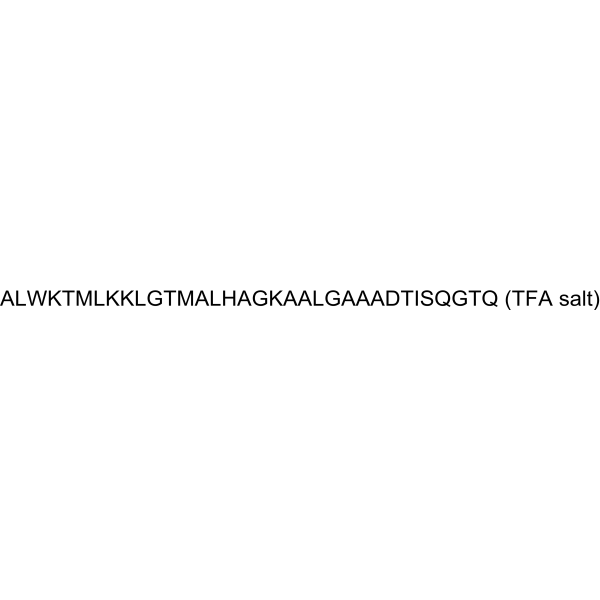
Sequence
Ala-Leu-Trp-Lys-Thr-Met-Leu-Lys-Lys-Leu-Gly-Thr-Met-Ala-Leu-His-Ala-Gly-Lys-Ala-Ala-Leu-Gly-Ala-Ala-Ala-Asp-Thr-Ile-Ser-Gln-Gly-Thr-Gln
-
Sequence Shortening
ALWKTMLKKLGTMALHAGKAALGAAADTISQGTQ
-
Shipping
Room temperature in continental US; may vary elsewhere.
-
Storage
Sealed storage, away from moisture and light
Powder -80°C 2 years -20°C 1 year * In solvent : -80°C, 6 months; -20°C, 1 month (sealed storage, away from moisture and light)


Solvent & Solubility
In Vitro:
DMSO : 100 mg/mL (Need ultrasonic; Hygroscopic DMSO has a significant impact on the solubility of product, please use newly opened DMSO)


Purity & Documentation
-
Data Sheet (269 KB)
-
SDS (252 KB)
- English - EN (252 KB)
- Français - FR (252 KB)
- Deutsch - DE (252 KB)
- Norwegian - NO (252 KB)
- Español - ES (252 KB)
- Swedish - SV (252 KB)
- Italian - IT (252 KB)
- Korean - KR (252 KB)
- Portuguese - PT (252 KB)
-
Handling Instructions (2659 KB)
References
[1]. Mor A, et al. Isolation, amino acid sequence, and synthesis of Dermaseptin TFA, a novel antimicrobial peptide of amphibian skin. Biochemistry. 1991 Sep 10;30(36):8824-30. [Content Brief]
[2]. Mor A, et al. The NH2-terminal alpha-helical domain 1-18 of Dermaseptin TFA is responsible for antimicrobial activity. J Biol Chem. 1994 Jan 21;269(3):1934-9. [Content Brief]

Calculators
Concentration (start) × Volume (start) = Concentration (final) × Volume (final)


Dermaseptin TFA Related Classifications
HY-P0263A Related Classifications
 Powered by Bioz