



CE3F4 (Standard)
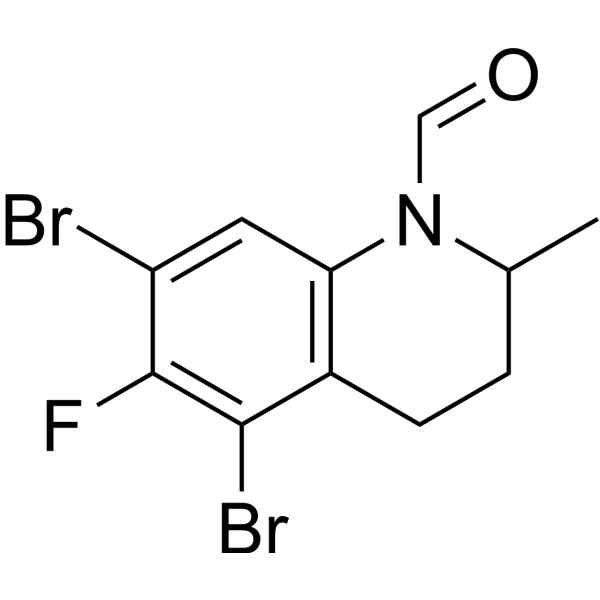
CE3F4 (Standard) is the analytical standard of CE3F4 (HY-108539). This product is intended for research and analytical applications. CE3F4 is a selective antagonist of exchange protein directly activated by cAMP (Epac1), with IC50s of 10.7 μM and 66 μM for Epac1 and Epac2(B), respectively.
Nos produits utilisent uniquement pour la recherche. Nous ne vendons pas aux patients.
- CAS No.: 143703-25-7
- Formule: C11H10Br2FNO
- Masse moléculaire:351.01
-
Stockage:
Please store the product under the recommended conditions in the Certificate of Analysis.


To place orders, for customer services and technical support, please contact: MedChemExpress USA
Tel: 609-228-6898 E-mail: [email protected] [email protected]


-
 Product Information
-
Chemical Information
- Pureté et documentation
-
 Help & FAQs





Product Information
Information
Application
The compound is the grade of analytical standard, which is the reference standard supplied assay. It is commonly used in qualitative, quantitative and methodological research experiments in HPLC, GC and MS.


Chemical Information
-
CAS No. 143703-25-7
-
Masse moléculaire 351.01
-
Formule C11H10Br2FNO
-
SMILES
O=CN1C(C)CCC2=C1C=C(Br)C(F)=C2Br
-
Livraison
Room temperature in continental US; may vary elsewhere.
-
Stockage
Please store the product under the recommended conditions in the Certificate of Analysis.


Pureté et documentation
Références
[1]. Courilleau D, et al. The (R)-enantiomer of CE3F4 is a preferential inhibitor of human exchange protein directly activated by cyclic AMP isoform 1 (Epac1). Biochem Biophys Res Commun. 2013 Oct 25;440(3):443-8. [Content Brief]
[2]. Courilleau D, et al. Identification of a tetrahydroquinoline analog as a pharmacological inhibitor of the cAMP-binding protein Epac. J Biol Chem. 2012 Dec 28;287(53):44192-202. [Content Brief]
[3]. Pratt EP, et al. Ca2+ influx through L-type Ca2+ channels and Ca2+-induced Ca2+ release regulate cAMP accumulation and Epac1-dependent ERK 1/2 activation in INS-1 cells. Mol Cell Endocrinol. 2016 Jan 5;419:60-71. [Content Brief]
[4]. Prajapati R, et al. Usefulness of Exchanged Protein Directly Activated by cAMP (Epac)1-Inhibiting Therapy for Prevention of Atrial and Ventricular Arrhythmias in Mice. Circ J. 2019;83(2):295-303. [Content Brief]

Calculators
Concentration (start) × Volume (start) = Concentration (final) × Volume (final)


CE3F4 (Standard) Related Classifications
HY-108539R Related Classifications
 Powered by Bioz