



Gamma-Mangostin
Based on 4 publication(s) in Google Scholar
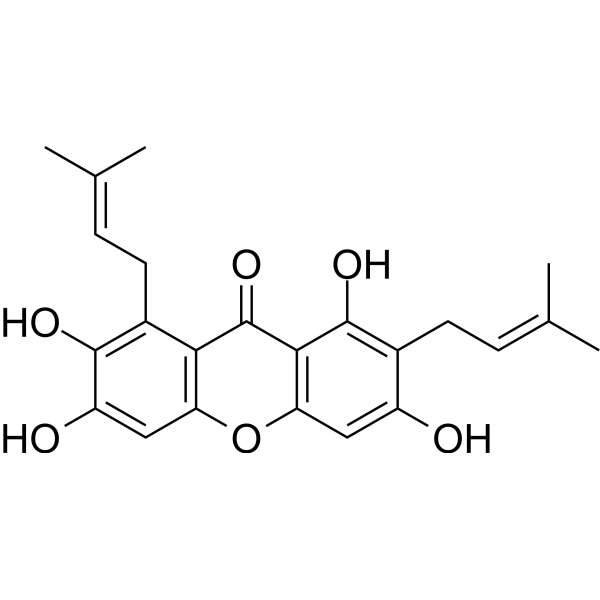
Gamma-Mangostin is a novel competitive 5-hydroxytryptamine 2A (5-HT2A) receptor antagonist and potent epoxidase 2 (COX-2) inhibitor, as well as a transthyroxin protein (TTR) profibrosis inhibitor. Gamma-Mangostin binds to the thyroxine (T4)-binding sites and stabilized the TTR tetramer. Gamma-Mangostin inhibits [3H] spiperone binding to cultured rat aortic myocytes (IC50=3.5 nM) and reduces The perfusion pressure response of rat coronary artery to 5-HT2A (IC50=0.32 μM). Gamma-Mangostin has anti-inflammatory, antibacterial, antioxidant and anticancer activities, and can be used in the study of metabolic disorders such as diabetes.
For research use only. We do not sell to patients.
- Purity : 99.91%
- CAS No.: 31271-07-5
- Formula: C23H24O6
- Molecular Weight:396.43
-
Storage:Powder -20°C, 3 years , 4°C, 2 years ; In solvent -80°C, 6 months , -20°C, 1 month

To place orders, for customer services and technical support, please contact: MedChemExpress USA
Tel: 609-228-6898 E-mail: [email protected] [email protected]


-
 Biological Activity
-
Chemical Information
-
Solvent & Solubility
- Protocols
- Purity & Documentation
- References
-
 Help & FAQs




Publications Citing Use of MedChemExpress (MCE) Gamma-Mangostin
MoreAll 5-HT Receptor Isoforms
More

Biological Activity
Description
IC50 & Target
[1]|
5-HT2A Receptor |
COX-2 |
Cellular Effect
|
Cell Line

|
Type | Value | Description | References |
|---|---|---|---|---|
| ASPC1 | IC50 |
5.92 μM
Compound: 3, gama-mangostin
|
Cytotoxicity against human AsPC1 cells assessed as inhibition of cell proliferation after 48 hrs by XTT assay
Cytotoxicity against human AsPC1 cells assessed as inhibition of cell proliferation after 48 hrs by XTT assay
|
[PMID: 24717154] |
| HepG2 | IC50 |
>10 μM
Compound: 12
|
Cytotoxicity against human HepG2 cells by MTT assay
Cytotoxicity against human HepG2 cells by MTT assay
|
[PMID: 24960143] |
| HL-60 | IC50 |
6.1 μM
Compound: 3
|
Cytotoxicity against human HL60 cells assessed as cell viability after 72 hrs by Trypan blue exclusion test
Cytotoxicity against human HL60 cells assessed as cell viability after 72 hrs by Trypan blue exclusion test
|
[PMID: 12932141] |
| HT-29 | ED50 |
4 μM
Compound: 4
|
Cytotoxicity against human HT-29 cells after 3 days by sulforhodamine B assay
Cytotoxicity against human HT-29 cells after 3 days by sulforhodamine B assay
|
[PMID: 21428375] |
| HT-29 | IC50 |
>10 μM
Compound: 4
|
Effect on mitochondrial membrane potential in human HT-29 cells after 2 hrs using JC-1 staining by fluorescence assay
Effect on mitochondrial membrane potential in human HT-29 cells after 2 hrs using JC-1 staining by fluorescence assay
|
[PMID: 21428375] |
| L02 | IC50 |
>10 μM
Compound: 12
|
Cytotoxicity against human HL7702 cells by MTT assay
Cytotoxicity against human HL7702 cells by MTT assay
|
[PMID: 24960143] |
| MCF7 | IC50 |
>10 μM
Compound: 12
|
Cytotoxicity against human MCF7 cells by MTT assay
Cytotoxicity against human MCF7 cells by MTT assay
|
[PMID: 24960143] |
| MDA-MB-231 | IC50 |
5.87 μM
Compound: 3, gama-mangostin
|
Cytotoxicity against human MDA-MB-231 cells assessed as inhibition of cell proliferation after 48 hrs by XTT assay
Cytotoxicity against human MDA-MB-231 cells assessed as inhibition of cell proliferation after 48 hrs by XTT assay
|
[PMID: 24717154] |
| MDA-MB-231 | IC50 |
6.6 μM
Compound: 12
|
Cytotoxicity against human MDA-MB-231 cells by MTT assay
Cytotoxicity against human MDA-MB-231 cells by MTT assay
|
[PMID: 24960143] |
| NCI-H1299 | EC50 |
2.2 μM
Compound: 2a
|
Antiproliferative activity against human NCI-H1299 cells assessed as inhibition of cell proliferation
Antiproliferative activity against human NCI-H1299 cells assessed as inhibition of cell proliferation
|
[PMID: 33513389] |
| NCI-H460 | IC50 |
4.48 μM
Compound: 3, gama-mangostin
|
Cytotoxicity against human NCI-H460 cells assessed as inhibition of cell proliferation after 48 hrs by XTT assay
Cytotoxicity against human NCI-H460 cells assessed as inhibition of cell proliferation after 48 hrs by XTT assay
|
[PMID: 24717154] |
| RAW264.7 | IC50 |
>50 μM
Compound: 12
|
Anti-inflammatory activity in mouse RAW264.7 cells assessed as inhibition of IFN-gamma plus LPS-induced NO production
Anti-inflammatory activity in mouse RAW264.7 cells assessed as inhibition of IFN-gamma plus LPS-induced NO production
|
[PMID: 24960143] |
| SK-BR-3 | IC50 |
25.99 μM
Compound: 9
|
Cytotoxicity against human SKBR3 cells assessed as survival by MTT assay
Cytotoxicity against human SKBR3 cells assessed as survival by MTT assay
|
[PMID: 18558747] |
| SK-BR-3 | IC50 |
4.97 μM
Compound: 9
|
Inhibition of aromatase over-expressed in human SKBR3 cells
Inhibition of aromatase over-expressed in human SKBR3 cells
|
[PMID: 18558747] |
| SW-620 | IC50 |
5.69 μM
Compound: 3, gama-mangostin
|
Cytotoxicity against human SW620 cells assessed as inhibition of cell proliferation after 48 hrs by XTT assay
Cytotoxicity against human SW620 cells assessed as inhibition of cell proliferation after 48 hrs by XTT assay
|
[PMID: 24717154] |
In Vitro
Gamma-Mangostin (0.5, 2.5, 5 μM; 2 hours) as an insulin sensitizer, alleviates hyperglycemia and is nontoxic to both vascular smoothing cells isolated from the external carotid artery in SD rats and FL83B mouse hepatocytes[5].
MedChemExpress (MCE) has not independently confirmed the accuracy of these methods. They are for reference only.
-
Cell Line:vascular smoothing cells isolated from the external carotid artery of SD rats and liver cells of FL83B mice
-
Concentration:0.5, 2.5, 5 μM
-
Incubation Time:2h
-
Result:Was not toxic to either cell line.
5 μM hypoglycemic effect was better than 0.5 and 2.5 μM.
In combination with insulin, reached a plateau in its synergistic effect on glucose uptake within 90 minutes.
In Vivo
Gamma-Mangostin (1, 2, 4 mg/kg; Oral gavage (p.o.); 14 days) significantly reduces blood urea nitrogen (BUN) and creatinine in plasma, and ameliorates the damage to renal proximal tubular cells in BALB/C mice with streptozotocin (STZ) (HY-13753) (30 mg/kg) induced diabetes[4].
Gamma-Mangostin (0.1, 0.2, 0.4 mg; Oral gavage (p.o.); 4 weeks) can reduce fasting blood glucose levels and oral glucose tolerance tests in diabetic ICR mice[5].
MedChemExpress (MCE) has not independently confirmed the accuracy of these methods. They are for reference only.
-
Animal Model:STZ (HY-13753) (30 mg/kg)-induced BALB/C diabetic mouse model[3]
-
Dosage:0.5 mg/kg, 1 mg/kg, 2 mg/kg
-
Administration:Oral gavage (p.o.); 14 days
-
Result:Significantly reduced fasting blood glucose, cholesterol, serum glutamic oxaloacetic transaminase (SGOT), and serum glutamate-pyruvate transaminase (SGPT) in diabetic mice.
Improved damaged liver cells, primarily those exhibiting swelling, water accumulation, and cell necrosis.


Chemical Information
-
CAS No. 31271-07-5
-
Appearance Solid
-
Molecular Weight 396.43
-
Formula C23H24O6
-
Color Light yellow to yellow
-
SMILES
O=C1C2=C(OC3=C1C(C/C=C(C)\C)=C(O)C(O)=C3)C=C(O)C(C/C=C(C)\C)=C2O
-
Synonyms
γ-Mangostin
-
Structure Classification
-
Initial Source
-
Shipping
Room temperature in continental US; may vary elsewhere.
-
Storage
Powder -20°C 3 years 4°C 2 years In solvent -80°C 6 months -20°C 1 month


Publications (4)
-
Journal Impact Factor
-
Most Recent
-
Nat Commun
2023 Jun 10;14(1):3445. PMID: 37301862 -
-
-


Solvent & Solubility
In Vitro:
DMSO : 100 mg/mL (252.25 mM; Need ultrasonic; Hygroscopic DMSO has a significant impact on the solubility of product, please use newly opened DMSO)
Please refer to the solubility information to select the appropriate solvent. Once prepared, please aliquot and store the solution to prevent product inactivation from repeated freeze-thaw cycles.
Storage method and period of stock solution: -80°C, 6 months; -20°C, 1 month. When stored at -80°C, please use it within 6 months. When stored at -20°C, please use it within 1 month.
Please refer to the solubility information to select the appropriate solvent. Once prepared, please aliquot and store the solution to prevent product inactivation from repeated freeze-thaw cycles.
Storage method and period of stock solution: -80°C, 6 months; -20°C, 1 month. When stored at -80°C, please use it within 6 months. When stored at -20°C, please use it within 1 month.
Concentration (start) × Volume (start) = Concentration (final) × Volume (final)
In Vivo:
Select the appropriate dissolution method based on your experimental animal and administration route.
- For the following dissolution methods, please ensure to first prepare a clear stock solution using an In Vitro approach and then sequentially add co-solvents:
- To ensure reliable experimental results, the clarified stock solution can be appropriately stored based on storage conditions. As for the working solution for In Vivo experiments, it is recommended to prepare freshly and use it on the same day.
- The percentages shown for the solvents indicate their volumetric ratio in the final prepared solution. If precipitation or phase separation occurs during preparation, heat and/or sonication can be used to aid dissolution.
Add each solvent one by one: 10% DMSO 40% PEG300 5% Tween-80 45% Saline
Solubility: ≥ 2.5 mg/mL (6.31 mM); Clear solution
This protocol yields a clear solution of ≥ 2.5 mg/mL (saturation unknown).
Taking 1 mL working solution as an example, add 100 μL DMSO stock solution (25.0 mg/mL) to 400 μL PEG300, and mix evenly; then add 50 μL Tween-80 and mix evenly; then add 450 μL Saline to adjust the volume to 1 mL.
Preparation of Saline: Dissolve 0.9 g sodium chloride in ddH₂O and dilute to 100 mL to obtain a clear Saline solution.
Add each solvent one by one: 10% DMSO 90% (20% SBE-β-CD in Saline)
Solubility: ≥ 2.5 mg/mL (6.31 mM); Clear solution
This protocol yields a clear solution of ≥ 2.5 mg/mL (saturation unknown).
Taking 1 mL working solution as an example, add 100 μL DMSO stock solution (25.0 mg/mL) to 900 μL 20% SBE-β-CD in Saline, and mix evenly.
Preparation of 20% SBE-β-CD in Saline (4°C, storage for one week): 2 g SBE-β-CD powder is dissolved in 10 mL Saline, completely dissolve until clear.
In Vivo Dissolution Calculator
Please enter the basic information of animal experiments:
-
-
-
-
Recommended: Prepare an additional quantity of animals to account for potential losses during experiments.
Please enter your animal formula composition:
-
%DMSO +
Recommended: Keep the proportion of DMSO in working solution below 2% if your animal is weak.
-
%+
-
+%Tween-80 + +
-
%Saline +
The co-solvents required include: DMSO, . All of co-solvents are available by MedChemExpress (MCE). , Tween 80. All of co-solvents are available by MedChemExpress (MCE).
Working solution concentration: 0.22 mg/mL
Method for preparing stock solution: mg drug dissolved in μL DMSO. Stock solution concentration: mg/mL.
1. Take μL DMSO stock solution;
2. Add μL .
μL , mix evenly;
3. Then add μL Tween 80, mix evenly;
4. Then add μL
Please ensure that the stock solution in the first step is dissolved to a clear state, and add co-solvents in sequence. You can use ultrasonic heating (ultrasonic cleaner, recommended frequency 20-40 kHz), vortexing, etc. to assist dissolution.


Purity & Documentation
-
Data Sheet (281 KB)
-
SDS (393 KB)
- English - EN (393 KB)
- Français - FR (393 KB)
- Deutsch - DE (393 KB)
- Norwegian - NO (393 KB)
- Español - ES (393 KB)
- Swedish - SV (393 KB)
- Italian - IT (393 KB)
- Korean - KR (393 KB)
- Portuguese - PT (393 KB)
-
Handling Instructions (2659 KB)
References
[1]. Chairungsrilerd N, et al. Gamma-mangostin, a novel type of 5-hydroxytryptamine 2A receptor antagonist. Naunyn Schmiedebergs Arch Pharmacol. 1998 Jan;357(1):25-31. [Content Brief]
[2]. Yokoyama T, et al. Discovery of γ-Mangostin as an Amyloidogenesis Inhibitor. Sci Rep. 2015 Aug 27;5:13570. [Content Brief]


Complete Stock Solution Preparation Table
Please refer to the solubility information to select the appropriate solvent. Once prepared, please aliquot and store the solution to prevent product inactivation from repeated freeze-thaw cycles.
Storage method and period of stock solution: -80°C, 6 months; -20°C, 1 month. When stored at -80°C, please use it within 6 months. When stored at -20°C, please use it within 1 month.
| Optional Solvent | Concentration Solvent Mass | 1 mg | 5 mg | 10 mg | 25 mg |
|---|---|---|---|---|---|
| DMSO | 1 mM | 2.5225 mL | 12.6126 mL | 25.2251 mL | 63.0628 mL |
| 5 mM | 0.5045 mL | 2.5225 mL | 5.0450 mL | 12.6126 mL | |
| 10 mM | 0.2523 mL | 1.2613 mL | 2.5225 mL | 6.3063 mL | |
| 15 mM | 0.1682 mL | 0.8408 mL | 1.6817 mL | 4.2042 mL | |
| 20 mM | 0.1261 mL | 0.6306 mL | 1.2613 mL | 3.1531 mL | |
| 25 mM | 0.1009 mL | 0.5045 mL | 1.0090 mL | 2.5225 mL | |
| 30 mM | 0.0841 mL | 0.4204 mL | 0.8408 mL | 2.1021 mL | |
| 40 mM | 0.0631 mL | 0.3153 mL | 0.6306 mL | 1.5766 mL | |
| 50 mM | 0.0505 mL | 0.2523 mL | 0.5045 mL | 1.2613 mL | |
| 60 mM | 0.0420 mL | 0.2102 mL | 0.4204 mL | 1.0510 mL | |
| 80 mM | 0.0315 mL | 0.1577 mL | 0.3153 mL | 0.7883 mL | |
| 100 mM | 0.0252 mL | 0.1261 mL | 0.2523 mL | 0.6306 mL |


Gamma-Mangostin Related Classifications
HY-N1957 Related Classifications
 Powered by Bioz