



GSK 3 Inhibitor IX (Standard)
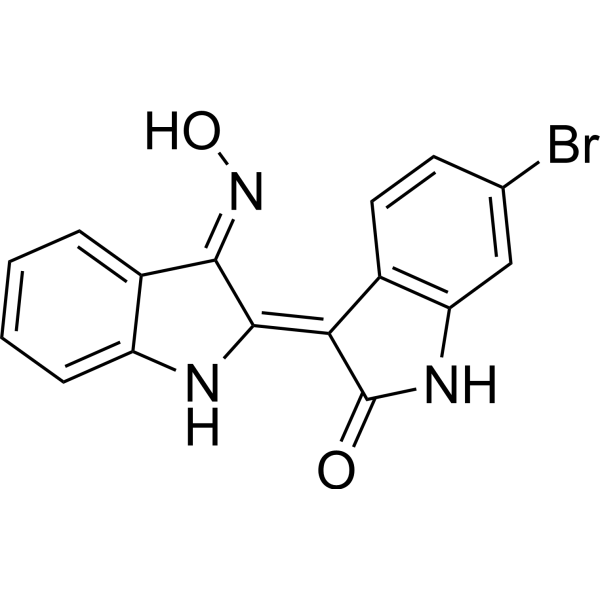
GSK 3 Inhibitor IX (Standard) is the analytical standard of GSK 3 Inhibitor IX (HY-10580). This product is intended for research and analytical applications. GSK 3 Inhibitor IX (6-Bromoindirubin-3'-oxime; BIO) is a potent, selective, reversible and ATP-competitive inhibitor of GSK-3α/β and CDK1-cyclinB complex with IC50s of 5 nM/320 nM/80 nM for (GSK-3α/β)/CDK1/CDK5, respectively.
For research use only. We do not sell to patients.
- Purity : 98%
- CAS No.: 667463-62-9
- Formula: C16H10BrN3O2
- Molecular Weight:356.17
-
Storage:
Please store the product under the recommended conditions in the Certificate of Analysis.


To place orders, for customer services and technical support, please contact: MedChemExpress USA
Tel: 609-228-6898 E-mail: [email protected] [email protected]


-
 Product Information
-
Chemical Information
- Purity & Documentation
-
 Help & FAQs





Product Information
Information
Application
The compound is the grade of analytical standard, which is the reference standard supplied assay. It is commonly used in qualitative, quantitative and methodological research experiments in HPLC, GC and MS.


Chemical Information
-
CAS No. 667463-62-9
-
Molecular Weight 356.17
-
Formula C16H10BrN3O2
-
SMILES
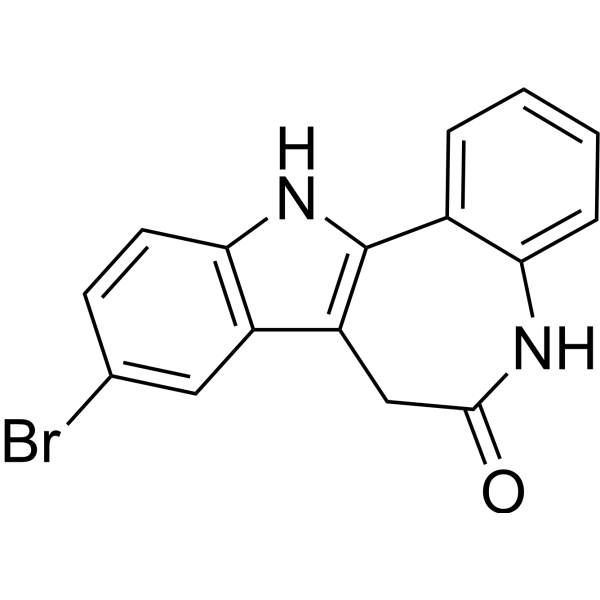
O/N=C(C1=CC=CC=C1N2)/C2=C3C(NC4=C/3C=CC(Br)=C4)=O
-
Synonyms
6-Bromoindirubin-3'-oxime (Standard); BIO (Standard); MLS 2052 (Standard)
-
Shipping
Room temperature in continental US; may vary elsewhere.
-
Storage
Please store the product under the recommended conditions in the Certificate of Analysis.


Purity & Documentation
References
[1]. Meijer L, et al. GSK-3-selective inhibitors derived from Tyrian purple indirubins. Chem Biol. 2003 Dec;10(12):1255-66. [Content Brief]
[2]. Sato N, et al. Maintenance of pluripotency in human and mouse embryonic stem cells through activation of Wnt signaling by a pharmacological GSK-3-specific inhibitor. Nat Med. 2004 Jan;10(1):55-63. Epub 2003 Dec 21. [Content Brief]
[3]. Tseng AS, et al. The GSK-3 inhibitor BIO promotes proliferation in mammalian cardiomyocytes. Chem Biol. 2006 Sep;13(9):957-63. [Content Brief]
[4]. Liu L1, et al. 6-Bromoindirubin-3'-oxime inhibits JAK/STAT3 signaling and induces apoptosis of human melanoma cells. Cancer Res. 2011 Jun 1;71(11):3972-9 [Content Brief]

Calculators
Concentration (start) × Volume (start) = Concentration (final) × Volume (final)


GSK 3 Inhibitor IX (Standard) Related Classifications
HY-10580R Related Classifications
 Powered by Bioz