



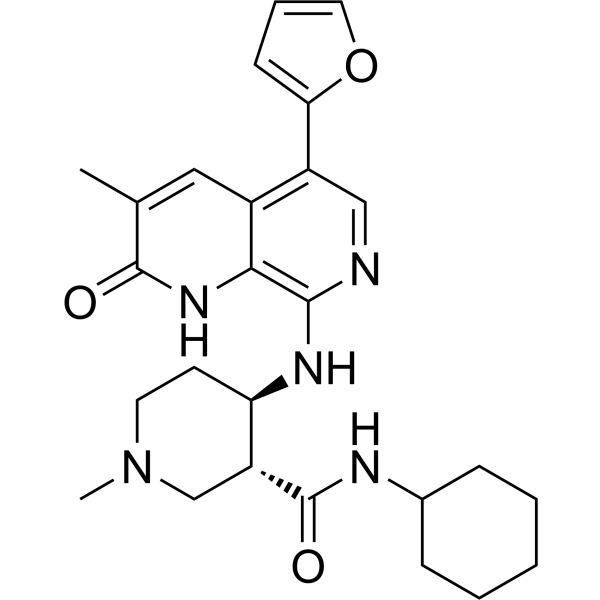
GSK789
GSK789 is a selective inhibitor of BET BD1. GSK789 inhibits the growth of leukemia cell lines. GSK789 inhibits LPS-stimulated production of MCP-1, TNFα and IL-6 in human whole blood. GSK789 exhibits antiproliferative, anti-inflammatory and immunomodulatory activities. GSK789 can be used in research related to cancers such as leukemia, as well as inflammatory and immune diseases.
Nos produits utilisent uniquement pour la recherche. Nous ne vendons pas aux patients.
- CAS No.: 2540591-06-6
- Formule: C26H33N5O3
- Masse moléculaire:463.57
-
Stockage:
Please store the product under the recommended conditions in the Certificate of Analysis.

To place orders, for customer services and technical support, please contact: MedChemExpress USA
Tel: 609-228-6898 E-mail: [email protected] [email protected]


-
 Activité biologique
-
Chemical Information
- Protocole
- Pureté et documentation
- Références
-
 Help & FAQs


Voir tous les produits spécifiques à Isoform TNF Receptor
More

Activité biologique
Description
Cellular Effect
|
Cell Line

|
Type | Value | Description | References |
|---|---|---|---|---|
| HL-60 | IC50 |
390 nM
Compound: 42, GSK789, Single enantiomer
|
Antiproliferative activity against human HL-60 cells after 72 hrs by cell titer glo assay
Antiproliferative activity against human HL-60 cells after 72 hrs by cell titer glo assay
|
[PMID: 32691589] |
| MV4-11 | IC50 |
124.6 nM
Compound: 42, GSK789, Single enantiomer
|
Antiproliferative activity against human MV4-11 cells after 72 hrs by cell titer glo assay
Antiproliferative activity against human MV4-11 cells after 72 hrs by cell titer glo assay
|
[PMID: 32691589] |
| THP-1 | IC50 |
158 nM
Compound: 42, GSK789, Single enantiomer
|
Antiproliferative activity against human THP-1 cells after 72 hrs by cell titer glo assay
Antiproliferative activity against human THP-1 cells after 72 hrs by cell titer glo assay
|
[PMID: 32691589] |
In Vitro
GSK789 (Compound 42) binds efficiently to BRD2 BD1, BRD3 BD1, BRD4 BD1 and BRDT BD1 (pKd = 7.7-8.4)[1].
GSK789 potently inhibits BRD4 BD1 (pIC50 = 7.5) and inhibits BRD4 BD2 (pIC50 = 4.5) in TR-FRET assays[1].
GSK789 (0.001-100 μM; 3 days) potently inhibits the growth of MV-4-11, HL60 and THP-1 leukemia cell lines, with IC50 values of 124.6 nM, 390.0 nM and 158.0 nM, respectively; complete inhibition is achieved at the concentration with the weakest binding affinity to the BET BD2 domain[1].
GSK789 potently inhibits the production of LPS (HY-D1056)-stimulated MCP-1 (IC50 = 0.67 μM), TNFα (IC50 = 0.87 μM), and IL-6 (IC50 = 3.55 μM) in human whole blood[1].
GSK789 (0.3-10 μM) exhibits a phenotypic fingerprint unique to BD1-selective BET inhibitors in the BioMAP Diversity PLUS platform, and exerts antiproliferative, anti-inflammatory and immunomodulatory effects in human primary cell assays[1].
MedChemExpress (MCE) has not independently confirmed the accuracy of these methods. They are for reference only.
-
Cell Line:human leukemia cell lines (MV-4-11, HL60, THP-1)
-
Concentration:0.001, 0.01, 0.1, 1, 10, 100 μM
-
Incubation Time:3 days
-
Result:Inhibited cell growth with an IC50 of 124.6 nM in MV-4-11 cells.
Inhibited cell growth with an IC50 of 390.0 nM in HL60 cells.
Inhibited cell growth with an IC50 of 158.0 nM in THP-1 cells.
Achieved full inhibition at concentrations where BD2 engagement was minimal.


Chemical Information
-
CAS No. 2540591-06-6
-
Masse moléculaire 463.57
-
Formule C26H33N5O3
-
SMILES
O=C([C@@H]1CN(C)CC[C@H]1NC2=C3NC(C(C)=CC3=C(C4=CC=CO4)C=N2)=O)NC5CCCCC5
-
Livraison
Room temperature in continental US; may vary elsewhere.
-
Stockage
Please store the product under the recommended conditions in the Certificate of Analysis.


Pureté et documentation
Références

Calculators
Concentration (start) × Volume (start) = Concentration (final) × Volume (final)


GSK789 Related Classifications
HY-138623 Related Classifications
 Powered by Bioz