



IRBP(651-670) human, mouse TFA
IRBP (651-670) human, mouse TFA is an epitope and uveitis inducer naturally processed from the conserved region of native IRBP. IRBP (651-670) human, mouse TFA increases the levels of proinflammatory cytokines in ocular tissues (IL-1β, IL-6, TNFα, IL-17A and IL-17F). IRBP (651-670) human, mouse TFA is a IRBP fragment conserved among human, mouse and bovine species. IRBP (651-670) human, mouse TFA induces experimental autoimmune uveitis. IRBP (651-670) human, mouse TFA is applicable to research related to experimental autoimmune uveitis.
For research use only. We do not sell to patients.
- Formula: C91H151N25O32.xC2HF3O2
- Molecular Weight:2107.32 (free acid)
-
Storage:
Please store the product under the recommended conditions in the Certificate of Analysis.

To place orders, for customer services and technical support, please contact: MedChemExpress USA
Tel: 609-228-6898 E-mail: [email protected] [email protected]


-
 Biological Activity
-
Chemical Information
-
Solvent & Solubility
- Purity & Documentation
- References
-
 Help & FAQs


All Lipocalin Family Isoforms
More

Biological Activity
Description
|
IL-1β |
IL-6 |
IL-17A |
IL-17F |
In Vitro
IRBP(651-670) human, mouse (0.2-20.0 μg/mL; 72 h) TFA induces in vitro proliferation responses in draining lymph node cells from hIRBP651-670-immunized C57BL/6J mice[1].
MedChemExpress (MCE) has not independently confirmed the accuracy of these methods. They are for reference only.
In Vivo
MedChemExpress (MCE) has not independently confirmed the accuracy of these methods. They are for reference only.
-
Animal Model:C57BL/6J mice[1]
-
Dosage:300 μg
-
Administration:s.c.; single dose on day 0
-
Result:Induced experimental autoimmune uveitis with a combined average histological score of 0.8 and 100% incidence reached by day 14 post-immunization.
Elevated proinflammatory cytokine levels in eye tissue extracts on day 14 post-immunization: IL-1β (400 pg/mL), IL-6 (6 pg/mL), TNFα (1.0 pg/mL), IL-17A (8 pg/mL), and IL-17F (8 pg/mL).
Caused more extensive retinal damage and higher inflammatory cell infiltration compared to hIRBP1-20 immunized mice.


Chemical Information
-
Molecular Weight 2107.32 (free acid)
-
Formula C91H151N25O32.xC2HF3O2
-
Sequence
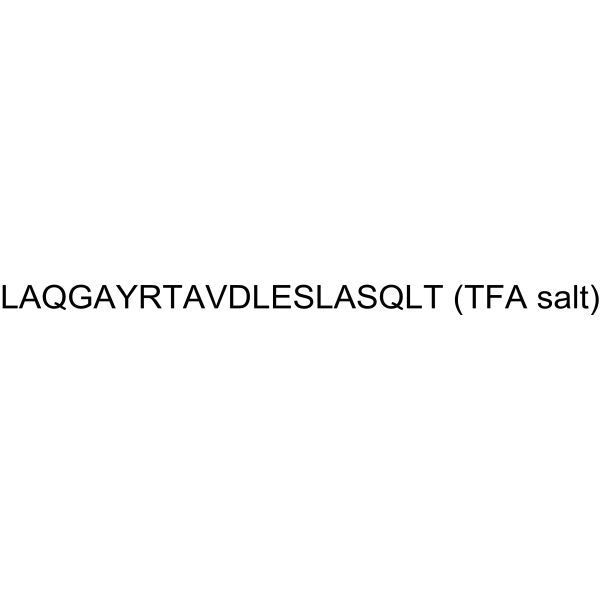
Leu-Ala-Gln-Gly-Ala-Tyr-Arg-Thr-Ala-Val-Asp-Leu-Glu-Ser-Leu-Ala-Ser-Gln-Leu-Thr
-
Sequence Shortening
LAQGAYRTAVDLESLASQLT
-
Shipping
Room temperature in continental US; may vary elsewhere.
-
Storage
Please store the product under the recommended conditions in the Certificate of Analysis.


Solvent & Solubility
In Vitro
H2O
Peptide Solubility and Storage Guidelines:
1. Calculate the length of the peptide.
2. Calculate the overall charge of the entire peptide according to the following table:
| Contents | Assign value | |
|---|---|---|
| Acidic amino acid | Asp (D), Glu (E), and the C-terminal -COOH. | -1 |
| Basic amino acid | Arg (R), Lys (K), His (H), and the N-terminal -NH2 | +1 |
| Neutral amino acid | Gly (G), Ala (A), Leu (L), Ile (I), Val (V), Cys (C), Met (M), Thr (T), Ser (S), Phe (F), Tyr (Y), Trp (W), Pro (P), Asn (N), Gln (Q) | 0 |
3. Recommended solution:
| Overall charge of peptide | Details |
|---|---|
| Negative (<0) |
1. Try to dissolve the peptide in water first. 2. If water fails, add NH4OH (<50 μL). 3. If the peptide still does not dissolve, add DMSO (50-100 μL) to solubilize the peptide. |
| Positive (>0) |
1. Try to dissolve the peptide in water first. 2. If water fails, try dissolving the peptide in a 10%-30% acetic acid solution. 3. If the peptide still does not dissolve, try dissolving the peptide in a small amount of DMSO. |
| Zero (=0) |
1. Try to dissolve the peptide in organic solvent (acetonitrile, methanol, etc.) first. 2. For very hydrophobic peptides, try dissolving the peptide in a small amount of DMSO, and then dilute the solution with water to the desired concentration. |


Purity & Documentation
References
[1]. Mattapallil MJ, et al. Characterization of a New Epitope of IRBP That Induces Moderate to Severe Uveoretinitis in Mice With H-2b Haplotype. Invest Ophthalmol Vis Sci. 2015 Aug;56(9):5439-49. [Content Brief]
[2]. Liu Y, et al. Galectin-3 regulates microglial activation and promotes inflammation through TLR4/MyD88/NF-kB in experimental autoimmune uveitis. Clin Immunol. 2022;236:108939. [Content Brief]

Calculators
Concentration (start) × Volume (start) = Concentration (final) × Volume (final)


IRBP(651-670) human, mouse TFA Related Classifications
HY-P1924A Related Classifications
 Powered by Bioz