



Exaluren
Based on 2 publication(s) in Google Scholar
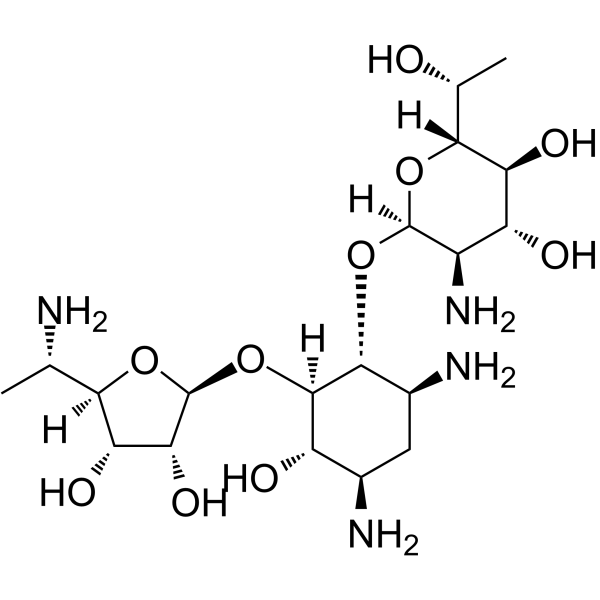
Exaluren (ELX-02; NB-124) is an synthetic eukaryotic ribosome-selective glycoside that induces read-through of nonsense mutations, resulting in normally localized full-length functional proteins. Exaluren is used for the research of cystic fibrosis caused by nonsense mutations.
For research use only. We do not sell to patients.
- Purity : 98.0%
- CAS No.: 1375073-93-0
- Formula: C19H38N4O10
- Molecular Weight:482.53
-
Storage:
-20°C, sealed storage, away from moisture
* In solvent : -80°C, 6 months; -20°C, 1 month (sealed storage, away from moisture)

To place orders, for customer services and technical support, please contact: MedChemExpress USA
Tel: 609-228-6898 E-mail: [email protected] [email protected]


-
 Biological Activity
-
Chemical Information
-
Solvent & Solubility
- Protocols
- Purity & Documentation
- References
-
 Help & FAQs


Publications Citing Use of MedChemExpress (MCE) Exaluren
More Customer Validation & Images

-
Bio/Physico-chemical Assay


Biological Activity
Description
In Vitro
Exaluren induces significant premature stop codon read-through with maintained native stop codon fidelity in DMS-114 cells, increasing p53 protein expression and reducing nonsense-mediated mRNA decay of TP53 mRNA[1].
Exaluren exhibits consistent nonsense mutation read-through activity and efficacy in human bronchial epithelial cells, Fischer rat thyroid cells, and a dual luciferase cystic fibrosis model[1].
Exaluren induces read-through of the CTNS W138X nonsense allele in human cystinosis fibroblasts, increasing cystinosin protein and CTNS mRNA levels while reducing half-cystine levels[1].
MedChemExpress (MCE) has not independently confirmed the accuracy of these methods. They are for reference only. Further protocols information, click here.
In Vivo
Exaluren (10 mg/kg; s.c.; 7 injections over a 3-week period) reduces kidney cell cystine levels by 30% in CTNSY226X nonsense mutant mice without overt renal toxicity[1].
MedChemExpress (MCE) has not independently confirmed the accuracy of these methods. They are for reference only.
-
Animal Model:CF mouse model expressing a human CFTRG542X transgene[1]
-
Dosage:30, 60 mg/kg
-
Administration:s.c.; daily; 14 days
-
Result:Achieved CFTR functional rescue superior to gentamicin and exhibited favorable pharmacodynamic properties.


Chemical Information
-
CAS No. 1375073-93-0
-
Appearance Solid
-
Molecular Weight 482.53
-
Formula C19H38N4O10
-
Color White to off-white
-
SMILES
C[C@@H](O)[C@@]([C@@H](O)[C@H](O)[C@H]1N)([H])O[C@]1([H])O[C@H]([C@H](C[C@@H](N)[C@@H]2O)N)[C@]2([H])O[C@@H]3O[C@@]([C@@H](N)C)([H])[C@@H](O)[C@H]3O
-
Synonyms
ELX-02; NB-124
-
Shipping
Room temperature in continental US; may vary elsewhere.
-
Storage
-20°C, sealed storage, away from moisture
* In solvent : -80°C, 6 months; -20°C, 1 month (sealed storage, away from moisture)


Publications (2)
-
Journal Impact Factor
-
Most Recent
-
Mol Ther
Use of 2,6-diaminopurine as a potent suppressor of UGA premature stop codons in cystic fibrosis. [Abstract]2023 Apr 5;31(4):970-985. PMID: 36641622
Exaluren purchased from MedChemExpress. Usage Cited in: Mol Ther. 2023 Apr 5;31(4):970-985. [Abstract]
Exaluren disulfate (ELX-02; 20, 40, 80, 160 μM; 24, 48 h) caused slight organoid swelling.
-
Genet Med Open
CFTR rescue in W1282X cystic fibrosis patient-derived intestinal organoids (PDIOs) mediated by translational readthrough-inducing drugs (TRIDs). [Abstract]2025 Nov 17:4:103472. PMID: 41492359


Solvent & Solubility
In Vitro:
H2O : 100 mg/mL (207.24 mM; Need ultrasonic)
Please refer to the solubility information to select the appropriate solvent. Once prepared, please aliquot and store the solution to prevent product inactivation from repeated freeze-thaw cycles.
Storage method and period of stock solution: -80°C, 6 months; -20°C, 1 month (sealed storage, away from moisture). When stored at -80°C, please use it within 6 months. When stored at -20°C, please use it within 1 month.
* Note: If you choose water as the stock solution, please dilute it to the working solution, then filter and sterilize it with a 0.22 μm filter before use.
Please refer to the solubility information to select the appropriate solvent. Once prepared, please aliquot and store the solution to prevent product inactivation from repeated freeze-thaw cycles.
Storage method and period of stock solution: -80°C, 6 months; -20°C, 1 month (sealed storage, away from moisture). When stored at -80°C, please use it within 6 months. When stored at -20°C, please use it within 1 month.
* Note: If you choose water as the stock solution, please dilute it to the working solution, then filter and sterilize it with a 0.22 μm filter before use.
Concentration (start) × Volume (start) = Concentration (final) × Volume (final)

Protocols
-
Fibrosis/Collagen Morphometry
Fibrosis and collagen morphometry is based on the quantitative visualization of fibrillar collagen deposition in tissue sections using histochemical stains such as Sirius Red (Picrosirius Red) or Masson's trichrome, followed by image-based or polarization-enhanced analysis to estimate collagen proportional area as a surrogate of extracellular matrix accumulation during fibrotic remodeling. Sirius Red combined with polarized light microscopy enhances detection of collagen fibers due to birefringence properties, enabling more specific visualization of collagen type I and III fibrils compared to conventional bright-field histology, while whole-section or region-restricted digital morphometry reduces field-selection bias in fibrosis assessment. Alternative quantitative approaches include second harmonic generation (SHG) and two-photon excited fluorescence microscopy, which enable label-free detection of fibrillar collagen and have been validated against histological staining and biochemica
-
Collagen: Sirius Red Staining
Sirius Red or picrosirius red staining is a histochemical method for visualizing collagen-rich extracellular matrix in tissue sections, and collagen fibers are detected as red-stained structures under bright-field microscopy with enhanced birefringence under polarized light. Picrosirius red is useful for assessing total collagen organization, distribution, and fibrosis burden, but polarized color should not be interpreted as a definitive collagen type I versus type III readout because color is affected by fiber orientation, thickness, and packing.
-
Connective Tissue: Masson's Trichrome/Collagen Trichrome Staining
Masson’s Trichrome (collagen/trichrome staining) is a histological technique that differentially stains tissue compartments using sequential acidic dyes to distinguish collagen from muscle and cytoplasmic components based on dye affinity and tissue permeability differences, enabling visualization of fibrosis and connective tissue architecture in histological sections. The classical formulation typically uses Weigert's iron hematoxylin for nuclear staining, Biebrich scarlet-acid fuchsin for cytoplasm and muscle, and aniline blue (or light green variants) for collagen, producing a characteristic blue/green collagen signal contrasted against red cytoplasm and dark nuclei. The staining principle relies on selective displacement of smaller dye molecules by larger anionic dyes in collagen-rich regions under controlled acidified conditions, which enhances collagen-specific dye retention. This property makes the method widely used for fibrosis assessment in organs such as heart, liver, lung, a


Purity & Documentation
-
Data Sheet (281 KB)
-
SDS (252 KB)
- English - EN (252 KB)
- Français - FR (252 KB)
- Deutsch - DE (252 KB)
- Norwegian - NO (252 KB)
- Español - ES (252 KB)
- Swedish - SV (252 KB)
- Italian - IT (252 KB)
- Korean - KR (252 KB)
- Portuguese - PT (252 KB)
-
Handling Instructions (2659 KB)
References
[1]. Kerem E, et al. ELX-02: an investigational read-through agent for the treatment of nonsense mutation-related genetic disease. Expert Opin Investig Drugs. 2020;29(12):1347-1354. [Content Brief]
[2]. Leubitz A, et al. Safety, Tolerability, and Pharmacokinetics of Single Ascending Doses of ELX-02, a Potential Treatment for Genetic Disorders Caused by Nonsense Mutations, in Healthy Volunteers. Clin Pharmacol Drug Dev. 2019;8(8):984-994. [Content Brief]


Complete Stock Solution Preparation Table
Please refer to the solubility information to select the appropriate solvent. Once prepared, please aliquot and store the solution to prevent product inactivation from repeated freeze-thaw cycles.
Storage method and period of stock solution: -80°C, 6 months; -20°C, 1 month (sealed storage, away from moisture). When stored at -80°C, please use it within 6 months. When stored at -20°C, please use it within 1 month.
| Optional Solvent | Concentration Solvent Mass | 1 mg | 5 mg | 10 mg | 25 mg |
|---|---|---|---|---|---|
| H2O | 1 mM | 2.0724 mL | 10.3621 mL | 20.7241 mL | 51.8103 mL |
| 5 mM | 0.4145 mL | 2.0724 mL | 4.1448 mL | 10.3621 mL | |
| 10 mM | 0.2072 mL | 1.0362 mL | 2.0724 mL | 5.1810 mL | |
| 15 mM | 0.1382 mL | 0.6908 mL | 1.3816 mL | 3.4540 mL | |
| 20 mM | 0.1036 mL | 0.5181 mL | 1.0362 mL | 2.5905 mL | |
| 25 mM | 0.0829 mL | 0.4145 mL | 0.8290 mL | 2.0724 mL | |
| 30 mM | 0.0691 mL | 0.3454 mL | 0.6908 mL | 1.7270 mL | |
| 40 mM | 0.0518 mL | 0.2591 mL | 0.5181 mL | 1.2953 mL | |
| 50 mM | 0.0414 mL | 0.2072 mL | 0.4145 mL | 1.0362 mL | |
| 60 mM | 0.0345 mL | 0.1727 mL | 0.3454 mL | 0.8635 mL | |
| 80 mM | 0.0259 mL | 0.1295 mL | 0.2591 mL | 0.6476 mL | |
| 100 mM | 0.0207 mL | 0.1036 mL | 0.2072 mL | 0.5181 mL |
* Note: If you choose water as the stock solution, please dilute it to the working solution, then filter and sterilize it with a 0.22 μm filter before use.


Exaluren Related Classifications
HY-114231 Related Classifications
 Powered by Bioz
Keywords