



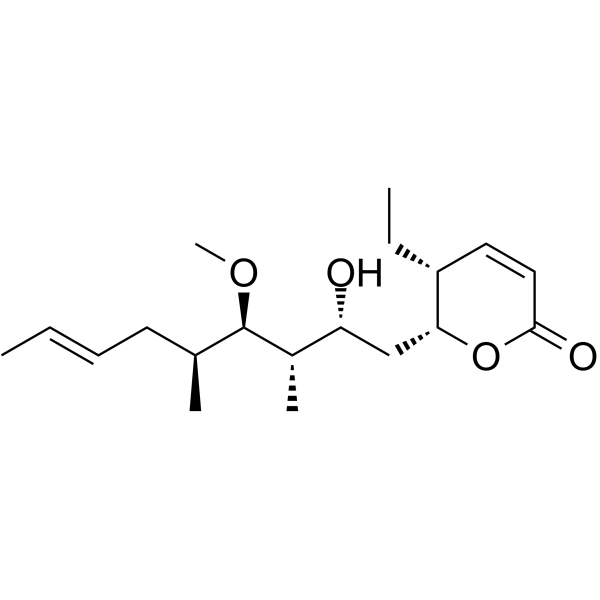
Pironetin
Based on 1 publication(s) in Google Scholar
Pironetin is an α/β unsaturated lactone isolated from Streptomyces species. Pironetin binds to α-tubulin and is a potent inhibitor of microtubule polymerization, and has cell cycle arrest and antitumor activity.
연구목적의 판매만을 진행합니다. 환자를 대상으로 한 판매는 하지 않습니다.
- Purity : 96.79%
- CAS No.: 151519-02-7
- 화학식: C19H32O4
- 분자량:324.45
-
보관:Pure form -20°C, 3 years ; In solvent -80°C, 6 months , -20°C, 1 month

To place orders, for customer services and technical support, please contact: MedChemExpress USA
Tel: 609-228-6898 E-mail: [email protected] [email protected]


-
 Biological Activity
-
Chemical Information
-
용액&용해도
- Protocol
- 순도&문서
- References
-
 Help & FAQs



Publications Citing Use of MedChemExpress (MCE) Pironetin
More

Biological Activity
제품 설명
IC50 & Target
Microtubule[1]
Cellular Effect
|
Cell Line

|
Type | Value | Description | References |
|---|---|---|---|---|
| A2780 | GI50 |
22.2 nM
Compound: 1
|
Inhibition of tubulin alpha in human A2780 cells assessed as cell growth inhibition after 48 hrs by MTT assay
Inhibition of tubulin alpha in human A2780 cells assessed as cell growth inhibition after 48 hrs by MTT assay
|
[PMID: 30693770] |
| A2780 | IC50 |
0.0029 μM
Compound: Pironetin
|
Cytotoxicity against compound-sensitive human A2780 cells after 24 hrs by MTT assay
Cytotoxicity against compound-sensitive human A2780 cells after 24 hrs by MTT assay
|
[PMID: 21396747] |
| A2780 | IC50 |
0.008 μM
Compound: pironetin
|
Cytotoxicity against human A2780 cells after 24 hrs by MTT assay
Cytotoxicity against human A2780 cells after 24 hrs by MTT assay
|
[PMID: 25426924] |
| A2780 | IC50 |
26 nM
Compound: 1
|
Inhibition of tubulin alpha in human A2780 cells assessed as reduction in cell growth
Inhibition of tubulin alpha in human A2780 cells assessed as reduction in cell growth
|
[PMID: 30693770] |
| A2780 ADR | IC50 |
0.003 μM
Compound: Pironetin
|
Cytotoxicity against compound-resistant human A2780AD cells after 24 hrs by MTT assay
Cytotoxicity against compound-resistant human A2780AD cells after 24 hrs by MTT assay
|
[PMID: 21396747] |
| A2780 ADR | IC50 |
0.025 μM
Compound: pironetin
|
Cytotoxicity against human A2780AD cells after 24 hrs by MTT assay
Cytotoxicity against human A2780AD cells after 24 hrs by MTT assay
|
[PMID: 25426924] |
| A549 | GI50 |
7.5 nM
Compound: 1; (-)-PA-48153C
|
Cytotoxicity against human A549 cells assessed as reduction in growth after 4 days by HCS assay
Cytotoxicity against human A549 cells assessed as reduction in growth after 4 days by HCS assay
|
[PMID: 31130264] |
| DC3F | GI50 |
9.5 nM
Compound: 1; (-)-PA-48153C
|
Cytotoxicity against hamster DC-3F cells assessed as reduction in growth after 4 days by HCS assay
Cytotoxicity against hamster DC-3F cells assessed as reduction in growth after 4 days by HCS assay
|
[PMID: 31130264] |
| EL4 | GI50 |
15 nM
Compound: 1; (-)-PA-48153C
|
Cytotoxicity against C57BL/6 mouse EL4 cells assessed as reduction in growth after 3 days
Cytotoxicity against C57BL/6 mouse EL4 cells assessed as reduction in growth after 3 days
|
[PMID: 31130264] |
| HCT-15 | IC50 |
<0.015 μM
Compound: Pironetin
|
Cytotoxicity against human HCT15 cells after 48 hrs by sulforhodamine B assay
Cytotoxicity against human HCT15 cells after 48 hrs by sulforhodamine B assay
|
[PMID: 30601004] |
| HEK293 | IC50 |
0.017 μM
Compound: Pironetin
|
Cytotoxicity against HEK293 cells assessed as inhibition of cell growth after 72 hrs by MTT assay
Cytotoxicity against HEK293 cells assessed as inhibition of cell growth after 72 hrs by MTT assay
|
[PMID: 25240870] |
| HEK293 | IC50 |
0.017 μM
Compound: pironetin
|
Cytotoxicity against human HEK293 cells after 3 days by MTT assay
Cytotoxicity against human HEK293 cells after 3 days by MTT assay
|
[PMID: 25426924] |
| HeLa | GI50 |
30 nM
Compound: 1; (-)-PA-48153C
|
Cytotoxicity against human HeLa cells assessed as reduction in growth
Cytotoxicity against human HeLa cells assessed as reduction in growth
|
[PMID: 31130264] |
| HeLa | IC50 |
0.092 μM
Compound: Pironetin
|
Cytotoxicity against human HeLa cells after 48 hrs by sulforhodamine B assay
Cytotoxicity against human HeLa cells after 48 hrs by sulforhodamine B assay
|
[PMID: 30601004] |
| HL-60 | GI50 |
20 nM
Compound: 1; (-)-PA-48153C
|
Cytotoxicity against human HL60 cells assessed as reduction in growth after 24 hrs by MTT assay
Cytotoxicity against human HL60 cells assessed as reduction in growth after 24 hrs by MTT assay
|
[PMID: 31130264] |
| HT-29 | IC50 |
0.0064 μM
Compound: Pironetin
|
Cytotoxicity against human HT-29 cells assessed as inhibition of cell growth after 72 hrs by MTT assay
Cytotoxicity against human HT-29 cells assessed as inhibition of cell growth after 72 hrs by MTT assay
|
[PMID: 25240870] |
| HT-29 | IC50 |
0.0064 μM
Compound: pironetin
|
Cytotoxicity against human HT-29 cells after 3 days by MTT assay
Cytotoxicity against human HT-29 cells after 3 days by MTT assay
|
[PMID: 25426924] |
| K562 | GI50 |
17.3 nM
Compound: 1; (-)-PA-48153C
|
Cytotoxicity against human K562 cells assessed as reduction in growth after 4 days by MTT assay
Cytotoxicity against human K562 cells assessed as reduction in growth after 4 days by MTT assay
|
[PMID: 31130264] |
| K562/Adr | GI50 |
16 nM
Compound: 1; (-)-PA-48153C
|
Cytotoxicity against human K562/ADR cells assessed as reduction in growth after 4 days by MTT assay
Cytotoxicity against human K562/ADR cells assessed as reduction in growth after 4 days by MTT assay
|
[PMID: 31130264] |
| MCF7 | GI50 |
5 nM
Compound: 1; (-)-PA-48153C
|
Cytotoxicity against human MCF7 cells assessed as reduction in growth after 3 days by MTT assay
Cytotoxicity against human MCF7 cells assessed as reduction in growth after 3 days by MTT assay
|
[PMID: 31130264] |
| MCF7 | IC50 |
0.006 μM
Compound: Pironetin
|
Cytotoxicity against human MCF7 cells assessed as inhibition of cell growth after 72 hrs by MTT assay
Cytotoxicity against human MCF7 cells assessed as inhibition of cell growth after 72 hrs by MTT assay
|
[PMID: 25240870] |
| MCF7 | IC50 |
0.006 μM
Compound: pironetin
|
Cytotoxicity against human MCF7 cells after 3 days by MTT assay
Cytotoxicity against human MCF7 cells after 3 days by MTT assay
|
[PMID: 25426924] |
| MCF7 | IC50 |
0.015 μM
Compound: Pironetin
|
Cytotoxicity against human MCF7 cells after 48 hrs by sulforhodamine B assay
Cytotoxicity against human MCF7 cells after 48 hrs by sulforhodamine B assay
|
[PMID: 30601004] |
| MDA-MB-231 | GI50 |
4.6 nM
Compound: 1; (-)-PA-48153C
|
Cytotoxicity against human MDA-MB-231 cells assessed as reduction in growth after 4 days by HCS assay
Cytotoxicity against human MDA-MB-231 cells assessed as reduction in growth after 4 days by HCS assay
|
[PMID: 31130264] |
| NCI-H69 | GI50 |
17.5 nM
Compound: 1; (-)-PA-48153C
|
Cytotoxicity against human H69 cells assessed as reduction in growth after 7 days by MTT assay
Cytotoxicity against human H69 cells assessed as reduction in growth after 7 days by MTT assay
|
[PMID: 31130264] |
| P388 | GI50 |
100 nM
Compound: 1; (-)-PA-48153C
|
Cytotoxicity against mouse P388 cells assessed as reduction in growth after 24 hrs by MTT assay
Cytotoxicity against mouse P388 cells assessed as reduction in growth after 24 hrs by MTT assay
|
[PMID: 31130264] |
| T98G | GI50 |
7.5 nM
Compound: 1; (-)-PA-48153C
|
Cytotoxicity against human T98G cells assessed as reduction in growth after 4 days by MTS assay
Cytotoxicity against human T98G cells assessed as reduction in growth after 4 days by MTS assay
|
[PMID: 31130264] |
In Vitro
Pironetin (20-100 ng/mL; 24 hours; 3Y1 cells) treatment arrests the cell cycle progression at G2/M in 3Y1 cells[1].
Pironetin (1-10000 ng/mL; 3 days; HeLa, A2780 and K-NRK cells) treatment inhibits the cell proliferation. IC50 values against these cell lines are almost 10 ng/mL[1].
MedChemExpress (MCE) has not independently confirmed the accuracy of these methods. They are for reference only. Further protocols information, click here.
-
Cell Line:3Y1 cells
-
Concentration:20 ng/mL, 50 ng/mL, 100 ng/mL
-
Incubation Time:24 hours
-
Result:Arrested the cell cycle progression at G2/M in3Y1 cells.
-
Cell Line:HeLa, A2780 and K-NRK cells
-
Concentration:1 ng/mL, 10 ng/mL, 100 ng/mL, 1000 ng/mL and 10000 ng/mL
-
Incubation Time:3 days
-
Result:Inhibited the cell proliferation.
In Vivo
MedChemExpress (MCE) has not independently confirmed the accuracy of these methods. They are for reference only.
-
Animal Model:Female CDF1-SLC mice (10 weeks) injected with P388 murine leukemia cells[1]
-
Dosage:0.78 mg/kg, 1.56 mg/kg, 3.13 mg/kg, 6.25 mg/kg
-
Administration:Intraperitoneal injection; daily; for 5 days
-
Result:Showed a moderate antitumor effect.


Chemical Information
-
CAS No. 151519-02-7
-
Appearance Oil
-
분자량 324.45
-
화학식 C19H32O4
-
Color Colorless to off-white
-
SMILES
O=C1C=C[C@H]([C@H](O1)C[C@H]([C@@H]([C@@H]([C@H](C/C=C/C)C)OC)C)O)CC
-
선적
Room temperature in continental US; may vary elsewhere.
-
보관
Pure form -20°C 3 years In solvent -80°C 6 months -20°C 1 month


Publications (1)
-
Journal Impact Factor
-
Most Recent


용액&용해도
In Vitro:
DMSO : < 1 mg/mL (insoluble or slightly soluble)

Protocol
-
Flow cytometric DNA-content cell-cycle staining
Flow cytometric DNA-content cell-cycle staining measures the fluorescence intensity of DNA-bound fluorochromes in single cells or nuclei to estimate DNA content distributions, allowing assignment of populations to G0/G1, S, and G2/M phases by DNA histogram deconvolution. Propidium iodide (PI) intercalates into DNA, and PI fluorescence is proportional to cellular DNA content when staining is performed under conditions that make DNA accessible and minimize non-DNA signal. Cells with G2/M DNA content are expected to show approximately twice the fluorescence intensity of G0/G1 cells, while S-phase cells occupy intermediate fluorescence values. PI-based DNA-content analysis can also detect cells with fractional DNA content, often reported as sub-G1, when DNA fragmentation and extraction during staining reduce retained DNA signal in apoptotic cells. DAPI is an alternative DNA fluorochrome for univariate DNA-content analysis, while bivariate approaches combining DNA content with proliferation
-
BrdU Incorporation Assay
Bromodeoxyuridine (BrdU) incorporation assay is based on the principle that BrdU, a thymidine analog, is incorporated into newly synthesized DNA during the S phase of the cell cycle, thereby serving as a marker of DNA replication and cellular proliferation. Incorporated BrdU can be detected using anti-BrdU antibodies following DNA denaturation, enabling visualization or quantification of proliferating cells through immunochemical detection methods such as immunofluorescence or immunohistochemistry.
-
Protocol for Cell Cycle
Cell-cycle analysis by flow cytometry measures DNA content in single cells to estimate the fraction of cells in G0/G1, S, and G2/M phases. Propidium iodide intercalates into DNA, and after RNA removal with RNase, fluorescence intensity reflects cellular DNA content: 2N cells are assigned to G0/G1, cells between 2N and 4N to S phase, and 4N cells to G2/M. DNA-content analysis alone cannot reliably separate G0 from G1 or G2 from M. Ki-67 can distinguish quiescent G0 cells from cycling cells, EdU or BrdU incorporation marks active DNA synthesis in S phase, and phospho-histone H3 staining identifies mitotic cells within the 4N population.
-
Subcutaneous Cell-Line-Derived Xenograft
Subcutaneous cell-line-derived xenograft (CDX) models are established by implanting cultured human cancer cell lines into immunodeficient mice, where the injected cells form localized tumors that can be monitored in vivo as a measure of tumorigenic potential, growth kinetics, and treatment response. These models are widely used in oncology research because they allow reproducible tumor formation and enable comparative assessment of tumor growth between different cell lines or genetic manipulations in a controlled in vivo microenvironment. Subcutaneous implantation of cancer cells in immunodeficient mice is a standard approach for evaluating tumor growth behavior and therapeutic response across multiple cancer types, including prostate, esophageal, pancreatic, and colon cancer models.


순도&문서
-
Data Sheet (270 KB)
-
SDS (252 KB)
- English - EN (252 KB)
- Français - FR (252 KB)
- Deutsch - DE (252 KB)
- Norwegian - NO (252 KB)
- Español - ES (252 KB)
- Swedish - SV (252 KB)
- Italian - IT (252 KB)
- Korean - KR (252 KB)
- Portuguese - PT (252 KB)
-
Handling Instructions (2659 KB)
References
[1]. Kondoh M, et al. Cell cycle arrest and antitumor activity of pironetin and its derivatives. Cancer Lett. 1998 Apr 10;126(1):29-32. [Content Brief]
[2]. Yang J, et al. Pironetin reacts covalently with cysteine-316 of α-tubulin to destabilize microtubule. ] Nat Commun. 2016 Jun 30;7:12103. [Content Brief]

Calculators
Concentration (start) × Volume (start) = Concentration (final) × Volume (final)


Pironetin Related Classifications
HY-116446 Related Classifications
 Powered by Bioz