



L-Cystine monohydrochloride
Based on 5 publication(s) in Google Scholar
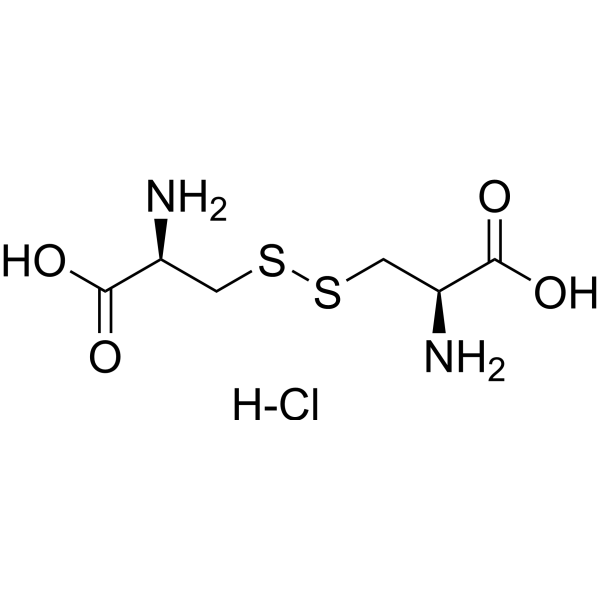
L-Cystine monohydrochloride is an amino acid. L-Cystine is converted to L-Cysteine in the body. Moreover, L-Cystine/L-Cysteine conversion system is a channel on the cell membrane, which can maintain the internal REDOX homeostasis of E. coli.
Para uso exclusivo en investigación. No vendemos a pacientes.
- No. CAS: 438633-05-7
- Fòrmula: C6H13ClN2O4S2
- Peso molecular:276.76
-
Almacenamiento:
Please store the product under the recommended conditions in the Certificate of Analysis.

To place orders, for customer services and technical support, please contact: MedChemExpress USA
Tel: 609-228-6898 E-mail: [email protected] [email protected]


-
 Actividad biológica
-
Chemical Information
- Pureza y Documentación
- Referencias
-
 Help & FAQs


Publications Citing Use of MedChemExpress (MCE) L-Cystine monohydrochloride
More Customer Validation & Images

-
ELISA
-
Histological Imaging/Staining
-
Cell Imaging/Staining
-
WB


Actividad biológica
Descripciòn


Chemical Information
-
No. CAS 438633-05-7
-
Peso molecular 276.76
-
Fòrmula C6H13ClN2O4S2
-
SMILES
O=C([C@H](CSSC[C@@H](C(O)=O)N)N)O.Cl
-
Envío
Room temperature in continental US; may vary elsewhere.
-
Almacenamiento
Please store the product under the recommended conditions in the Certificate of Analysis.


Publications (5)
-
Journal Impact Factor
-
Most Recent
-
Nature
2025 Jul;643(8070):192-200. PMID: 39695227 -
J Nanobiotechnology
Dual metabolic intervention nanoplatform co-delivering BAY-876 and L-cystine for Wilms tumor therapy via disulfidptosis-associated cytoskeletal collapse. [Abstract]2026 Jun 10. PMID: 42271349 -
Mater Today Bio
CD24-targeted cystine and glucose oxidase cascade catalytic nanosystem triggers disulfidptosis in neuroblastoma. [Abstract]2025 Nov 1:35:102496. PMID: 41281650 -
Mol Psychiatry
Correction of eIF4E overactivation rescues translatome imbalance and core ASD-like behaviors in valproic acid-induced offspring mice. [Abstract]2026 Mar 7. PMID: 41795048 -
Biochim Biophys Acta Mol Basis Dis
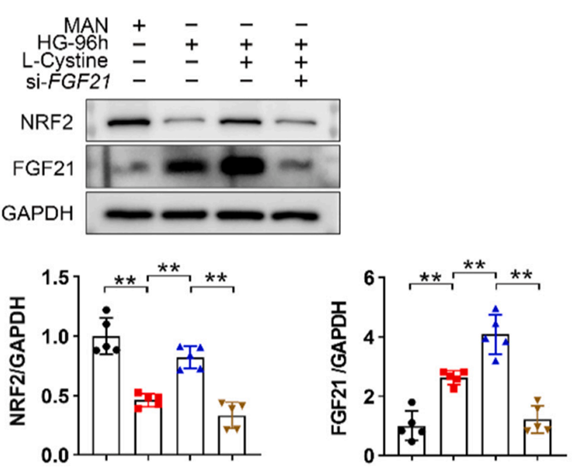
Mitigation of gestational diabetes-induced endothelial dysfunction through FGF21-NRF2 pathway activation involving L-Cystine. [Abstract]2024 Oct;1870(7):167329. PMID: 38960053
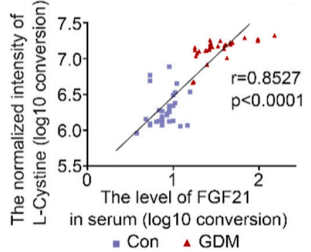
L-Cystine monohydrochloride purchased from MedChemExpress. Usage Cited in: Biochim Biophys Acta Mol Basis Dis. 2024 Oct;1870(7):167329. [Abstract]
HUVECs in the presence of 5.5 or 35 mM d-Glucose with or without Si-Scr, Si-FGF21, with or without L-Cystine (0.8 mM) for 96 h. The correlation between L-Cystine and FGF21 expression levels. The X-axis represents the concentration of FGF21 measured via ELISA assay (Log10 conversion). The Y-axis represents the intensity of L-Cystine mass spectrometry signal (Log10 conversion).
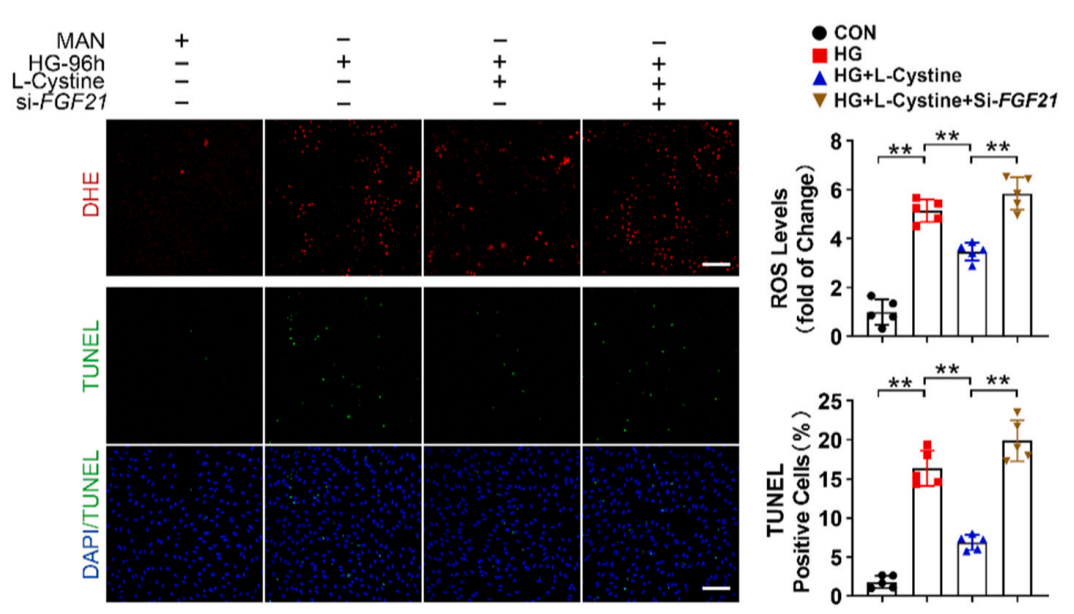
L-Cystine monohydrochloride purchased from MedChemExpress. Usage Cited in: Biochim Biophys Acta Mol Basis Dis. 2024 Oct;1870(7):167329. [Abstract]
HUVECs in the presence of 5.5 or 35 mM d-Glucose with or without Si-Scr, Si-FGF21, with or without L-Cystine (0.8 mM) for 96 h. DHE staining and TUNEL staining of HUVECs. Scale bar: 100 μm. The right bar chart explored the quantitative analysis the ROS level and the number of TUNEL positive HUVECs.
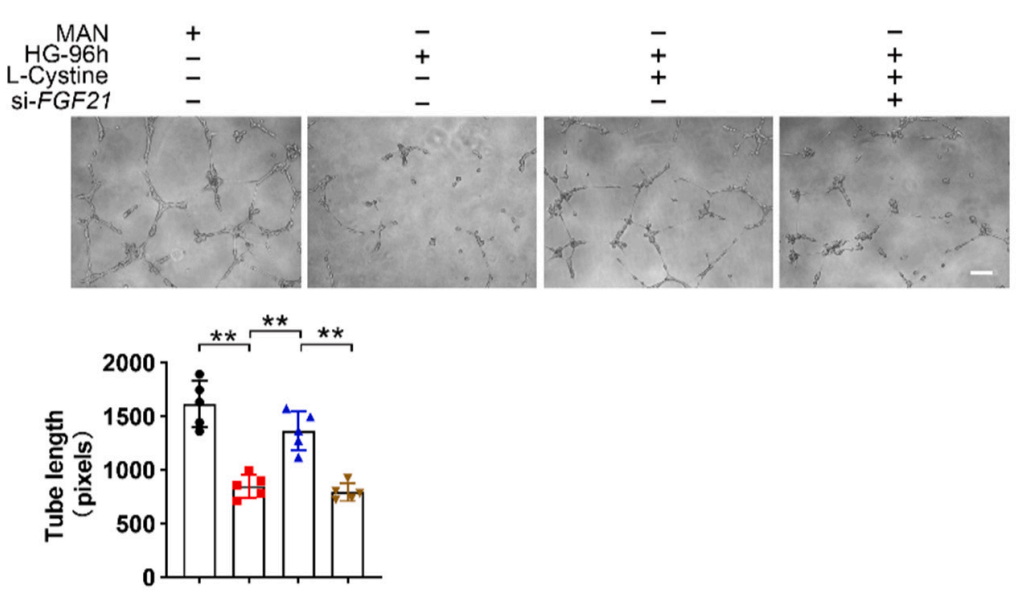
L-Cystine monohydrochloride purchased from MedChemExpress. Usage Cited in: Biochim Biophys Acta Mol Basis Dis. 2024 Oct;1870(7):167329. [Abstract]
HUVECs in the presence of 5.5 or 35 mM d-Glucose with or without Si-Scr, Si-FGF21, with or without L-Cystine (0.8 mM) for 96 h. A tube formation assay was performed to assess the angiogenesis ability of HUVECs after being treated as mentioned above. Scale bar: 100 μm. The tube length was quantified and is shown in right.
L-Cystine monohydrochloride purchased from MedChemExpress. Usage Cited in: Biochim Biophys Acta Mol Basis Dis. 2024 Oct;1870(7):167329. [Abstract]
HUVECs in the presence of 5.5 or 35 mM d-Glucose with or without Si-Scr, Si-FGF21, with or without L-Cystine (0.8 mM) for 96 h. A tube formation assay was performed to assess the angiogenesis ability of HUVECs after being treated as mentioned above. Scale bar: 100 μm. The tube length was quantified and is shown in right.


Pureza y Documentación
Referencias

Calculators
Concentration (start) × Volume (start) = Concentration (final) × Volume (final)


L-Cystine monohydrochloride Related Classifications
HY-W009356A Related Classifications
 Powered by Bioz