



Animal-Free TGF alpha/TGFA Protein, Human (His)
Based on 1 Customer Validation
TGF α/TGFA protein is a mitogenic polypeptide that binds to EGFR and acts synergistically with TGF β to promote anchorage-dependent cell proliferation. Its interaction with MAGI3, SDCBP, and the SNTA1 PDZ domain, especially with SDCBP, is critical for efficient cell surface targeting. Animal-Free TGF alpha/TGFA Protein, Human (His) is the recombinant human-derived animal-FreeTGF alpha/TGFA protein, expressed by E. coli , with C-His labeled tag. This product is for cell culture use only.
- Species: Human
- Source: E. coli
-
Storage:Stored at -20°C for 2 years from date of receipt. After reconstitution, it is stable at 4°C for 1 week or -20°C for longer (with carrier protein). It is recommended to freeze aliquots at -20°C or -80°C for extended storage.



To place orders, for customer services and technical support, please contact: MedChemExpress USA
Tel: 609-228-6898 E-mail: [email protected] [email protected]


-
 Biological Activity
-
Technical Parameters
-
Product Properties
- Documentation
- Help & FAQs




Biological Activity
Description
TGF α/TGFA protein is a mitogenic polypeptide that binds to EGFR and acts synergistically with TGF β to promote anchorage-dependent cell proliferation. Its interaction with MAGI3, SDCBP, and the SNTA1 PDZ domain, especially with SDCBP, is critical for efficient cell surface targeting. Animal-Free TGF alpha/TGFA Protein, Human (His) is the recombinant human-derived animal-FreeTGF alpha/TGFA protein, expressed by E. coli , with C-His labeled tag. This product is for cell culture use only.
Background
The TGF alpha/TGFA protein, a mitogenic polypeptide, demonstrates the capacity to bind to the EGF receptor/EGFR and synergistically acts with TGF beta, facilitating anchorage-independent cell proliferation in soft agar. This protein interacts with the PDZ domains of MAGI3, SDCBP, and SNTA1, with the association with SDCBP being crucial for effective targeting to the cell surface. In its immature form within the endoplasmic reticulum, characterized by a prosegment and lacking full N-glycosylation, TGF alpha/TGFA interacts with CNIH. Furthermore, in the Golgi apparatus, it may form a complex with CNIH and GORASP2. Additionally, through its cytoplasmic C-terminal domain, TGF alpha/TGFA interacts with NKD2, thereby exhibiting a spectrum of potential functional roles in diverse cellular compartments and interactions.
Verified Bioactivity
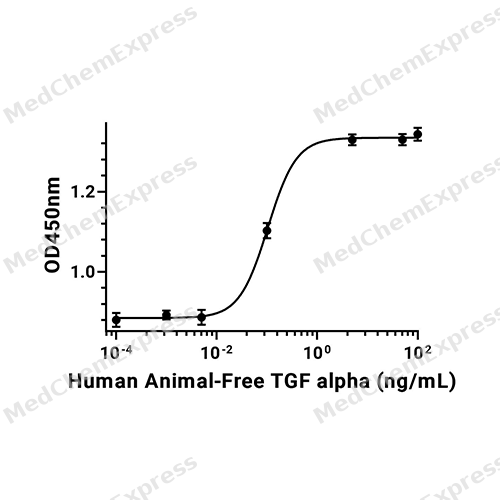
1.Measure by its ability to induce NIH/3T3 cells proliferation. The ED50 for this effect is <0.2 ng/mL. The specific activity of recombinant human TGF alpha is > 5 x 10⁶ IU/mg.
2.Measured in a cell proliferation assay using Balb/3T3 mouse embryonic fibroblast cells. The ED50 for this effect is 0.1 ng/mL, corresponding to a specific activity is 1.0×10⁷ units/mg.
MCE Validation Data
-
Purity - SDS-PAGE
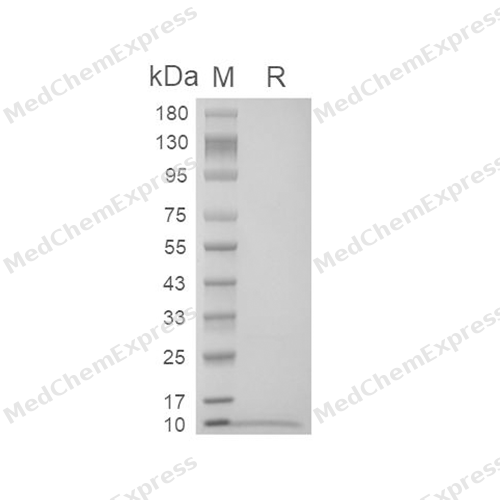
Purity - SDS-PAGE
-
Bioactivity - Cell-Based Assay
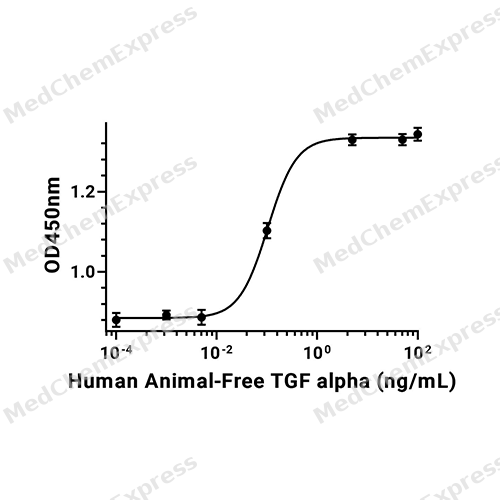
Bioactivity - Cell-Based Assay


Technical Parameters
-
Species Human
-
Source E. coli
-
Tag C-6*His
-
Accession
P01135 (V40-A89)
-
Molecular Construction
-
N-term
-
TGF-α (V40-A89)
Accession # P01135 -
6*His
-
C-term
-
-
Protein Length
Full Length of TGFA Chain
-
Synonyms
TGFA; Transforming Growth Factor, Alpha; Transforming Growth Factor Alpha; TGF-Alpha; Protransforming Growth Factor Alpha; TFGA; Transforming Growth Factor, Alpha, Isoform CRA_d
-
AA Sequence
VVSHFNDCPDSHTQFCFHGTCRFLVQEDKPACVCHSGYVGARCEHADLLA
-
Predicted Molecular Mass
6.5 kDa
-
Molecular Weight
Approximately 7 kDa, based on SDS-PAGE under reducing conditions.
-
Purity
≥ 95%, as determined by reducing SDS-PAGE.


Product Properties
Lyophilized powder
1.Lyophilized from a 0.22 μm filtered solution of PBS, pH 8.0, trehalose.
2.Lyophilized from a 0.22 μm filtered solution of 20 mM sodium citrate, 0.2 M NaCl, pH 4.5.
Please refer to the lot-specific COA for specific buffer information.
<0.1 EU/μg, determined by LAL method.
It is recommended to reconstitute to a concentration of 100-200 μg/mL in ddH2O. For long term storage it is recommended to add a carrier protein (0.1% BSA, 5% HSA, 10% FBS or 5% Trehalose).
Stored at -20°C for 2 years from date of receipt. After reconstitution, it is stable at 4°C for 1 week or -20°C for longer (with carrier protein). It is recommended to freeze aliquots at -20°C or -80°C for extended storage.
Room temperature in continental US; may vary elsewhere.


Documentation
-
Data Sheet (235 KB)
-
SDS (252 KB)
- English - EN (252 KB)
- Français - FR (252 KB)
- Deutsch - DE (252 KB)
- Norwegian - NO (252 KB)
- Español - ES (252 KB)
- Swedish - SV (252 KB)
- Italian - IT (252 KB)
- Korean - KR (252 KB)
- Portuguese - PT (252 KB)
-
Handling Instructions (2659 KB)

Calculators
Concentration (start) × Volume (start) = Concentration (final) × Volume (final)


 Powered by Bioz

