



Antithrombin III/Serpin C1 Protein, Human (HEK293, His)
Based on 1 publication(s) in Google Scholar
Antithrombin III/Serpin C1 protein, the main plasma serine protease inhibitor, regulates the blood coagulation cascade. It inhibits thrombin, matriptase-3/TMPRSS7, and factors IXa, Xa, and XIa, with enhanced potency in the presence of heparin. Furthermore, it forms a protease-inhibiting heterodimer with TMPRSS7. Antithrombin III/Serpin C1 Protein, Human (HEK293, His) is the recombinant human-derived Antithrombin III/Serpin C1 protein, expressed by HEK293 , with C-His labeled tag.
- Species: Human
- Source: HEK293
-
Storage:Stored at -20°C for 2 years from date of receipt. After reconstitution, it is stable at 4°C for 1 week or -20°C for longer (with carrier protein). It is recommended to freeze aliquots at -20°C or -80°C for extended storage.


To place orders, for customer services and technical support, please contact: MedChemExpress USA
Tel: 609-228-6898 E-mail: [email protected] [email protected]


-
 Biological Activity
-
Technical Parameters
-
Product Properties
- Documentation
- Help & FAQs




Biological Activity
Description
Antithrombin III/Serpin C1 protein, the main plasma serine protease inhibitor, regulates the blood coagulation cascade. It inhibits thrombin, matriptase-3/TMPRSS7, and factors IXa, Xa, and XIa, with enhanced potency in the presence of heparin. Furthermore, it forms a protease-inhibiting heterodimer with TMPRSS7. Antithrombin III/Serpin C1 Protein, Human (HEK293, His) is the recombinant human-derived Antithrombin III/Serpin C1 protein, expressed by HEK293 , with C-His labeled tag.
Background
Antithrombin III/Serpin C1 protein, the principal serine protease inhibitor in plasma, plays a crucial role in regulating the blood coagulation cascade. It effectively inhibits thrombin, matriptase-3/TMPRSS7, and factors IXa, Xa, and XIa, with its inhibitory activity significantly potentiated in the presence of heparin. Additionally, Antithrombin III/Serpin C1 forms a protease-inhibiting heterodimer with TMPRSS7.
Verified Bioactivity
Measured by its ability to inhibit thrombin cleavage of a fluorogenic peptide substrate Boc-VPR-AMC and the IC50 value is < 5 nM.
MCE Validation Data
-
Purity - SDS-PAGE
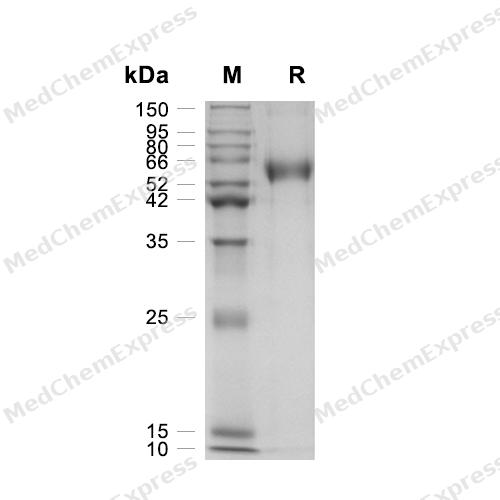
Purity - SDS-PAGE

Assay Procedure
Materials
Assay buffer: 50 mM Tris, 10 mM CaCl?, 150 mM NaCl, 0.05% (w/v) Brij-35, pH 7.5 (TCNB)
Thrombin (MW 37kDa)(HY-114164)
Antithrombin III/Serpin C1 Protein, Human (HEK293, His)(HY-P72831)
Heparin (HY-17567A), diluted to 20 mg/mL with deionized water
Substrate: BOC-Val-Pro-Arg-AMC, 10 mM dissolved in DMSO
Procedure
1. Dilute Thrombin to 0.5 μg/mL with assay buffer (final heparin concentration of 48.6 μg/mL) .
2. Prepare different concentrations of rhSerpin C1 with assay buffer, and perform the following serial dilutions: 50, 10, 5, 2.5, 1.25, 0.625, 0.3125, 0.156, 0.078, 0.039 nM.
3. Mix equal volumes of Human Serpin C1 with Thrombin/Heparin (from step 1) ; for the control group, add equal volumes of assay buffer and Thrombin/Heparin.
4. Incubate the mixtures at room temperature for 30 minutes.
5. After incubation, dilute the mixtures 1/5 with assay buffer.
6. Dilute the substrate to 200 μM with assay buffer.
7. In a 96-well plate, add 50 μL of the diluted reaction mixture and 50 μL of 200 μM substrate to initiate the reaction.
8. Read in kinetic mode for 5 minutes with excitation and emission wavelengths at 380 nm and 460 nm (top read) .
9. Determine the IC50 of Human Serpin C1 by fitting the RFU/min versus concentration curve with a 4-parameter logistic (4-PL) model.


Publications (1)
-
Journal Impact Factor
-
Most Recent
-
Adv Sci (Weinh)
Evolution of Multivalent Aptamer Corona for High-Throughput Multiplexed Detection of Multiple Cancers. [Abstract]2025 Nov 25:e14976. PMID: 41290548


Technical Parameters
-
Species Human
-
Source HEK293
-
Tag C-His
-
Accession
P01008 (S35-K464)
-
Molecular Construction
-
N-term
-
AT-III (S35-K464)
Accession # P01008 -
His
-
C-term
-
-
Protein Length
Full Length of Mature Protein
-
Synonyms
SERPINC1; Signal Peptide Antithrombin Part 1; Prev. AT3; Antithrombin III; ATIII; SERPINC1 Protein; Antithrombin-III; Antithrombin; Serine (Or Cysteine) Proteinase Inhibitor, Clade C (Antithrombin), Member 1; ATIII-R2; Serpin Peptidase Inhibitor, Clade C
-
AA Sequence
SPVDICTAKPRDIPMNPMCIYRSPEKKATEDEGSEQKIPEATNRRVWELSKANSRFATTFYQHLADSKNDNDNIFLSPLSISTAFAMTKLGACNDTLQQLMEVFKFDTISEKTSDQIHFFFAKLNCRLYRKANKSSKLVSANRLFGDKSLTFNETYQDISELVYGAKLQPLDFKENAEQSRAAINKWVSNKTEGRITDVIPSEAINELTVLVLVNTIYFKGLWKSKFSPENTRKELFYKADGESCSASMMYQEGKFRYRRVAEGTQVLELPFKGDDITMVLILPKPEKSLAKVEKELTPEVLQEWLDELEEMMLVVHMPRFRIEDGFSLKEQLQDMGLVDLFSPEKSKLPGIVAEGRDDLYVSDAFHKAFLEVNEEGSEAAASTAVVIAGRSLNPNRVTFKANRPFLVFIREVPLNTIIFMGRVANPCVK
-
Molecular Weight
Approximately 55-60 kDa, based on SDS-PAGE under reducing conditions, due to the glycosylation.
-
Glycosylation
Yes
-
Purity
≥ 90%, as determined by reducing SDS-PAGE.


Product Properties
Lyophilized powder.
Lyophilized from a 0.2 μm filtered solution of PBS or 20 mM PB, 150 mM NaCl, pH 7.4.
<1 EU/μg, determined by LAL method.
It is not recommended to reconstitute to a concentration less than 100 μg/mL in ddH2O. For long term storage it is recommended to add a carrier protein (0.1% BSA, 5% HSA, 10% FBS or 5% Trehalose).
Stored at -20°C for 2 years from date of receipt. After reconstitution, it is stable at 4°C for 1 week or -20°C for longer (with carrier protein). It is recommended to freeze aliquots at -20°C or -80°C for extended storage.
Room temperature in continental US; may vary elsewhere.


Documentation
-
Data Sheet (238 KB)
-
SDS (252 KB)
- English - EN (252 KB)
- Français - FR (252 KB)
- Deutsch - DE (252 KB)
- Norwegian - NO (252 KB)
- Español - ES (252 KB)
- Swedish - SV (252 KB)
- Italian - IT (252 KB)
- Korean - KR (252 KB)
- Portuguese - PT (252 KB)
-
Handling Instructions (2659 KB)

Calculators
Concentration (start) × Volume (start) = Concentration (final) × Volume (final)


 Powered by Bioz

