



Coagulation Factor XIV/PROC Protein, Human (HEK293, His)

Based on 1 Customer Validation
Coagulation Factor XIV/PROC is a vital vitamin K-dependent serine protease regulating blood coagulation. Active Protein C inactivates factors Va and VIIIa in the presence of calcium ions and phospholipids, maintaining the intricate balance of coagulation pathways. Its protective effect on endothelial cell barrier function underscores a broader impact on vascular integrity. Coagulation Factor XIV/PROC Protein, Human (HEK293, His) is the recombinant human-derived Coagulation Factor XIV/PROC protein, expressed by HEK293 , with C-His labeled tag. The total length of Coagulation Factor XIV/PROC Protein, Human (HEK293, His) is 443 a.a., with molecular weight of 56-64 & 45 kDa, respectively.
- Species: Human
- Source: HEK293
-
Storage:Stored at -20°C for 2 years from date of receipt. After reconstitution, it is stable at 4°C for 1 week or -20°C for longer (with carrier protein). It is recommended to freeze aliquots at -20°C or -80°C for extended storage.


To place orders, for customer services and technical support, please contact: MedChemExpress USA
Tel: 609-228-6898 E-mail: [email protected] [email protected]


-
 Biological Activity
-
Technical Parameters
-
Product Properties
- Documentation
- Help & FAQs




Biological Activity
Description
Coagulation Factor XIV/PROC is a vital vitamin K-dependent serine protease regulating blood coagulation. Active Protein C inactivates factors Va and VIIIa in the presence of calcium ions and phospholipids, maintaining the intricate balance of coagulation pathways. Its protective effect on endothelial cell barrier function underscores a broader impact on vascular integrity. Coagulation Factor XIV/PROC Protein, Human (HEK293, His) is the recombinant human-derived Coagulation Factor XIV/PROC protein, expressed by HEK293 , with C-His labeled tag. The total length of Coagulation Factor XIV/PROC Protein, Human (HEK293, His) is 443 a.a., with molecular weight of 56-64 & 45 kDa, respectively.
Background
Coagulation Factor XIV (PROC) is a vitamin K-dependent serine protease crucial for the regulation of blood coagulation. In its active form, Protein C plays a vital role in inactivating factors Va and VIIIa in the presence of calcium ions and phospholipids, contributing significantly to the intricate balance of coagulation pathways. Additionally, Protein C demonstrates a protective effect on endothelial cell barrier function, highlighting its broader impact on vascular integrity.
Verified Bioactivity
Measured by its ability to cleave the fluorogenic peptide substrate Boc-VPR-AMC (HY-137784)that incubate at the room temperature in kinetic mode for 5 minutes. The specific activity is >25 pmol/min/µg. (Activation description: The proenzyme needs to be activated by Thermolysin for an activated form.)
MCE Validation Data
-
Purity - SDS-PAGE
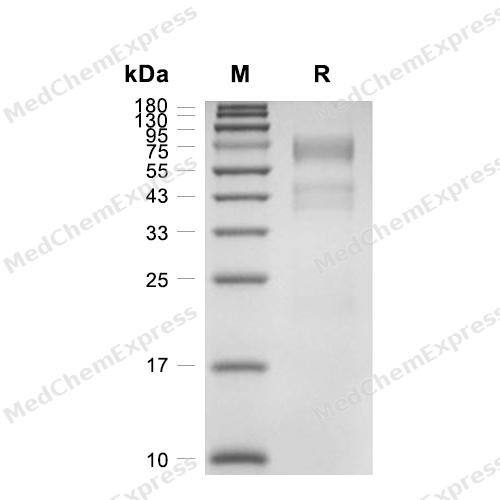
Purity - SDS-PAGE


Technical Parameters
-
Species Human
-
Source HEK293
-
Tag C-His
-
Accession
P04070 (T19-P461)
-
Molecular Construction
-
N-term
-
PROC (T19-P461)
Accession # P04070 -
His
-
C-term
-
-
Protein Length
Full Length of Mature Protein
-
Synonyms
PROC; Activated Protein C; Protein C, Inactivator Of Coagulation Factors Va And VIIIa; Protein C-Nagoya; Vitamin K-Dependent Protein C; Type I Protein C; Blood Coagulation Factor XIV; Protein C; Anticoagulant Protein C; PROC1; Autoprothrombin IIA; THPH3;
-
AA Sequence
TPAPLDSVFSSSERAHQVLRIRKRANSFLEELRHSSLERECIEEICDFEEAKEIFQNVDDTLAFWSKHVDGDQCLVLPLEHPCASLCCGHGTCIDGIGSFSCDCRSGWEGRFCQREVSFLNCSLDNGGCTHYCLEEVGWRRCSCAPGYKLGDDLLQCHPAVKFPCGRPWKRMEKKRSHLKRDTEDQEDQVDPRLIDGKMTRRGDSPWQVVLLDSKKKLACGAVLIHPSWVLTAAHCMDESKKLLVRLGEYDLRRWEKWELDLDIKEVFVHPNYSKSTTDNDIALLHLAQPATLSQTIVPICLPDSGLAERELNQAGQETLVTGWGYHSSREKEAKRNRTFVLNFIKIPVVPHNECSEVMSNMVSENMLCAGILGDRQDACEGDSGGPMVASFHGTWFLVGLVSWGEGCGLLHNYGVYTKVSRYLDWIHGHIRDKEAPQKSWAP
-
Molecular Weight
Approximately 56-64 kDa & 45 kDa, based on SDS-PAGE under reducing conditions, due to the glycosylation.
-
Glycosylation
Yes
-
Purity
≥ 95%, as determined by reducing SDS-PAGE.


Product Properties
Lyophilized powder.
1.Lyophilized from a 0.22 μm filtered solution of PBS, pH 7.4, 5% trehalose, 5% mannitol, 0.01% tween 80.
2.Lyophilized from a 0.22 μm filtered solution of PBS, pH 7.4, 8% trehalose.
Please refer to the lot-specific COA for specific buffer information.
<1 EU/μg, determined by LAL method.
It is not recommended to reconstitute to a concentration less than 100 μg/mL in ddH2O. For long term storage it is recommended to add a carrier protein (0.1% BSA, 5% HSA, 10% FBS or 5% Trehalose).
Stored at -20°C for 2 years from date of receipt. After reconstitution, it is stable at 4°C for 1 week or -20°C for longer (with carrier protein). It is recommended to freeze aliquots at -20°C or -80°C for extended storage.
Room temperature in continental US; may vary elsewhere.


Documentation
-
Data Sheet (238 KB)
-
SDS (252 KB)
- English - EN (252 KB)
- Français - FR (252 KB)
- Deutsch - DE (252 KB)
- Norwegian - NO (252 KB)
- Español - ES (252 KB)
- Swedish - SV (252 KB)
- Italian - IT (252 KB)
- Korean - KR (252 KB)
- Portuguese - PT (252 KB)
-
Handling Instructions (2659 KB)

Calculators
Concentration (start) × Volume (start) = Concentration (final) × Volume (final)


 Powered by Bioz

