



AZGP1 Protein, Human (HEK293, His)
Based on 1 publication(s) in Google Scholar
AZGP1 Proteinas, a key regulator, induces lipid degradation in adipocytes, contributing to fat loss in advanced cancer. Its potential binding to polyunsaturated fatty acids emphasizes its role in lipid metabolism. Interacting with PIP adds complexity to its functional role in cellular processes, highlighting the molecular interplay involved. AZGP1 Protein, Human (HEK293, His) is the recombinant human-derived AZGP1 protein, expressed by HEK293 , with C-6*His labeled tag.
- Species: Human
- Source: HEK293
-
Storage:Stored at -20°C for 2 years from date of receipt. After reconstitution, it is stable at 4°C for 1 week or -20°C for longer (with carrier protein). It is recommended to freeze aliquots at -20°C or -80°C for extended storage.


To place orders, for customer services and technical support, please contact: MedChemExpress USA
Tel: 609-228-6898 E-mail: [email protected] [email protected]


-
 Biological Activity
-
Technical Parameters
-
Product Properties
- Documentation
- Help & FAQs




Biological Activity
Description
AZGP1 Proteinas, a key regulator, induces lipid degradation in adipocytes, contributing to fat loss in advanced cancer. Its potential binding to polyunsaturated fatty acids emphasizes its role in lipid metabolism. Interacting with PIP adds complexity to its functional role in cellular processes, highlighting the molecular interplay involved. AZGP1 Protein, Human (HEK293, His) is the recombinant human-derived AZGP1 protein, expressed by HEK293 , with C-6*His labeled tag.
Background
CaCarboxypeptidase B2 (CPB2) plays a critical role in physiological regulation, particularly within the circulatory system. The enzyme exhibits specificity in cleaving C-terminal arginine or lysine residues from biologically active peptides, including kinins and anaphylatoxins, thereby finely tuning their activities and downstream signaling in the circulation. Additionally, CPB2 is instrumental in the down-regulation of fibrinolysis by selectively removing C-terminal lysine residues from fibrin that has undergone partial degradation by plasmin. This dual functionality underscores CPB2's pivotal role in maintaining the balance of peptide activities and coagulation processes, emphasizing its significance in orchestrating intricate regulatory mechanisms within the physiological context.
Verified Bioactivity
Measured by the ability of the immobilized protein to support the adhesion of MC3T3‑E1 mouse preosteoblast cells. The ED50 for this effect is 0.0948 μg/mL , corresponding to a specific activity is 1.055×10⁴ U/mg.
MCE Validation Data
-
Purity - SDS-PAGE
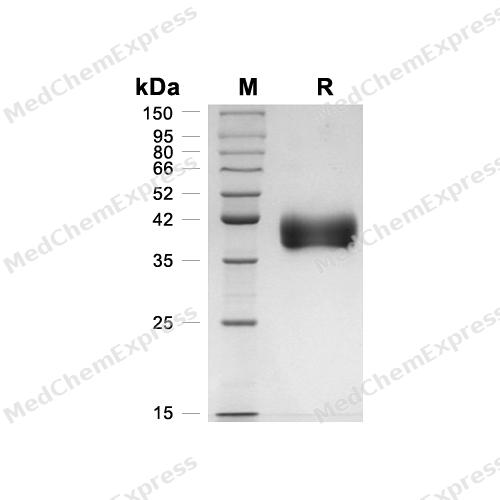
Purity - SDS-PAGE


Publications (1)
-
Journal Impact Factor
-
Most Recent
-
Invest Ophthalmol Vis Sci
AZGP1 Attenuates Subretinal Fibrosis and Inhibits Epithelial-Mesenchymal Transition by Blocking the PI3K/AKT Signaling Pathway. [Abstract]2025 Apr 1;66(4):83. PMID: 40305469


Technical Parameters
-
Species Human
-
Source HEK293
-
Tag C-6*His
-
Accession
P25311 (Q21-S298)
-
Molecular Construction
-
N-term
-
AZGP1 (Q21-S298)
Accession # P25311 -
6*His
-
C-term
-
-
Protein Length
Full Length of Mature Protein
-
Synonyms
AZGP1; Testicular Tissue Protein Li 227; Alpha-2-Glycoprotein 1, Zinc-Binding; Alpha-2-Glycoprotein 1, Zinc; ZAG; Alpha-2-Glycoprotein, Zinc; Zinc-Alpha-2-Glycoprotein; Zn-Alpha2-Glycoprotein; ZA2G; AZGP1 Protein; Zn-Alpha-2-Glycoprotein; ZNGP1; Zn-Alpha-
-
AA Sequence
QENQDGRYSLTYIYTGLSKHVEDVPAFQALGSLNDLQFFRYNSKDRKSQPMGLWRQVEGMEDWKQDSQLQKAREDIFMETLKDIVEYYNDSNGSHVLQGRFGCEIENNRSSGAFWKYYYDGKDYIEFNKEIPAWVPFDPAAQITKQKWEAEPVYVQRAKAYLEEECPATLRKYLKYSKNILDRQDPPSVVVTSHQAPGEKKKLKCLAYDFYPGKIDVHWTRAGEVQEPELRGDVLHNGNGTYQSWVVVAVPPQDTAPYSCHVQHSSLAQPLVVPWEAS
-
Molecular Weight
Approximately 42 kDa, based on SDS-PAGE under reducing conditions.
-
Glycosylation
Yes
-
Purity
≥ 95%, as determined by reducing SDS-PAGE.


Product Properties
Lyophilized powder.
Lyophilized from a 0.22 μm filtered solution of 20 mM Tris-HCl, 150 mM NaCl, pH 7.5.
Note: For SPR assay, please replace the buffer. Primary amine components (e.g., Tris, imidazole) can affect protein-coupled chips.
<1 EU/μg, determined by LAL method.
It is not recommended to reconstitute to a concentration less than 100 μg/mL in ddH2O. For long term storage it is recommended to add a carrier protein (0.1% BSA, 5% HSA, 10% FBS or 5% Trehalose).
Stored at -20°C for 2 years from date of receipt. After reconstitution, it is stable at 4°C for 1 week or -20°C for longer (with carrier protein). It is recommended to freeze aliquots at -20°C or -80°C for extended storage.
Room temperature in continental US; may vary elsewhere.


Documentation
-
Data Sheet (237 KB)
-
SDS (252 KB)
- English - EN (252 KB)
- Français - FR (252 KB)
- Deutsch - DE (252 KB)
- Norwegian - NO (252 KB)
- Español - ES (252 KB)
- Swedish - SV (252 KB)
- Italian - IT (252 KB)
- Korean - KR (252 KB)
- Portuguese - PT (252 KB)
-
Handling Instructions (2659 KB)

Calculators
Concentration (start) × Volume (start) = Concentration (final) × Volume (final)


 Powered by Bioz

