



BMP-2 Protein, Human/Mouse/Rat (Tag Free)
Based on 1 publication(s) in Google Scholar
Bone morphogenetic protein 2 (BMP-2) is a pleiotropic ligand protein belonging to TNFβ family, and is involved in key embryonic development of vascular and valvular homeostasis. BMP-2 binds to type I receptors (ALK-2/-3/-6) and type II receptors (BMPR2, ACVR2A) to regulate various types of calcification, including atherosclerosis, chronic kidney disease, diabetes, and valve calcification. BMP-2 is overexpressed by myofibroblast and preosteoblast in the calcified area of human calcified valve, which are densely infiltrated by B lymphocytes and T lymphocytes. BMP-2 is the junction between atherosclerotic vascular calcification and normal bone formation mechanism. BMP-2 Protein, Human/Mouse/Rat is 114 a.a. (Q283-R396), expressed in E. coli.
- Species: Rat; Mouse; Human
- Source: E. coli
-
Storage:Stored at -20°C for 2 years from date of receipt. After reconstitution, it is stable at 4°C for 1 week or -20°C for longer (with carrier protein). It is recommended to freeze aliquots at -20°C or -80°C for extended storage.


To place orders, for customer services and technical support, please contact: MedChemExpress USA
Tel: 609-228-6898 E-mail: [email protected] [email protected]


-
 Biological Activity
-
Technical Parameters
-
Product Properties
- Documentation
- Help & FAQs


-
HY-13418A
DorsomorphinAMPK Inhibitor -

HY-P7025
IFN-gamma Protein, Human -
HY-P7063
IL-6 Protein, Mouse -
HY-P70648
TGF beta 1/TGFB1 Protein, Mouse/Rat (HEK293) -
HY-P7007
BMP-4 Protein, Human -
HY-P70699A
PDGF-BB Protein, Mouse (C-His) -
HY-17571A
Oxytocin acetateHypothalamic Peptide -
HY-P7004
FGF basic/bFGF Protein, Human (146a.a) -
HY-P7425B
RANKL/TNFSF11 Protein, Mouse (HEK293, N-His)


Biological Activity
Description
Bone morphogenetic protein 2 (BMP-2) is a pleiotropic ligand protein belonging to TNFβ family, and is involved in key embryonic development of vascular and valvular homeostasis. BMP-2 binds to type I receptors (ALK-2/-3/-6) and type II receptors (BMPR2, ACVR2A) to regulate various types of calcification, including atherosclerosis, chronic kidney disease, diabetes, and valve calcification[1]. BMP-2 is overexpressed by myofibroblast and preosteoblast in the calcified area of human calcified valve, which are densely infiltrated by B lymphocytes and T lymphocytes[2]. BMP-2 is the junction between atherosclerotic vascular calcification and normal bone formation mechanism[3]. BMP-2 Protein, Human/Mouse/Rat is 114 a.a. (Q283-R396), expressed in E. coli.
Background
Bone Morphogenetic Protein 2 (BMP-2) is a ligand protein with pleiotropic, belongs to TNFβ family. BMP-2 formats BMP/TGFβ signaling to involve in vascular and valvular homeostasis, which is a critical process of embryonic development[1].
BMP-2/TGFβ signaling can be terminated by inhibitory SMADs including SMAD6 and SMAD7, which are activated and induced by BMP signaling and switch off BMP signaling via multiple mechanisms[4].
BMP-2 is widely found in different animals, while the sequence in human is similar to Rat (91.86%), and mouse (92.13%).
BMPs exhibits critical contributions to the pathophysiology of atherosclerosis, pulmonary vascular disease, and vascular and valvular calcification[1].
BMP-2 binds different receptor, such as type I receptors (ALK-2/-3/-6) and type II receptors (BMPR2, ACVR2A), to regulate various calcification type including Atherosclerosis, Chronic Kidney Disease, Diabetes, Valvular Calcification[1].
BMP-2 promotes monocyte infiltration and inflammation of atherosclerotic legions[5].
It is linked to increased plaque formation via pro-inflammatory and pro-atherogenic effects, promoting oxidative stress, endothelial dysfunction and osteogenic differentiation[6].
BMP-2 is overexpressed in ossified regions of human calcified valves by myofibroblasts and pre-osteoblasts in areas densely infiltrated with B- and T-lymphocytes[2].
And it serves as the linkers between atherosclerotic vascular calcification with mechanisms of normal bone formation[3].
BMP-2 induces angiogenesis, endothelial cells (ECs) proliferation, and migration[7].
And BMP-2 also enhances the expression of the osteoblast and chondrocyte master transcriptional regulator RUNX2 to promote the mineralization of cultured human coronary vascular SMCs in a manner that was dependent on oxidative stress and endoplasmic reticulum (ER) stress[8].
Verified Bioactivity
Measured by its ability to induce alkaline phosphatase production by ATDC5 mouse chondrogenic cells. The ED50 for this effect is ≤0.5 μg/mL, corresponding to a specific activity is ≥2×10³ U/mg.
MCE Validation Data
-
Purity - SDS-PAGE
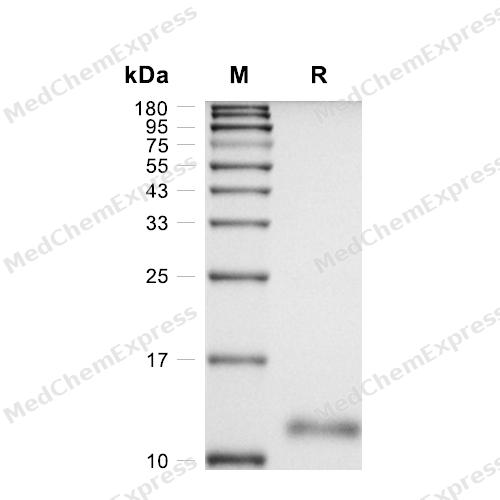
Purity - SDS-PAGE
-
Bioactivity - Cell-Based Assay
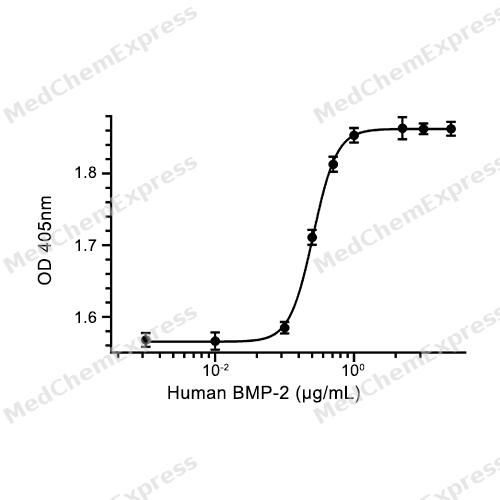
Bioactivity - Cell-Based Assay


Publications (1)
-
Journal Impact Factor
-
Most Recent
-
Adv Sci (Weinh)
Single-Cell RNA Sequencing Identifies MMP11+ Cancer-Associated Fibroblasts as Drivers of Angiogenesis and Bladder Cancer Progression. [Abstract]2025 Aug;12(32):e02774. PMID: 40552583


Technical Parameters
-
Species Rat; Mouse; Human
-
Source E. coli
-
Tag Tag Free
-
Accession
P12643 (Q283-R396)
-
Gene ID650
-
Molecular Construction
-
N-term
-
BMP-2 (Q283-R396)
Accession # P12643 -
C-term
-
-
Protein Length
Full Length of Mature Protein
-
Synonyms
BMP2; SSFSC1; Prev. BMP2A; SSFSC; Bone Morphogenetic Protein 2A; BMP-2; BMP2 Protein; BDA2; Bone Morphogenetic Protein 2; BMP-2A
-
AA Sequence
QAKHKQRKRLKSSCKRHPLYVDFSDVGWNDWIVAPPGYHAFYCHGECPFPLADHLNSTNHAIVQTLVNSVNSKIPKACCVPTELSAISMLYLDENEKVVLKNYQDMVVEGCGCR
-
Predicted Molecular Mass
12.9 kDa
-
Molecular Weight
Approximately 12 kDa, based on SDS-PAGE under reducing conditions.
-
Purity
≥ 95%, as determined by reducing SDS-PAGE.


Product Properties
Lyophilized powder
Lyophilized from a 0.22 μm filtered solution of 50 mM Tris-HCl, 200 mM NaCL, 500 mM arginine, pH 8.0 or 50 mM Tris-HCl, 200 mM NaCl, 500 mM arginine, pH 8.0, 5% trehalose or 0.1% TFA, 30% Acetonitrile, pH 2.5 or pH 2.4.
Note: For SPR assay, please replace the buffer. Primary amine components (e.g., Tris, imidazole) can affect protein-coupled chips.
<1 EU/μg, determined by LAL method.
It is not recommended to reconstitute to a concentration less than 100 μg/mL in ddH2O. For long term storage it is recommended to add a carrier protein (0.1% BSA, 5% HSA, 10% FBS or 5% Trehalose).
Stored at -20°C for 2 years from date of receipt. After reconstitution, it is stable at 4°C for 1 week or -20°C for longer (with carrier protein). It is recommended to freeze aliquots at -20°C or -80°C for extended storage.
Room temperature in continental US; may vary elsewhere.


Documentation
-
Data Sheet (237 KB)
-
SDS (252 KB)
- English - EN (252 KB)
- Français - FR (252 KB)
- Deutsch - DE (252 KB)
- Norwegian - NO (252 KB)
- Español - ES (252 KB)
- Swedish - SV (252 KB)
- Italian - IT (252 KB)
- Korean - KR (252 KB)
- Portuguese - PT (252 KB)
-
Handling Instructions (2659 KB)

Calculators
Concentration (start) × Volume (start) = Concentration (final) × Volume (final)


 Powered by Bioz

