



Cadherin-13 Protein, Rat (HEK293)

Based on 1 Customer Validation
Cadherin-13 Protein is an atypical member of the cadherin family, devoid of a transmembrane domain and anchored to the exterior surface of the plasma membrane via a glycosylphosphatidylinositol anchor. And it exhibits a preference for homophilic interactions, fostering connections between neighboring cells and potentially playing a role in cell type sorting. Cadherin-13 may act as negative regulators of neural cell growth. Moreover, it may act rather as a signalling receptor participating in recognition of the environment and regulation of cell motility, proliferation and phenotype. Cadherin-13 Protein, Rat (HEK293) is the recombinant rat-derived Cadherin-13 protein, expressed by HEK293 , with tag free.
- Species: Rat
- Source: HEK293
-
Storage:Stored at -20°C for 2 years from date of receipt. After reconstitution, it is stable at 4°C for 1 week or -20°C for longer (with carrier protein). It is recommended to freeze aliquots at -20°C or -80°C for extended storage.


To place orders, for customer services and technical support, please contact: MedChemExpress USA
Tel: 609-228-6898 E-mail: [email protected] [email protected]


-
 Biological Activity
-
Technical Parameters
-
Product Properties
- Documentation
- References
- Help & FAQs




Biological Activity
Description
Cadherin-13 Protein is an atypical member of the cadherin family, devoid of a transmembrane domain and anchored to the exterior surface of the plasma membrane via a glycosylphosphatidylinositol anchor. And it exhibits a preference for homophilic interactions, fostering connections between neighboring cells and potentially playing a role in cell type sorting. Cadherin-13 may act as negative regulators of neural cell growth. Moreover, it may act rather as a signalling receptor participating in recognition of the environment and regulation of cell motility, proliferation and phenotype. Cadherin-13 Protein, Rat (HEK293) is the recombinant rat-derived Cadherin-13 protein, expressed by HEK293 , with tag free.
Background
Cadherin-13 is an atypical member of the cadherin family, devoid of a transmembrane domain and anchored to the exterior surface of the plasma membrane via a glycosylphosphatidylinositol anchor. And it exhibits a preference for homophilic interactions, fostering connections between neighboring cells and potentially playing a role in cell type sorting. Cadherin-13 may act as negative regulators of neural cell growth. Cadherin-13 is highly expressed in nervous and cardiovascular system (in endothelial and smooth muscle cells). Thereby, it may facilitate progression of proliferative vascular disorders such as atherosclerosis, restenosis and tumor angiogenesis. Moreover, it may act rather as a signalling receptor participating in recognition of the environment and regulation of cell motility, proliferation and phenotype. Cadherin-13-dependent activation of PI3K/Akt/GSK3β signalling axis protects endothelial cells from oxidative stress-induced apoptosis.
Verified Bioactivity
Measured by the ability of the immobilized protein to inhibit the adhesion of HUVEC human umbilical vein endothelial cells. The ED50 for this effect is 4.702 μg/mL, corresponding to a specific activity is 212.67 units/mg.
MCE Validation Data
-
Purity - SDS-PAGE
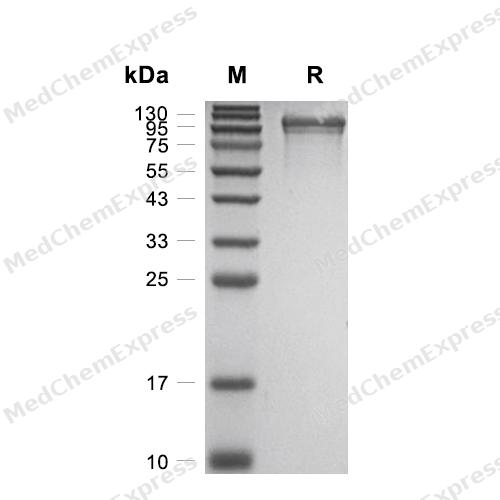
Purity - SDS-PAGE
-
Bioactivity - Cell-Based Assay
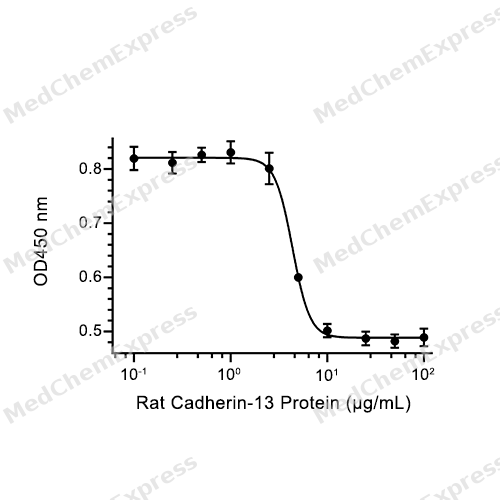
Bioactivity - Cell-Based Assay


Technical Parameters
-
Species Rat
-
Source HEK293
-
Tag Tag Free
-
Accession
Q8R490 (A22-A692)
-
Molecular Construction
-
N-term
-
Cadherin-13 (A22-A692)
Accession # Q8R490 -
C-term
-
-
Protein Length
Partial
-
Synonyms
CDH13; Cadherin-13; Cadherin 13; T-Cad; CDHH; P105; T-Cadherin; Cadherin 13, H-Cadherin (Heart); H-Cadherin (Heart); Truncated Cadherin; Heart Cadherin; H-Cadherin
-
AA Sequence
AGDLDCTPGFQQKVLHIHQPAEFIEDQPVLNLTFSDCKGNKKLHYEVSSPYFKVNSDGTLVAVRNITAVGRTLFVHARTPHAEDMAELVIVGGKDIQGSLQDIFKFARTSPVPRQKRSIVVSPILIPENQRQPFPRDVGKVVDSDRPEGSKFRLTGKGVDQDPKGTFRINENTGSVSVTRTLDRETIATYQLFVETTDASGRTLEGPVPLEVIVIDQNDNRPIFREGPYIGHVMEGSPTGTTVMRMTAFDADDPATDNALLRYNIRQQTPDKPSPNMFYIDPEKGDIVTVVSPALLDRETLENPKYELIIEAQDMAGLDVGLTGTATATIVIDDKNDHSPKFTKKEFQATVEEGAVGVIVNLTVEDKDDPATGAWRAAYTIINGNPGQSFEIHTNPQTNEGMLSVVKPLDYEISAFHTLLIKVENEDPLVPDVSYGPSSTATVHITVLDVNEGPVFYPDPMMVTKQENISVGSVLLTVNATDPDSLQHQTIRYSVYKDPAGWLSINPINGTVDTTAVLDRESPFVHNSVYTALFLAIDSGNPPATGTGTLMITLEDVNDNAPVIYPTVAEVCDDARNLSVVILGASDKDLHPNTDPFKFEIHKQTVPDKVWKISKINNTHALVSLLQNLNKANYNLPIMVTDSGKPPMTNITDLRVQVCSCKNSKVDCNAA
-
Molecular Weight
Approximately 84-96 kDa, based on SDS-PAGE under reducing conditions.
-
Purity
≥ 90%, as determined by reducing SDS-PAGE.


Product Properties
Lyophilized powder.
Lyophilized from a 0.22 μm filtered solution of PBS, pH 7.4.
<1 EU/μg, determined by LAL method.
It is not recommended to reconstitute to a concentration less than 100 μg/mL in ddH2O. For long term storage it is recommended to add a carrier protein (0.1% BSA, 5% HSA, 10% FBS or 5% Trehalose).
Stored at -20°C for 2 years from date of receipt. After reconstitution, it is stable at 4°C for 1 week or -20°C for longer (with carrier protein). It is recommended to freeze aliquots at -20°C or -80°C for extended storage.
Room temperature in continental US; may vary elsewhere.


Documentation
-
Data Sheet (265 KB)
-
SDS (251 KB)
- English - EN (251 KB)
- Français - FR (251 KB)
- Deutsch - DE (251 KB)
- Norwegian - NO (251 KB)
- Español - ES (251 KB)
- Swedish - SV (251 KB)
- Italian - IT (251 KB)
- Korean - KR (251 KB)
- Portuguese - PT (251 KB)
-
Handling Instructions (2659 KB)


References

Calculators
Concentration (start) × Volume (start) = Concentration (final) × Volume (final)


 Powered by Bioz

