



CD3 gamma Protein, Human (HEK293, Fc)

Based on 1 Customer Validation
CD3 gamma is part of the TCR-CD3 complex on T lymphocytes, promoting TCR-mediated signaling and regulating surface expression. APC-induced TCR activation promotes CD3 gamma as well as CD3D, CD3E, and CD3Z signaling through ITAMs. CD3 gamma Protein, Human (HEK293, Fc) is the recombinant human-derived CD3 gamma protein, expressed by HEK293 , with C-hFc labeled tag.
- Species: Human
- Source: HEK293
-
Storage:Stored at -20°C for 2 years from date of receipt. After reconstitution, it is stable at 4°C for 1 week or -20°C for longer (with carrier protein). It is recommended to freeze aliquots at -20°C or -80°C for extended storage.


To place orders, for customer services and technical support, please contact: MedChemExpress USA
Tel: 609-228-6898 E-mail: [email protected] [email protected]


-
 Biological Activity
-
Technical Parameters
-
Product Properties
- Documentation
- Help & FAQs




Biological Activity
Description
CD3 gamma is part of the TCR-CD3 complex on T lymphocytes, promoting TCR-mediated signaling and regulating surface expression. APC-induced TCR activation promotes CD3 gamma as well as CD3D, CD3E, and CD3Z signaling through ITAMs. CD3 gamma Protein, Human (HEK293, Fc) is the recombinant human-derived CD3 gamma protein, expressed by HEK293 , with C-hFc labeled tag.
Background
CD3 gamma, an integral component of the TCR-CD3 complex on the T-lymphocyte cell surface, is pivotal in the adaptive immune response. As antigen-presenting cells (APCs) activate the T-cell receptor (TCR), CD3 gamma, along with other CD3 chains (CD3D, CD3E, and CD3Z), facilitates the transmission of TCR-mediated signals across the cell membrane. With immunoreceptor tyrosine-based activation motifs (ITAMs) in its cytoplasmic domain, CD3 gamma undergoes phosphorylation by Src family protein tyrosine kinases LCK and FYN upon TCR engagement, activating downstream signaling pathways. Beyond its role in signal transduction, CD3 gamma plays a crucial role in dynamically regulating TCR expression at the cell surface. Constitutive TCR cycling relies on the di-leucine-based (diL) receptor-sorting motif present in CD3 gamma. The TCR-CD3 complex comprises CD3D/CD3E and CD3G/CD3E heterodimers, which preferentially associate with TCRalpha and TCRbeta, forming trimers that interact with CD3Z homodimers to complete the hexameric TCR-CD3 complex. Alternatively, TCRalpha and TCRbeta can be replaced by TCRgamma and TCRdelta, showcasing the versatility of CD3 gamma in TCR assembly and functionality.
Verified Bioactivity
Measured by its binding ability in a functional ELISA. Immobilized Human CD3 gamma at 1 μg/mL (100 μL/Well) can bind biotinylated Human CD3E (HY-P70506). The ED50 for this effect is 4.208 μg/mL.
MCE Validation Data
-
Bioactivity - ELISA
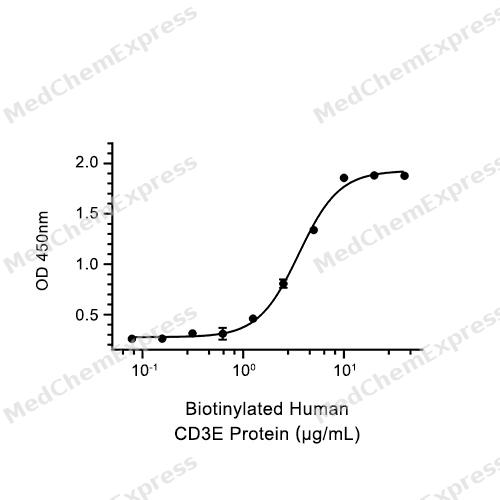
Bioactivity - ELISA


Technical Parameters
-
Species Human
-
Source HEK293
-
Tag C-hFc
-
Accession
P09693 (Q23-S116)
-
Molecular Construction
-
N-term
-
CD3 gamma (Q23-S116)
Accession # P09693 -
hFc
-
C-term
-
-
Protein Length
Extracellular Domain
-
Synonyms
CD3G; T3G; CD3 Gamma Subunit Of T-Cell Receptor Complex; T-Cell Antigen Receptor Complex, Gamma Subunit Of T3; T-Cell Surface Glycoprotein CD3 Gamma Chain; CD3g Molecule, Epsilon (CD3-TCR Complex); T-Cell Receptor T3 Gamma Chain; TCR Ti Gamma-Chain V8-J2
-
AA Sequence
QSIKGNHLVKVYDYQEDGSVLLTCDAEAKNITWFKDGKMIGFLTEDKKKWNLGSNAKDPRGMYQCKGSQNKSKPLQVYYRMCQNCIELNAATIS
-
Predicted Molecular Mass
39.6 kDa
-
Molecular Weight
Approximately 45-55 kDa, based on SDS-PAGE under reducing conditions, due to the glycosylation.
-
Glycosylation
Yes
-
Purity
≥ 95%, as determined by reducing SDS-PAGE.


Product Properties
Lyophilized powder.
Lyophilized from a 0.22 μm filtered solution of 20 mM Tris-HCl, 0.15 M NaCl, 6% trehalose, pH 8.0.
Note: For SPR assay, please replace the buffer. Primary amine components (e.g., Tris, imidazole) can affect protein-coupled chips.
<1 EU/μg, determined by LAL method.
It is not recommended to reconstitute to a concentration less than 100 μg/mL in ddH2O.
Stored at -20°C for 2 years from date of receipt. After reconstitution, it is stable at 4°C for 1 week or -20°C for longer (with carrier protein). It is recommended to freeze aliquots at -20°C or -80°C for extended storage.
Room temperature in continental US; may vary elsewhere.


Documentation
-
Data Sheet (236 KB)
-
SDS (251 KB)
- English - EN (251 KB)
- Français - FR (251 KB)
- Deutsch - DE (251 KB)
- Norwegian - NO (251 KB)
- Español - ES (251 KB)
- Swedish - SV (251 KB)
- Italian - IT (251 KB)
- Korean - KR (251 KB)
- Portuguese - PT (251 KB)
-
Handling Instructions (2659 KB)

Calculators
Concentration (start) × Volume (start) = Concentration (final) × Volume (final)


 Powered by Bioz

