



CutA Protein, Human (His)

Based on 1 Customer Validation
CUTA protein is a trimeric membrane anchor protein of AChE and a homolog of the bacterial divalent cation chelator CutA1 protein. CUTA protein also interacts with BACE1 and inhibits APP beta processing and Aβ production. CutA Protein, Human (His) is the recombinant human-derived CutA protein, expressed by E. coli , with C-6*His labeled tag.
- Species: Human
- Source: E. coli
-
Storage:Stored at -20°C for 2 years from date of receipt. After reconstitution, it is stable at 4°C for 1 week or -20°C for longer (with carrier protein). It is recommended to freeze aliquots at -20°C or -80°C for extended storage.


To place orders, for customer services and technical support, please contact: MedChemExpress USA
Tel: 609-228-6898 E-mail: [email protected] [email protected]


-
 Biological Activity
-
Technical Parameters
-
Product Properties
- Documentation
- Help & FAQs




Biological Activity
Description
CUTA protein is a trimeric membrane anchor protein of AChE and a homolog of the bacterial divalent cation chelator CutA1 protein. CUTA protein also interacts with BACE1 and inhibits APP beta processing and Aβ production. CutA Protein, Human (His) is the recombinant human-derived CutA protein, expressed by E. coli , with C-6*His labeled tag.
Background
CUTA protein is a membrane anchor protein of mammalian brain acetylcholinesterase (AChE) and is a trimeric protein that may form part of a membrane protein complex attached to acetylcholinesterase (AChE). Human CUTA is homologous to the bacterial CutA1 protein and is a divalent cation-tolerant homolog. Expression of longer CutA variants reduces AChE levels, an effect that depends on possible misfolding of the AChE C-terminal peptide. CutA increases secretion of mutants with a KDEL motif at the C terminus; it also increases AChE homotetramer formation. Longer CutA variants may affect secreted protein processing and trafficking, whereas shorter CutA variants may have unique functions in the cytoplasm. For example, CUTA proteins interact with β-secretase β-site APP cleavage 1 (BACE1) and inhibit APP β processing and Aβ production. Copper treatment promoted the increase in Aβ secretion induced by CUTA downregulation but had no effect on the CUTA-β site APP lyase 1 interaction. Therefore, indicating the mutual regulation of copper and CUTA, both regulate Aβ production through different mechanisms.
MCE Validation Data
-
Purity - SDS-PAGE
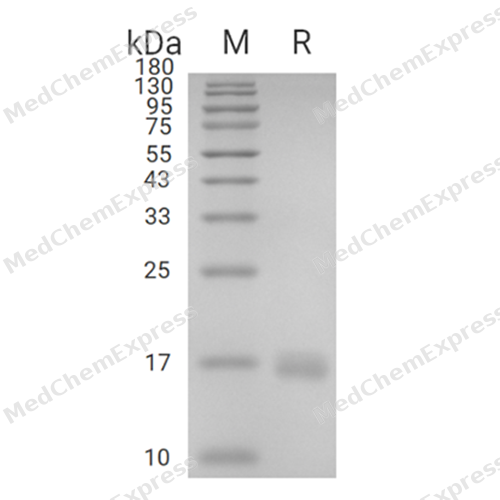
Purity - SDS-PAGE


Technical Parameters
-
Species Human
-
Source E. coli
-
Tag C-6*His
-
Accession
O60888-3 (M1-P156)
-
Molecular Construction
-
N-term
-
CutA (M24-P179)
Accession # O60888-3 -
6*His
-
C-term
-
-
Protein Length
Full Length of Isoform-3
-
Synonyms
CUTA; Protein CutA; Prev. C6orf82; Divalent Cation Tolerant Protein CUTA; Prev. ACHAP; Chromosome 6 Open Reading Frame 82; Acetylcholinesterase-Associated Protein; Alternative Protein CUTA; Brain Acetylcholinesterase Putative Membrane Anchor; CutA Divalen
-
AA Sequence
MPALLPVASRLLLLPRVLLTMASGSPPTQPSPASDSGSGYVPGSVSAAFVTCPNEKVAKEIARAVVEKRLAACVNLIPQITSIYEWKGKIEEDSEVLMMIKTQSSLVPALTDFVRSVHPYEVAEVIALPVEQGNFPYLQWVRQVTESVSDSITVLP
-
Predicted Molecular Mass
17.9 kDa
-
Molecular Weight
Approximately 17 kDa, based on SDS-PAGE under reducing conditions.
-
Purity
≥ 95%, as determined by reducing SDS-PAGE.


Product Properties
Lyophilized powder.
Lyophilized from a 0.22 μm filtered solution of 20 mM Tris-HCl, 1 mM DTT, pH 8.0.
Note: For SPR assay, please replace the buffer. Primary amine components (e.g., Tris, imidazole) can affect protein-coupled chips.
<1 EU/μg, determined by LAL method.
It is not recommended to reconstitute to a concentration less than 100 μg/mL in ddH2O. For long term storage it is recommended to add a carrier protein (0.1% BSA, 5% HSA, 10% FBS or 5% Trehalose).
Stored at -20°C for 2 years from date of receipt. After reconstitution, it is stable at 4°C for 1 week or -20°C for longer (with carrier protein). It is recommended to freeze aliquots at -20°C or -80°C for extended storage.
Room temperature in continental US; may vary elsewhere.


Documentation
-
Data Sheet (236 KB)
-
SDS (252 KB)
- English - EN (252 KB)
- Français - FR (252 KB)
- Deutsch - DE (252 KB)
- Norwegian - NO (252 KB)
- Español - ES (252 KB)
- Swedish - SV (252 KB)
- Italian - IT (252 KB)
- Korean - KR (252 KB)
- Portuguese - PT (252 KB)
-
Handling Instructions (2659 KB)

Calculators
Concentration (start) × Volume (start) = Concentration (final) × Volume (final)


 Powered by Bioz

