



Decorin/PGS2 Protein, Mouse (HEK293, His)

Based on 1 Customer Validation
Decorin/PGS2 protein, influencing fibril formation rate, binds strongly to type I and type II collagen, fibronectin, and TGF-beta. It participates in extracellular matrix organization by forming a ternary complex with MFAP2 and ELN, and interacts with DPT, potentially modulating matrix assembly and structure. Decorin/PGS2 Protein, Mouse (HEK293, His) is the recombinant mouse-derived Decorin/PGS2 protein, expressed by HEK293 , with C-6*His labeled tag.
- Species: Mouse
- Source: HEK293
-
Storage:Stored at -20°C for 2 years from date of receipt. After reconstitution, it is stable at 4°C for 1 week or -20°C for longer (with carrier protein). It is recommended to freeze aliquots at -20°C or -80°C for extended storage.


To place orders, for customer services and technical support, please contact: MedChemExpress USA
Tel: 609-228-6898 E-mail: [email protected] [email protected]


-
 Biological Activity
-
Technical Parameters
-
Product Properties
- Documentation
- Help & FAQs


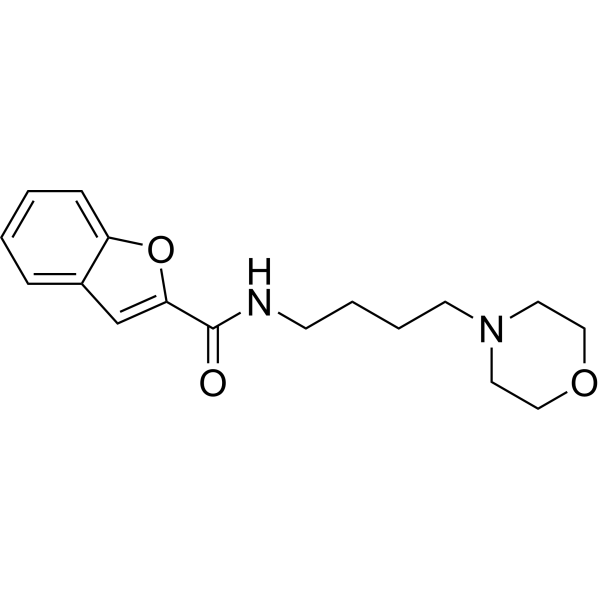


Biological Activity
Description
Decorin/PGS2 protein, influencing fibril formation rate, binds strongly to type I and type II collagen, fibronectin, and TGF-beta. It participates in extracellular matrix organization by forming a ternary complex with MFAP2 and ELN, and interacts with DPT, potentially modulating matrix assembly and structure. Decorin/PGS2 Protein, Mouse (HEK293, His) is the recombinant mouse-derived Decorin/PGS2 protein, expressed by HEK293 , with C-6*His labeled tag.
Background
Decorin/PGS2 protein influences the rate of fibril formation and exhibits binding affinity towards type I and type II collagen, fibronectin, and TGF-beta. It also forms a ternary complex with MFAP2 and ELN, suggesting its involvement in extracellular matrix organization. Additionally, it interacts with DPT, further highlighting its potential role in modulating matrix assembly and structure.
Verified Bioactivity
Measured by its ability to modulate collagen fibrillogenesis. 5 µg/mL of Recombinant Mouse Decorin can significantly delay the rate of collagen fibrillogenesis.
MCE Validation Data
-
Purity - SDS-PAGE
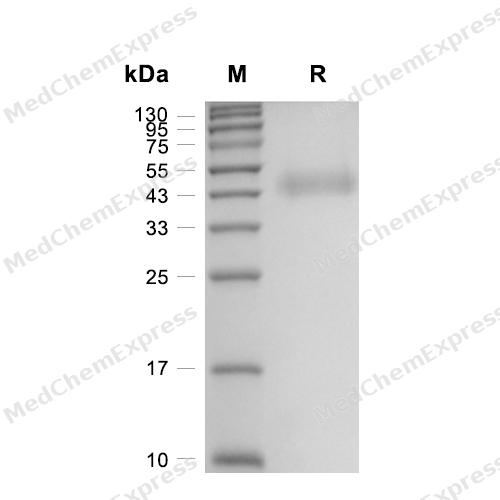
Purity - SDS-PAGE
-
Bioactivity - Biochemical Activity Assay
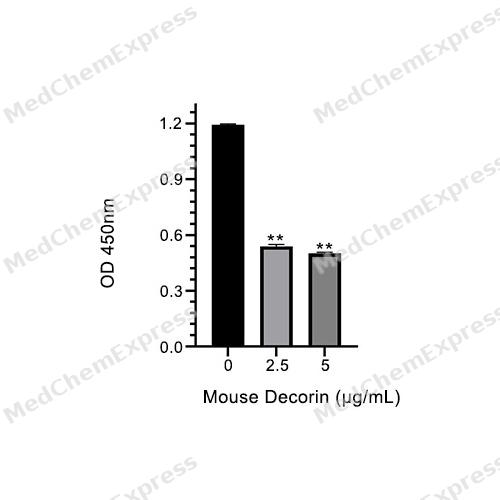
Bioactivity - Biochemical Activity Assay


Technical Parameters
-
Species Mouse
-
Source HEK293
-
Tag C-6*His
-
Accession
P28654 (G17-K354)
-
Molecular Construction
-
N-term
-
PGS2 (G17-K354)
Accession # P28654 -
6*His
-
C-term
-
-
Protein Length
Full Length of Mature Protein
-
Synonyms
DCN; Decorin Proteoglycan; Decorin; Decorin Isoform 3; SLRR1B; Decorin Isoform 4; Bone Proteoglycan II; DKFZp686J19238; DSPG2; PG-S2; PG40; CSCD; Dermatan Sulphate Proteoglycans II; PGII; Small Leucine-Rich Protein 1B; PGS2; Proteoglycan Core Protein
-
AA Sequence
GPFEQRGLFDFMLEDEASGIIPYDPDNPLISMCPYRCQCHLRVVQCSDLGLDKVPWDFPPDTTLLDLQNNKITEIKEGAFKNLKDLHTLILVNNKISKISPEAFKPLVKLERLYLSKNQLKELPEKMPRTLQELRVHENEITKLRKSDFNGLNNVLVIELGGNPLKNSGIENGAFQGLKSLSYIRISDTNITAIPQGLPTSLTEVHLDGNKITKVDAPSLKGLINLSKLGLSFNSITVMENGSLANVPHLRELHLDNNKLLRVPAGLAQHKYIQVVYLHNNNISAVGQNDFCRAGHPSRKASYSAVSLYGNPVRYWEIFPNTFRCVYVRSAIQLGNYK
-
Molecular Weight
Approximately 41-50 kDa, based on SDS-PAGE under reducing conditions.
-
Glycosylation
Yes
-
Purity
≥ 95%, as determined by reducing SDS-PAGE.


Product Properties
Lyophilized powder
1.Lyophilized from a 0.22 μm filtered solution of PBS, pH 7.4.
2.Lyophilized from a 0.22 μm filtered solution of PBS, pH 7.4, 8% trehalose.
Please refer to the lot-specific COA for specific buffer information.
<1 EU/μg, determined by LAL method.
It is not recommended to reconstitute to a concentration less than 100 μg/mL in ddH2O. For long term storage it is recommended to add a carrier protein (0.1% BSA, 5% HSA, 10% FBS or 5% Trehalose).
Stored at -20°C for 2 years from date of receipt. After reconstitution, it is stable at 4°C for 1 week or -20°C for longer (with carrier protein). It is recommended to freeze aliquots at -20°C or -80°C for extended storage.
Room temperature in continental US; may vary elsewhere.


Documentation
-
Data Sheet (237 KB)
-
SDS (252 KB)
- English - EN (252 KB)
- Français - FR (252 KB)
- Deutsch - DE (252 KB)
- Norwegian - NO (252 KB)
- Español - ES (252 KB)
- Swedish - SV (252 KB)
- Italian - IT (252 KB)
- Korean - KR (252 KB)
- Portuguese - PT (252 KB)
-
Handling Instructions (2659 KB)

Calculators
Concentration (start) × Volume (start) = Concentration (final) × Volume (final)


 Powered by Bioz

