



ENA-78/CXCL5 Protein, Human
Based on 1 publication(s) in Google Scholar
CXCL5, also known as neutrophil activating peptide 78 (ENA‐78), is a CXC chemokine containing ELR motif. CXCL5 promotes angiogenesis through interaction with its specific receptor CXCR2. CXCL5 is expressed by many immune cells, such as macrophages, eosinophils, and non-immune cells including mesothelial cells, and fibroblasts.CXCL5/CXCR2 axis not only contributes to the recruitment of neutrophils but also regulates the function of neutrophils in melanoma. ENA-78/CXCL5 Protein, Human is produced in E.coil, and consists of 70 amino acids (R45-N114).
- Species: Human
- Source: E. coli
-
Storage:Stored at -20°C for 2 years from date of receipt. After reconstitution, it is stable at 4°C for 1 week or -20°C for longer (with carrier protein). It is recommended to freeze aliquots at -20°C or -80°C for extended storage.


To place orders, for customer services and technical support, please contact: MedChemExpress USA
Tel: 609-228-6898 E-mail: [email protected] [email protected]


-
 Biological Activity
-
Technical Parameters
-
Product Properties
- Documentation
- References
- Help & FAQs




Biological Activity
Description
CXCL5, also known as neutrophil activating peptide 78 (ENA‐78), is a CXC chemokine containing ELR motif. CXCL5 promotes angiogenesis through interaction with its specific receptor CXCR2. CXCL5 is expressed by many immune cells, such as macrophages, eosinophils, and non-immune cells including mesothelial cells, and fibroblasts.CXCL5/CXCR2 axis not only contributes to the recruitment of neutrophils but also regulates the function of neutrophils in melanoma[1][2]. ENA-78/CXCL5 Protein, Human is produced in E.coil, and consists of 70 amino acids (R45-N114).
Background
CXCL5 belongs to the CXC-type chemokine family with a specific amino acid sequence of glutamic acid-leucine-arginine which is shortly named as ELR motif. The ELR motif of CXC-type chemokine family plays an important role in angiogenesis. CXCL5 is expressed by many immune cells, such as macrophages, eosinophils, as well as non-immune cells including mesothelial cells, and fibroblasts[1][2].
Human CXCL5 shares 57% amino acid sequence identity with mouse and rat CXCL5.
CXCL5 can recruit cells, such as T/B lymphocytes and eosinophils from the immune system to the corresponding regions during immune response. Besides, it also participates in promoting the adhesion and remodeling of connective tissues. CXCL5 is highly expressed in various tumor tissues. CXCL5 can be used as a potential indicator of tumor prognosis. In tumor microenvironment (TME), CXCL5 binds to its receptors, such as CXCR2, to participate in the recruitment of immune cells and promote angiogenesis, tumor growth, and metastasis. Mesenchymal stem cells (MSCs) activated by acidic TME or TNF-α can secrete CXCL5 and other pro-inflammatory factors. Besides, cancer-associated mesothelial cells, which are generated by plasminogen activator inhibitor-1 (PAI-1), can secrete IL-8 and CXCL5 via the NF-κB signaling pathway and thereby promoting peritoneal metastasis. Adipose tissue-derived stem cells (ASCs) secrete CXCL5 which subsequently promotes tumor growth and affects the development of breast tumors[2].
The CXCL5/CXCR2 axis recruits neutrophils, promotes angiogenesis and remodels connective tissues. In addition, CXCL5 promotes angiogenesis via activating the AKT/NF-κB/FOXD1/VEGF-A pathway in a CXCR2-dependent manner. CXCL5 plays a role in cancer cell proliferation, migration, and invasion. CXCL5 promotes the proliferation of several types of tumor cells, such as the tumor cells in prostate cancer, cervical cancer, lung cancer, hepatoblastoma, and osteosarcoma[1][2][3].
In Vivo
Recombinant human CXCL5 protein (1 ng/mL; 24-48 h) promotes proliferation, migration and partial invasion in Caco-2, HT-29 and SW-480 cells[1].
Recombinant human CXCL5 protein (1-10 ng/mL; 36 h) stimulates the formation ability, proliferation, and migration in HUVECs, which are enhanced by the activation of the AKT/NF-κB/FOXD1/VEGF-A pathway in a CXCR2-dependent manner[3].
Verified Bioactivity
1.The ED50 is <50 ng/mL as measured by CHO-K1/Gα15/hCXCR2 cells (human Gα15 and human CXCR2 stably expressed in CHO-K1 cells).
2.Measured by its ability to chemoattract THP-1 human acute monocytic leukemia cells. The ED50 for this effect is 6.072 ng/mL, corresponding to a specific activity is 1.647×10⁵ U/mg.
MCE Validation Data
-
Purity - SDS-PAGE
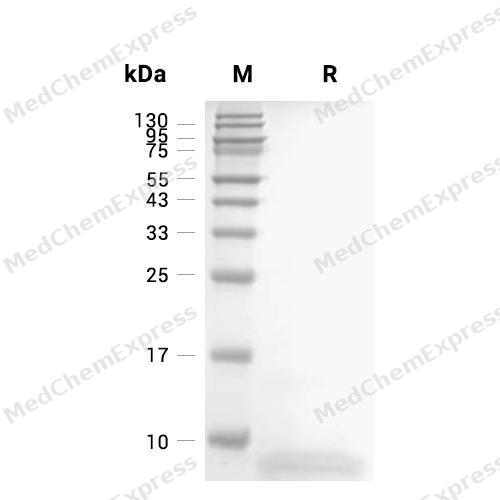
Purity - SDS-PAGE
-
Bioactivity - Cell-Based Assay
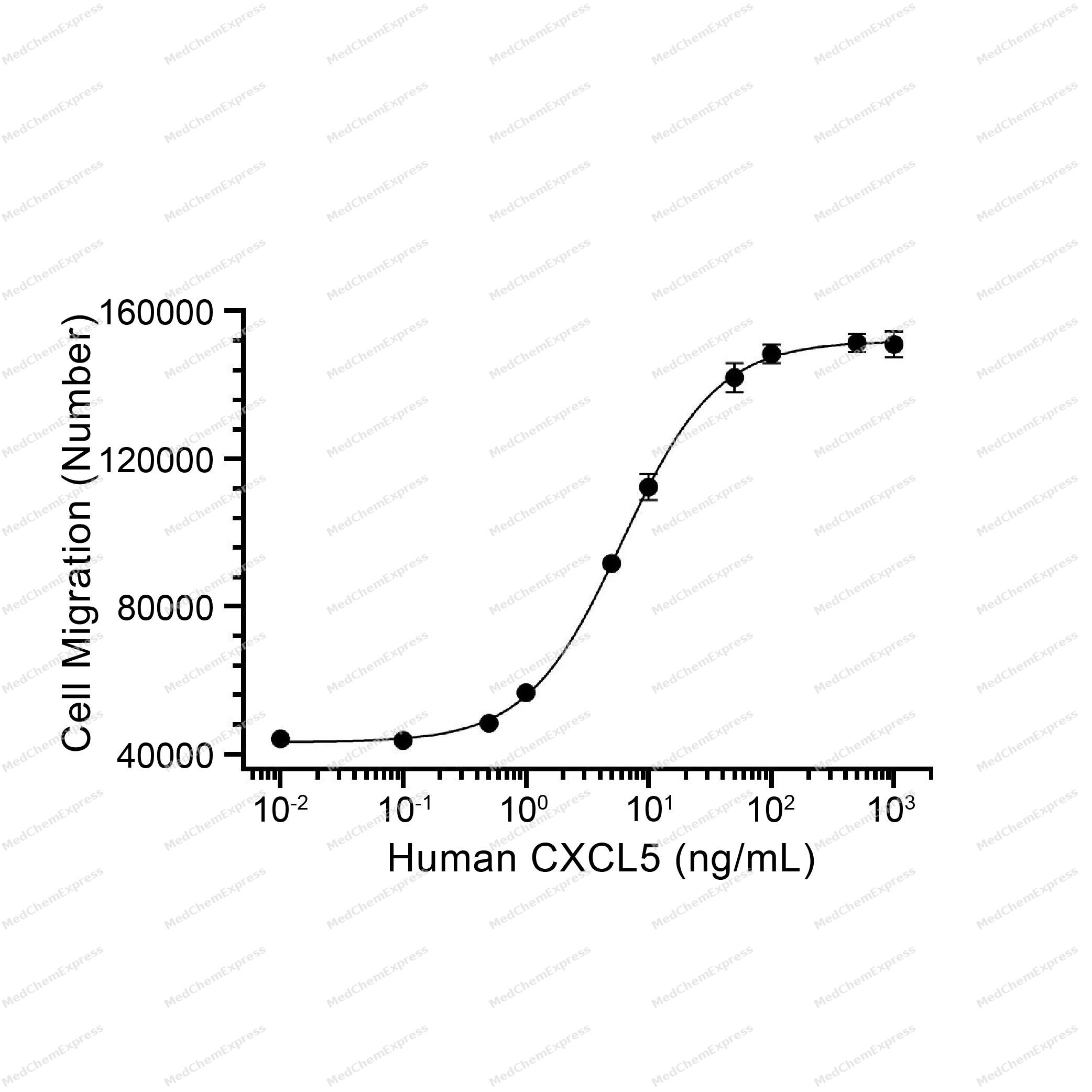
Bioactivity - Cell-Based Assay


Publications (1)
-
Journal Impact Factor
-
Most Recent
-
Cell Rep Med
Enhancing gastric cancer immunotherapy: Insights from multi-omics analysis and innovations in photodynamic-chemotherapy nanoplatforms. [Abstract]2026 Mar 17;7(3):102635. PMID: 41747719


Technical Parameters
-
Species Human
-
Source E. coli
-
Tag Tag Free
-
Accession
P42830 (R45-N114)
-
Molecular Construction
-
N-term
-
ENA-78 (R45-N114)
Accession # P42830 -
C-term
-
-
Protein Length
Full Length of ENA-78(9-78) Chain
-
Synonyms
CXCL5; Chemokine (C-X-C Motif) Ligand 5; Prev. SCYB5; Neutrophil-Activating Protein 78; ENA-78; Small-Inducible Cytokine B5; Small Inducible Cytokine Subfamily B (Cys-X-Cys), Member 5 (Epithelial-Derived Neutrophil-Activating Peptide 78); C-X-C Motif Chem
-
AA Sequence
RELRCVCLQTTQGVHPKMISNLQVFAIGPQCSKVEVVASLKNGKEICLDPEAPFLKKVIQKILDGGNKEN
-
Predicted Molecular Mass
7.7 kDa
-
Molecular Weight
Approximately 8 kDa, based on SDS-PAGE under reducing conditions.
-
Purity
≥ 95%, as determined by reducing SDS-PAGE.


Product Properties
Lyophilized powder
1.Lyophilized from a 0.22 μm filtered solution of PBS.
2.Lyophilized from a 0.22 μm filtered solution of 50 mM Tris-HCl, 300 mM NaCl, pH 8.0.
Please refer to the lot-specific COA for specific buffer information.
Note: For SPR assay, please replace the buffer. Primary amine components (e.g., Tris, imidazole) can affect protein-coupled chips.
<0.2 EU/μg, determined by LAL method.
It is not recommended to reconstitute to a concentration less than 100 μg/mL in ddH2O. For long term storage it is recommended to add a carrier protein (0.1% BSA, 5% HSA, 10% FBS or 5% Trehalose).
Stored at -20°C for 2 years from date of receipt. After reconstitution, it is stable at 4°C for 1 week or -20°C for longer (with carrier protein). It is recommended to freeze aliquots at -20°C or -80°C for extended storage.
Room temperature in continental US; may vary elsewhere.


Documentation
-
Data Sheet (263 KB)
-
SDS (251 KB)
- English - EN (251 KB)
- Français - FR (251 KB)
- Deutsch - DE (251 KB)
- Norwegian - NO (251 KB)
- Español - ES (251 KB)
- Swedish - SV (251 KB)
- Italian - IT (251 KB)
- Korean - KR (251 KB)
- Portuguese - PT (251 KB)
-
Handling Instructions (2659 KB)


References
[1]. Kawamura M, et al. CXCL5, a promoter of cell proliferation, migration and invasion, is a novel serum prognostic marker in patients with colorectal cancer. Eur J Cancer. 2012 Sep;48(14):2244-51. [Content Brief]
[2]. Kawamura M, et al. CXCL5, a promoter of cell proliferation, migration and invasion, is a novel serum prognostic marker in patients with colorectal cancer. Eur J Cancer. 2012 Sep;48(14):2244-51. [Content Brief]
[3]. Wen Zhang, et al. CXCL5/CXCR2 axis in tumor microenvironment as potential diagnostic biomarker and therapeutic target. Cancer Commun (Lond). 2020 Mar;40(2-3):69-80. [Content Brief]

Calculators
Concentration (start) × Volume (start) = Concentration (final) × Volume (final)


 Powered by Bioz

