



FGF-18 Protein, Human
Based on 1 Customer Validation
FGF-18 Protein, Human is a heparin-binding polypeptide growth factor, involved in cartilage growth, maturation and the development of functional cartilage and bone tissue.
- Species: Human
- Source: E. coli
-
Storage:Stored at -20°C for 2 years from date of receipt. After reconstitution, it is stable at 4°C for 1 week or -20°C for longer (with carrier protein). It is recommended to freeze aliquots at -20°C or -80°C for extended storage.


To place orders, for customer services and technical support, please contact: MedChemExpress USA
Tel: 609-228-6898 E-mail: [email protected] [email protected]


-
 Biological Activity
-
Technical Parameters
-
Product Properties
- Documentation
- References
- Help & FAQs


-
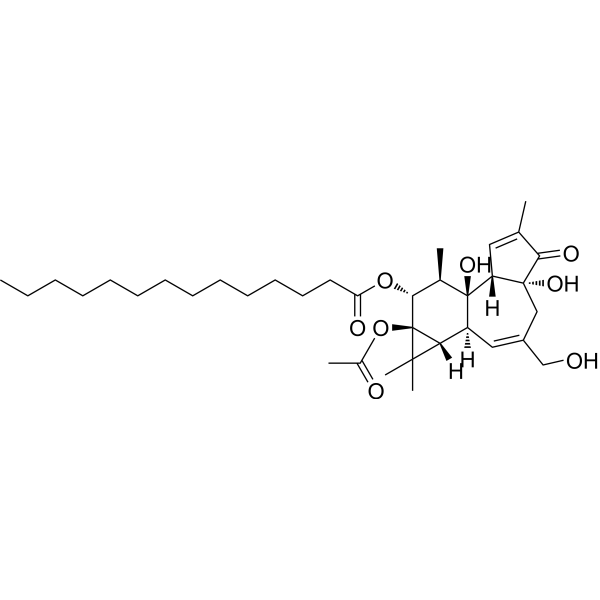
HY-18739
Phorbol 12-myristate 13-acetate -
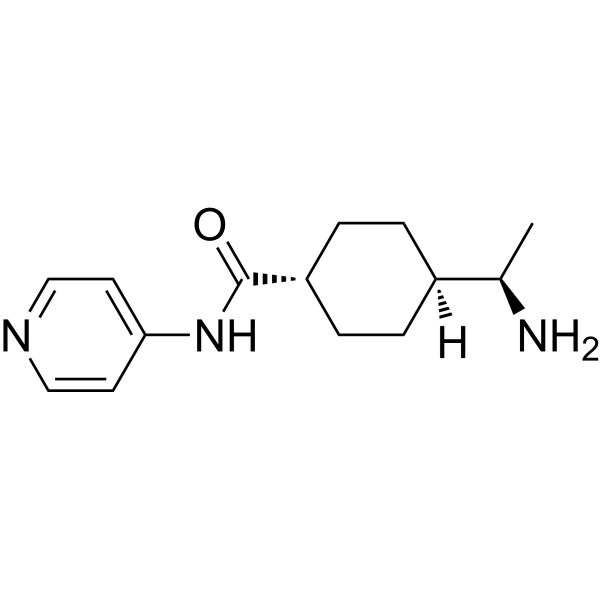
HY-10071
Y-27632 -
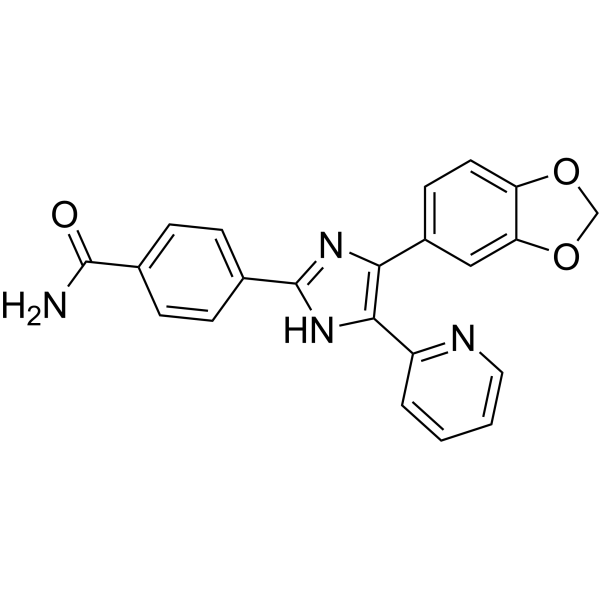
HY-10431
SB-431542 -
HY-K2014
PEI Transfection Reagent -

HY-P7004
FGF basic/bFGF Protein, Human (146a.a) -
HY-P7109
EGF Protein, Human -
HY-P7172
FGF-19 Protein, Human -
HY-P700065AF
Animal-Free FGF-3 Protein, Human (His) -
HY-P700067AF
Animal-Free FGF-5 Protein, Human (His) -
HY-P700063AF
Animal-Free FGF-22 Protein, Human (His-SUMO)


Biological Activity
Description
FGF-18 Protein, Human is a heparin-binding polypeptide growth factor, involved in cartilage growth, maturation and the development of functional cartilage and bone tissue.
Background
Fibroblast growth factor 18 (FGF18), a secreted heparin-binding polypeptide growth factor, is related to FGF8 and 175 and has been shown to have a number of functions in different organs. FGF18 is involved in cartilage growth and maturation and is implicated in the development of functional cartilage and bone tissue. It is also involved in processes within mature cartilage10-13 as well as being shown to have a role in enhancing regeneration and repair[1]. Fibroblast growth factor 18 (FGF18) acts as an important role in skeletal growth and limb development, potentially through the modulation of osteoblasts, chondrocytes, and osteoclasts[2].
Verified Bioactivity
1.The ED50 is <10 ng/mL as measured by 3T3 cells, corresponding to a specific activity of > 1.0 × 10⁵ units/mg.
2.Measured by its binding ability in a functional ELISA. Immobilized Human FGF18 at 10 μg/mL (100 μL/well) can bind Biotinylated Rat FGFR4 protein. The ED50 for this effect is 0.8084 μg/mL.
3.Measured by its binding ability in a functional ELISA. Immobilized Human FGF18 at 2 μg/mL (100 μL/well) can bind Biotinylated Rat FGFR4 protein. The ED50 for this effect is <0.6 μg/mL.
MCE Validation Data
-
Purity - SDS-PAGE
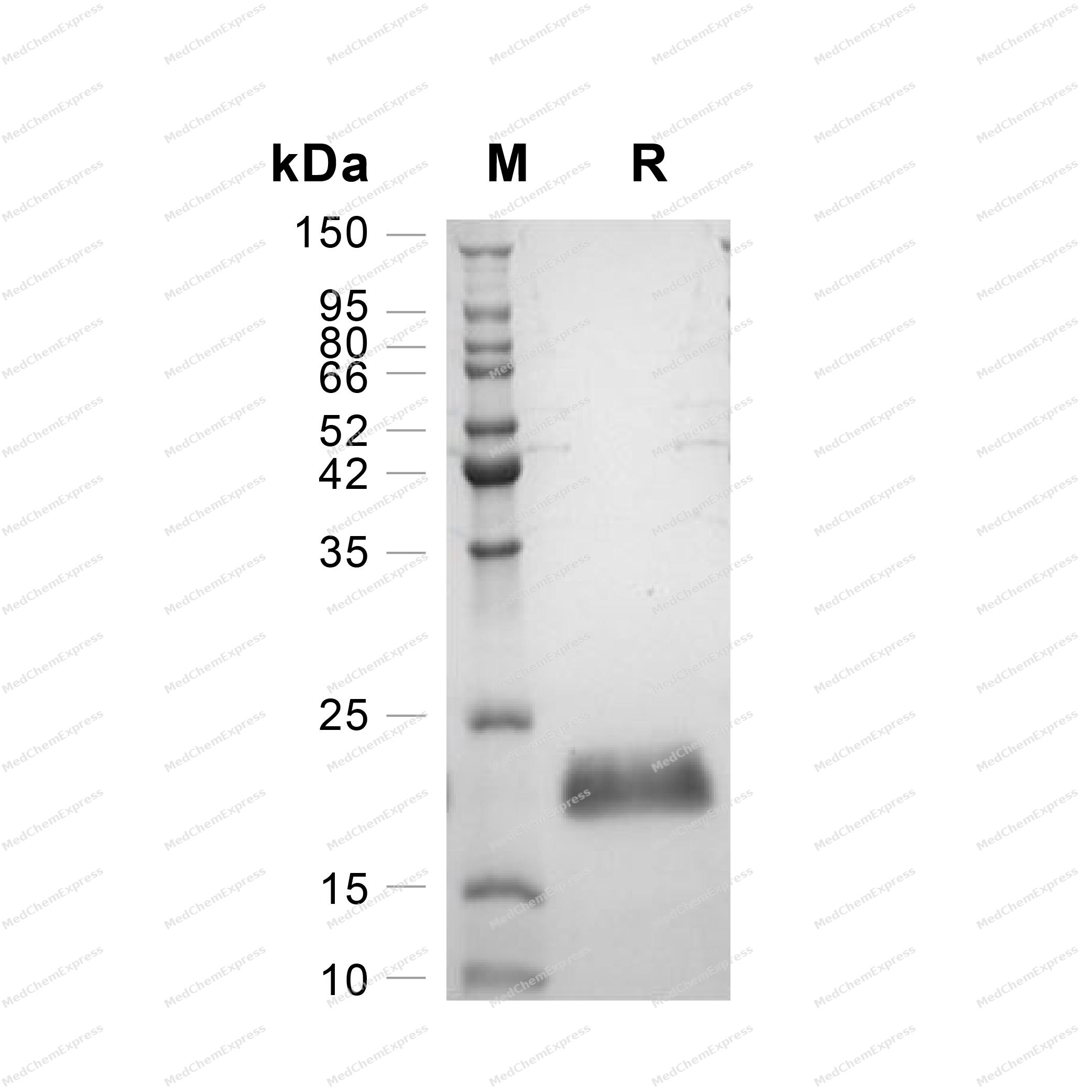
Purity - SDS-PAGE
-
Bioactivity - ELISA
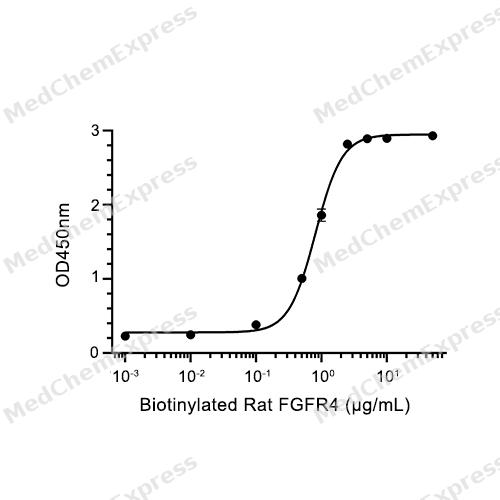
Bioactivity - ELISA


Technical Parameters
-
Species Human
-
Source E. coli
-
Tag Tag Free
-
Accession
O76093 (A27-R199)
-
Molecular Construction
-
N-term
-
FGF-18 (A27-R199)
Accession # O76093 -
C-term
-
-
Protein Length
Full Length of Fibroblast growth factor 18 Chain
-
Synonyms
FGF18; ZFGF5; Fibroblast Growth Factor 18; Fibroblast Growth Factor; FGF-18; FGF
-
AA Sequence
AEENVDFRIHVENQTRARDDVSRKQLRLYQLYSRTSGKHIQVLGRRISARGEDGDKYAQLLVETDTFGSQVRIKGKETEFYLCMNRKGKLVGKPDGTSKECVFIEKVLENNYTALMSAKYSGWYVGFTKKGRPRKGPKTRENQQDVHFMKRYPKGQPELQKPFKYTTVTKRSR
-
Predicted Molecular Mass
20.3 kDa
-
Molecular Weight
Approximately 20 kDa, based on SDS-PAGE under reducing conditions.
-
Purity
≥ 95%, as determined by reducing SDS-PAGE.


Product Properties
Lyophilized powder
1.Lyophilized from a 0.22 μm filtered solution of PBS.
2.Lyophilized from a 0.22 μm filtered solution of 20 mM PB, 150 mM NaCl, pH 7.4.
3.Lyophilized from a 0.22 μm filtered solution of PBS, pH 7.4, 8% trehalose.
Please refer to the lot-specific COA for specific buffer information.
<0.2 EU/μg, determined by LAL method.
It is not recommended to reconstitute to a concentration less than 100 μg/mL in ddH2O. For long term storage it is recommended to add a carrier protein (0.1% BSA, 5% HSA, 10% FBS or 5% Trehalose).
Stored at -20°C for 2 years from date of receipt. After reconstitution, it is stable at 4°C for 1 week or -20°C for longer (with carrier protein). It is recommended to freeze aliquots at -20°C or -80°C for extended storage.
Room temperature in continental US; may vary elsewhere.


Documentation
-
Data Sheet (262 KB)
-
SDS (251 KB)
- English - EN (251 KB)
- Français - FR (251 KB)
- Deutsch - DE (251 KB)
- Norwegian - NO (251 KB)
- Español - ES (251 KB)
- Swedish - SV (251 KB)
- Italian - IT (251 KB)
- Korean - KR (251 KB)
- Portuguese - PT (251 KB)
-
Handling Instructions (2659 KB)


References
[1]. Barr L, et al. The effect of recombinant human fibroblast growth factor-18 on articular cartilage following single impact load. J Orthop Res. 2014 Jul;32(7):923-7. [Content Brief]
[2]. Chen T, et al. Fibroblast growth factor 18 promotes proliferation and migration of H460 cells via the ERK and p38 signaling pathways. Oncol Rep. 2017 Feb;37(2):1235-1242. [Content Brief]

Calculators
Concentration (start) × Volume (start) = Concentration (final) × Volume (final)


 Powered by Bioz

