



FGFR-1 beta (IIIc) Protein, Human (HEK293, His-Avi)
Based on 1 Customer Validation
FGFR-1 alpha is a tyrosine-protein kinase receptor for fibroblast growth factor that is critical in embryonic development, cell proliferation, differentiation, and migration. GnRH is essential for mesodermal patterning, axial organization, skeletogenesis, and nervous system development. FGFR-1 beta (IIIc) Protein, Human (HEK293, His-Avi) is the recombinant human-derived FGFR-1 beta, expressed by HEK293 , with C-Avi, C-His labeled tag.
- Species: Human
- Source: HEK293
-
Storage:Stored at -20°C for 2 years from date of receipt. After reconstitution, it is stable at 4°C for 1 week or -20°C for longer (with carrier protein). It is recommended to freeze aliquots at -20°C or -80°C for extended storage.


To place orders, for customer services and technical support, please contact: MedChemExpress USA
Tel: 609-228-6898 E-mail: [email protected] [email protected]


-
 Biological Activity
-
Technical Parameters
-
Product Properties
- Documentation
- Help & FAQs




Biological Activity
Description
FGFR-1 alpha is a tyrosine-protein kinase receptor for fibroblast growth factor that is critical in embryonic development, cell proliferation, differentiation, and migration. GnRH is essential for mesodermal patterning, axial organization, skeletogenesis, and nervous system development. FGFR-1 beta (IIIc) Protein, Human (HEK293, His-Avi) is the recombinant human-derived FGFR-1 beta, expressed by HEK293 , with C-Avi, C-His labeled tag.
Background
FGFR-1 alpha, a tyrosine-protein kinase, functions as a cell-surface receptor for fibroblast growth factors and plays a pivotal role in regulating embryonic development, cell proliferation, differentiation, and migration. It is essential for normal mesoderm patterning, proper axial organization during embryonic development, skeletogenesis, and the development of the gonadotropin-releasing hormone (GnRH) neuronal system. Upon ligand binding, FGFR-1 alpha activates multiple signaling cascades, phosphorylating key proteins such as PLCG1, FRS2, GAB1, and SHB. This activation leads to the production of signaling molecules like diacylglycerol and inositol 1,4,5-trisphosphate through PLCG1. Moreover, phosphorylation of FRS2 triggers the recruitment of GRB2, GAB1, PIK3R1, and SOS1, mediating the activation of RAS, MAPK1/ERK2, MAPK3/ERK1, the MAP kinase signaling pathway, and the AKT1 signaling pathway. FGFR-1 alpha also promotes the phosphorylation of SHC1, STAT1, and PTPN11/SHP2. Within the nucleus, it enhances the activity of RPS6KA1 and CREB1, contributing to the regulation of transcription. The down-regulation of FGFR-1 alpha signaling occurs through IL17RD/SEF and FGFR-1 alpha ubiquitination, internalization, and degradation.
Verified Bioactivity
1.This product does not contain protein kinase domain.
2.Immobilized Anti-FGFR1 Anitibody, hFc Tag at 2 μg/mL (100 μl/Well)on the plate. Dose response curve for Human FGFR1 beta (Illc), His Tag with the EC50 of ≤ 0.34 μg/mL determined by ELISA.
3.Immobilized Human FGFR1 beta (IIIc) at 0.5 μg/mL (100 μL/Well) on the plate. Dose response curve for Anti-FGFR1 Antibody with the ED50 of 0.3177 μg/mL determined by ELISA.
MCE Validation Data
-
Purity - SDS-PAGE
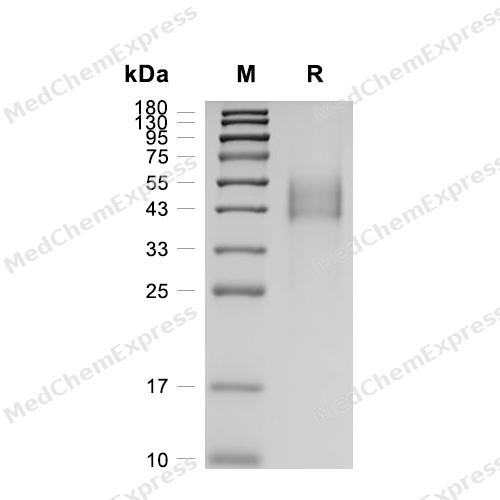
Purity - SDS-PAGE
-
Bioactivity - ELISA
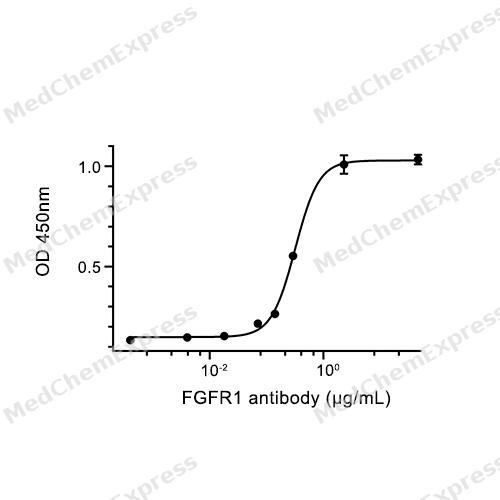
Bioactivity - ELISA


Technical Parameters
-
Species Human
-
Source HEK293
-
Tag C-Avi;C-His
-
Accession
P11362-7 (K158-T355)
-
Molecular Construction
-
N-term
-
FGFR-1 beta (IIIc) (K158-T355)
Accession # P11362-7 -
His-Avi
-
C-term
-
-
Protein Length
Partial Extracellular Domain
-
Synonyms
FGFR1; H3; Prev. FLT2; H5; Prev. KAL2; Heparin-Binding Growth Factor Receptor; BFGFR; Fibroblast Growth Factor Receptor; CEK; Receptor Protein-Tyrosine Kinase; FLG; FMS-Like Tyrosine Kinase 2; Basic Fibroblast Growth Factor Receptor 1; Hydroxyaryl-Protein
-
AA Sequence
KMEKKLHAVPAAKTVKFKCPSSGTPNPTLRWLKNGKEFKPDHRIGGYKVRYATWSIIMDSVVPSDKGNYTCIVENEYGSINHTYQLDVVERSPHRPILQAGLPANKTVALGSNVEFMCKVYSDPQPHIQWLKHIEVNGSKIGPDNLPYVQILKTAGVNTTDKEMEVLHLRNVSFEDAGEYTCLAGNSIGLSHHSAWLT
-
Molecular Weight
Approximately 45-55 kDa, based on SDS-PAGE under reducing conditions, due to the glycosylation.
-
Glycosylation
Yes
-
Purity
≥ 95%, as determined by reducing SDS-PAGE or Bis-Tris PAGE.


Product Properties
Lyophilized powder.
1.Lyophilized from a 0.22 μm filtered solution of PBS, 8% trehalose, pH 7.4.
2.Lyophilized from a 0.22 μm filtered solution of PBS, pH 6.5, 8% trehalose.
Please refer to the lot-specific COA for specific buffer information.
<1 EU/μg, determined by LAL method.
It is not recommended to reconstitute to a concentration less than 100 μg/mL in ddH2O.
Stored at -20°C for 2 years from date of receipt. After reconstitution, it is stable at 4°C for 1 week or -20°C for longer (with carrier protein). It is recommended to freeze aliquots at -20°C or -80°C for extended storage.
Room temperature in continental US; may vary elsewhere.


Documentation
-
Data Sheet (237 KB)
-
SDS (251 KB)
- English - EN (251 KB)
- Français - FR (251 KB)
- Deutsch - DE (251 KB)
- Norwegian - NO (251 KB)
- Español - ES (251 KB)
- Swedish - SV (251 KB)
- Italian - IT (251 KB)
- Korean - KR (251 KB)
- Portuguese - PT (251 KB)
-
Handling Instructions (2659 KB)

Calculators
Concentration (start) × Volume (start) = Concentration (final) × Volume (final)


 Powered by Bioz

