



FGFR-1 Protein, Rhesus Macaque (HEK293, His)

Based on 1 Customer Validation
FGFR-1 protein is a tyrosine-protein kinase that acts as a cell surface receptor for fibroblast growth factor and plays a critical role in the complex regulation of embryonic development, cell proliferation, differentiation, and migration. FGFR-1 mediates activation of RAS, MAPK1/ERK2, MAPK3/ERK1, MAP kinase signaling pathways, and AKT1 signaling pathways. FGFR-1 Protein, Rhesus Macaque (HEK293, His) is the recombinant Rhesus Macaque-derived FGFR-1 protein, expressed by HEK293 , with C-His labeled tag.
- Species: Rhesus Macaque
- Source: HEK293
-
Storage:Stored at -20°C for 2 years from date of receipt. After reconstitution, it is stable at 4°C for 1 week or -20°C for longer (with carrier protein). It is recommended to freeze aliquots at -20°C or -80°C for extended storage.


To place orders, for customer services and technical support, please contact: MedChemExpress USA
Tel: 609-228-6898 E-mail: [email protected] [email protected]


-
 Biological Activity
-
Technical Parameters
-
Product Properties
- Documentation
- References
- Help & FAQs




Biological Activity
Description
FGFR-1 protein is a tyrosine-protein kinase that acts as a cell surface receptor for fibroblast growth factor and plays a critical role in the complex regulation of embryonic development, cell proliferation, differentiation, and migration. FGFR-1 mediates activation of RAS, MAPK1/ERK2, MAPK3/ERK1, MAP kinase signaling pathways, and AKT1 signaling pathways. FGFR-1 Protein, Rhesus Macaque (HEK293, His) is the recombinant Rhesus Macaque-derived FGFR-1 protein, expressed by HEK293 , with C-His labeled tag.
Background
FGFR-1 protein is a tyrosine-protein kinase that acts as a cell surface receptor for fibroblast growth factor and plays a critical role in the complex regulation of embryonic development, cell proliferation, differentiation, and migration. FGFR-1 activates multiple signaling cascades, phosphorylating key proteins such as PLCG1, FRS2, GAB1, and SHB. This activation results in the production of signaling molecules via PLCG1. FRS2 phosphorylation triggers recruitment of GRB2, GAB1, PIK3R1, and SOS1, and mediates activation of RAS, MAPK1/ERK2, MAPK3/ERK1, MAP kinase signaling pathways, and AKT1 signaling pathways. FGFR1 also promotes phosphorylation of SHC1, STAT1, and PTPN11/SHP2. In the nucleus, it can enhance the activity of RPS6KA1 and CREB1 and participate in transcriptional regulation. Down-regulation of FGFR1 signaling occurs through IL17RD/SEF and FGFR1 ubiquitination, internalization, and degradation[1][2][3]
Verified Bioactivity
1.This product does not contain protein kinase domain.
2.Measured by its ability to inhibit FGF-acidic dependent proliferation of Balb/c 3T3 mouse fibroblasts. The ED50 for this effect is typically 0.3610ng/mL, corresponding to a specific activity is 2.770×10⁶ units/mg.
MCE Validation Data
-
Purity - SDS-PAGE
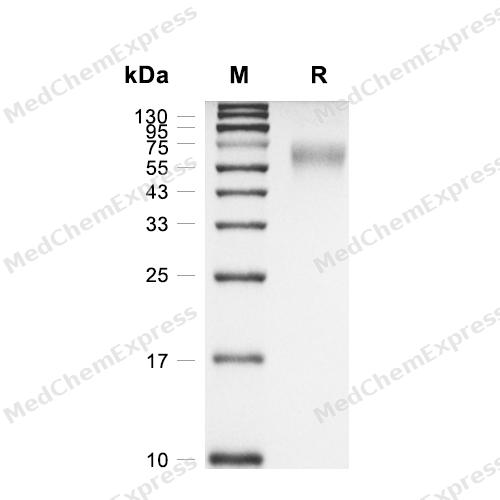
Purity - SDS-PAGE
-
Bioactivity - Cell-Based Assay
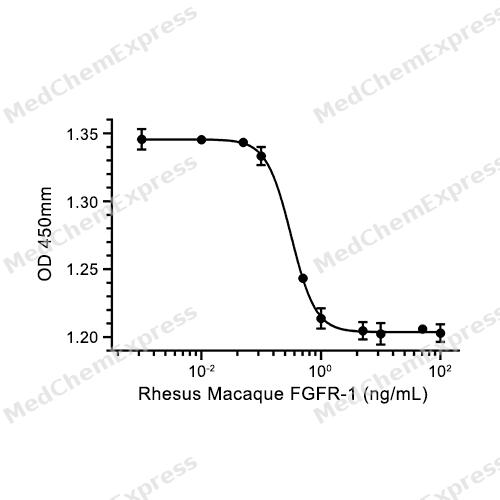
Bioactivity - Cell-Based Assay


Technical Parameters
-
Species Rhesus Macaque
-
Source HEK293
-
Tag C-6*His
-
Accession
H9FRD4/NP_001253576.1 (R22-Y283)
-
Molecular Construction
-
N-term
-
FGFR-1 (R22-Y283)
Accession # H9FRD4/NP_001253576.1 -
His
-
C-term
-
-
Protein Length
Partial
-
Synonyms
FGFR1; H3; Prev. FLT2; H5; Prev. KAL2; Heparin-Binding Growth Factor Receptor; BFGFR; Fibroblast Growth Factor Receptor; CEK; Receptor Protein-Tyrosine Kinase; FLG; FMS-Like Tyrosine Kinase 2; Basic Fibroblast Growth Factor Receptor 1; Hydroxyaryl-Protein
-
AA Sequence
RPSPTLPEQDALPSSEDDDDDDDSSSEEKETDNTKPNPVAPYWTSPEKMEKKLHAVPAAKTVKFKCPSSGTPNPTLRWLKNGKEFKPDHRIGGYKVRYATWSIIMDSVVPSDKGNYTCIVENEYGSINHTYQLDVVERSPHRPILQAGLPANKTVALGSNVEFMCKVYSDPQPHIQWLKHIEVNGSKIGPDNLPYVQILKTAGVNTTDKEMEVLHLRNVSFEDAGEYTCLAGNSIGLSHHSAWLTVLEALEERPAVMTSPLY
-
Molecular Weight
Approximately 50-75 kDa, based on SDS-PAGE under reducing conditions, due to the glycosylation.
-
Glycosylation
Yes
-
Purity
≥ 95%, as determined by reducing SDS-PAGE.


Product Properties
Lyophilized powder.
Lyophilized from a 0.22 μm filtered solution of PBS, pH 7.4.
<1 EU/μg, determined by LAL method.
It is not recommended to reconstitute to a concentration less than 100 μg/mL in ddH2O. For long term storage it is recommended to add a carrier protein (0.1% BSA, 5% HSA, 10% FBS or 5% Trehalose).
Stored at -20°C for 2 years from date of receipt. After reconstitution, it is stable at 4°C for 1 week or -20°C for longer (with carrier protein). It is recommended to freeze aliquots at -20°C or -80°C for extended storage.
Room temperature in continental US; may vary elsewhere.


Documentation
-
Data Sheet (264 KB)
-
SDS (252 KB)
- English - EN (252 KB)
- Français - FR (252 KB)
- Deutsch - DE (252 KB)
- Norwegian - NO (252 KB)
- Español - ES (252 KB)
- Swedish - SV (252 KB)
- Italian - IT (252 KB)
- Korean - KR (252 KB)
- Portuguese - PT (252 KB)
-
Handling Instructions (2659 KB)


References
[1]. Katoh M, et al. FGF receptors: cancer biology and therapeutics. Med Res Rev. 2014 Mar;34(2):280-300. [Content Brief]
[2]. Kelleher FC, et al. Fibroblast growth factor receptors, developmental corruption and malignant disease. Carcinogenesis. 2013 Oct;34(10):2198-205. [Content Brief]
[3]. Mariz BALA, et al. Expression of FGF-2/FGFR-1 in normal mucosa, salivary gland, preneoplastic, and neoplastic lesions of the oral cavity. J Oral Pathol Med. 2018 Oct;47(9):816-822. [Content Brief]

Calculators
Concentration (start) × Volume (start) = Concentration (final) × Volume (final)


 Powered by Bioz

