



GDF-15 Protein, Mouse (HEK293, hFc)
Based on 1 Customer Validation
Growth differentiation factor 15 (GDF-15) is a polypeptide hormone belonging to the transforming growth factor β (TGF-β) superfamily. GDF-15 is also known as non-steroidal anti-inflammatory drug activating Gene-1 (NAG-1), placental transforming growth factor-β (PTGFB), prostate-derived factor (PDF), and placental bone morphogenetic protein (PLAB). GDF-15 binds to glial cell-derived neurotrophic factor (GDNF) family receptor alpha-like protein (GFRAL) and is involved in aging, cancer, and metabolic processes. GFRAL-GDF15 does not affect SMAD activity and activates intracellular signals including RET, AKT, ERK1/2, and phospholipase C (PLCγ). GDF-15 Protein, Mouse (HEK293, hFc) has 115 amino acids expressed by HEK293 cells with N-terminal hFc tag.
- Species: Mouse
- Source: HEK293
-
Storage:Stored at -20°C for 2 years from date of receipt. After reconstitution, it is stable at 4°C for 1 week or -20°C for longer (with carrier protein). It is recommended to freeze aliquots at -20°C or -80°C for extended storage.


To place orders, for customer services and technical support, please contact: MedChemExpress USA
Tel: 609-228-6898 E-mail: [email protected] [email protected]


-
 Biological Activity
-
Technical Parameters
-
Product Properties
- Documentation
- Help & FAQs




Biological Activity
Description
Growth differentiation factor 15 (GDF-15) is a polypeptide hormone belonging to the transforming growth factor β (TGF-β) superfamily. GDF-15 is also known as non-steroidal anti-inflammatory drug activating Gene-1 (NAG-1), placental transforming growth factor-β (PTGFB), prostate-derived factor (PDF), and placental bone morphogenetic protein (PLAB). GDF-15 binds to glial cell-derived neurotrophic factor (GDNF) family receptor alpha-like protein (GFRAL) and is involved in aging, cancer, and metabolic processes. GFRAL-GDF15 does not affect SMAD activity and activates intracellular signals including RET, AKT, ERK1/2, and phospholipase C (PLCγ)[1]. GDF-15 Protein, Mouse (HEK293, hFc) has 115 amino acids expressed by HEK293 cells with N-terminal hFc tag.
Background
Growth differentiation factor 15 (GDF-15) is a polypeptide hormone belonging to the transforming growth factor β (TGF-β) superfamily. GDF-15 was highly expressed in placenta, low in prostate and colon, and to some extent in kidney. So GDF-15 is also known as placental transforming growth factor PGF-β, placental bone morphogenetic protein PLAB, and prostatus-derived factor PDF. GDF-15 has a wide range of biological functions in physiology and pathology, especially in aging, cancer, and metabolic processes. GDF-15 is initially stored in the extracellular matrix (ECM), where it undergoes proteolytic hydrolysis upon external stimulation to form an active form that is quickly secreted into circulation. In mouse cardiomyocytes, the cleavage process of GDF-15 may be catalyzed by the enzymes of the PCSK family, resulting in a mature dimer form. Upstream of the GDF15 promoter site, there are binding sites for various transcription factors, including specific protein 1 (Sp1), early growth response protein 1 (Egr-1), p53 and COUP transcription factor 1 (COUP-TF1). The receptor of GDF-15 is alpha-like protein (GFRAL), a receptor of the glial cell derived neurotrophic factor (GDNF) family. The GFRAL-GDF15 complex binds to the tyrosine kinase co-receptor RET, leading to RET phosphorylation. Subsequently, GFRAL-GDF15 continued to activate the intracellular signaling pathways of AKT, ERK1/2, and phospholipase C (PLCγ), but not the SMAD pathway. GDF-15 is overexpressed during and after many pathological states such as tissue injury and inflammation. The stimulating factors that contribute to this result include oxidized low-density lipoprotein (oxLDL), cytokines, and growth factors such as IL-1β, TNF-α, angiotensin II, macrophage colony-stimulating factor M-CSF, and TGFβ. GDF-15, also known as the NSAIDS drug activator gene NAG-1, may play an anti-inflammatory role by inhibiting macrophage activation. GDF-15 also inhibits the activity of NFκB or the expression of several cytokines, including interferon (IFN-γ), interleukin-6 (IL-6), monocyte chemotactic protein-1 (MCP-1), and tumor necrosis factor-α (TNF-α). GDF-15 has significant resistance to endotoxin-induced sepsis caused by acute kidney injury (AKI) and myocardial dysfunction. GDF-15 also appears to promote tumor growth in the later stages of malignancy. Elevated serum GDF15 levels have been reported as potential biomarkers for cancer progression, including breast, colon, pancreatic, and prostate tumors, among others. In human and cynomolgus monkeys, the amino acid sequence similarity of GDF-15 protein was high, and the similarity rate was 91.56%. Compared with the amino acid sequences of mice and rats, the similarity of human GDF-15 was low (59.73% and 59.39%, respectively)[1].
In Vivo
GDF-15 knockout mice show smaller Platinum-based treatment-induced anorexia and weight loss, while GDF-15 neutralization with the monoclonal antibody mAB1 improves survival[2].
Verified Bioactivity
1. Measured by its binding ability in a functional ELISA. Recombinant Mouse GDF-15 binds to Recombinant Mouse GFR alpha-like. The ED50 for this effect is 4.460 ng/mL.
2. Immobilized Mouse GFRAL-His at 2 μg/mL (100μL/well) on the plate. Dose response curve for Mouse GDF15-hFc with the ED50 <15 ng/mL determined by ELISA.
MCE Validation Data
-
Purity - SDS-PAGE
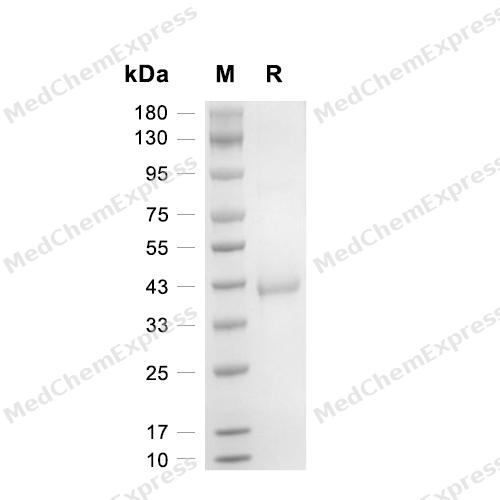
Purity - SDS-PAGE
-
Bioactivity - ELISA
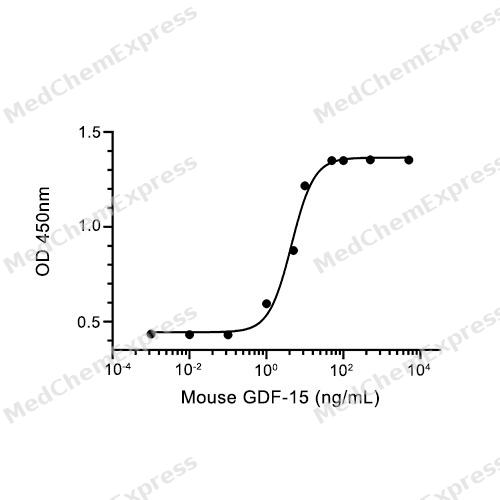
Bioactivity - ELISA


Technical Parameters
-
Species Mouse
-
Source HEK293
-
Tag N-hFc
-
Accession
Q9Z0J7 (S189-A303)
-
Gene ID23886
-
Molecular Construction
-
N-term
-
hFc
-
GDF-15 (S189-A303)
Accession # Q9Z0J7 -
C-term
-
-
Protein Length
Full Length of Mature Protein
-
Synonyms
GDF15; Placental Bone Morphogenetic Protein; Growth Differentiation Factor 15; Macrophage Inhibitory Cytokine 1; MIC-1; NSAID-Activated Gene 1 Protein; NAG-1; NSAID-Regulated Gene 1 Protein; PTGFB; Placental TGF-Beta; PLAB; GDF-15; MIC1; NRG-1; PDF; NSAID
-
AA Sequence
SAHAHPRDSCPLGPGRCCHLETVQATLEDLGWSDWVLSPRQLQLSMCVGECPHLYRSANTHAQIKARLHGLQPDKVPAPCCVPSSYTPVVLMHRTDSGVSLQTYDDLVARGCHCA
-
Predicted Molecular Mass
38.6 kDa
-
Molecular Weight
Approximately 42 kDa, based on SDS-PAGE under reducing conditions.
-
Purity
≥ 95%, as determined by Bis-Tris PAGE.


Product Properties
Lyophilized powder
Lyophilized from a 0.22 μm filtered solution of PBS, pH 7.4, 8% trehalose.
<1 EU/μg, determined by LAL method.
It is not recommended to reconstitute to a concentration less than 100 μg/mL in ddH2O.
Stored at -20°C for 2 years from date of receipt. After reconstitution, it is stable at 4°C for 1 week or -20°C for longer (with carrier protein). It is recommended to freeze aliquots at -20°C or -80°C for extended storage.
Room temperature in continental US; may vary elsewhere.


Documentation
-
Data Sheet (239 KB)
-
SDS (254 KB)
- English - EN (254 KB)
- Français - FR (254 KB)
- Deutsch - DE (254 KB)
- Norwegian - NO (254 KB)
- Español - ES (254 KB)
- Swedish - SV (254 KB)
- Italian - IT (254 KB)
- Korean - KR (254 KB)
- Portuguese - PT (254 KB)
-
Handling Instructions (2659 KB)

Calculators
Concentration (start) × Volume (start) = Concentration (final) × Volume (final)


 Powered by Bioz

