



GDF-5 Protein, Human
Based on 2 publication(s) in Google Scholar
The GDF-5 protein is critical in bone and cartilage formation, complexly regulating chondrogenic tissue differentiation through dual pathways. It positively affects cartilage formation by inducing SMAD protein signaling by binding to BMPR1B and BMPR1A. GDF-5 Protein, Human is the recombinant human-derived GDF-5 protein, expressed by E. coli , with tag free.
- Species: Human
- Source: E. coli
-
Storage:Stored at -20°C for 2 years from date of receipt. After reconstitution, it is stable at 4°C for 1 week or -20°C for longer (with carrier protein). It is recommended to freeze aliquots at -20°C or -80°C for extended storage.


To place orders, for customer services and technical support, please contact: MedChemExpress USA
Tel: 609-228-6898 E-mail: [email protected] [email protected]


-
 Biological Activity
-
Technical Parameters
-
Product Properties
- Documentation
- Help & FAQs


-

HY-P70543
TGF beta 1/TGFB1 Protein, Human (HEK293) -
HY-P7006
BMP-2 Protein, Human/Mouse/Rat -
HY-P7118
TGF beta 1/TGFB1 Protein, Human (CHO) -
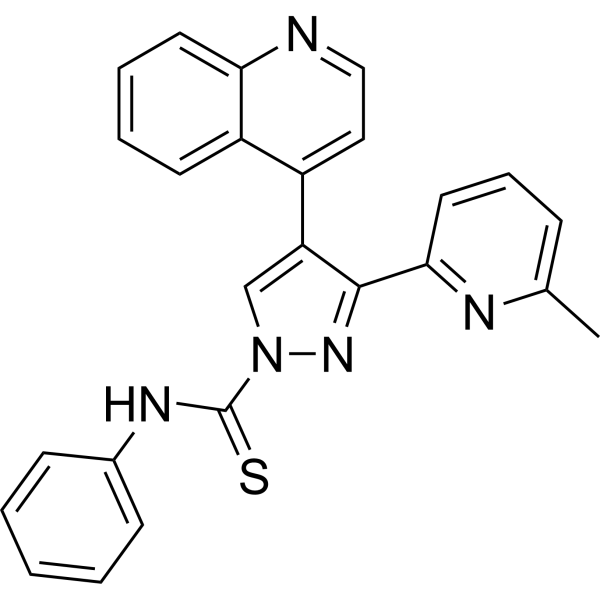
HY-10432
A 83-01 -
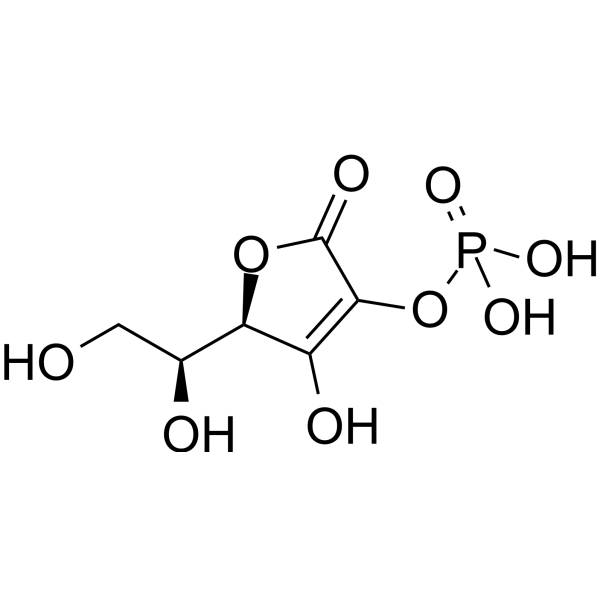
HY-103701
L-Ascorbic acid 2-phosphate -
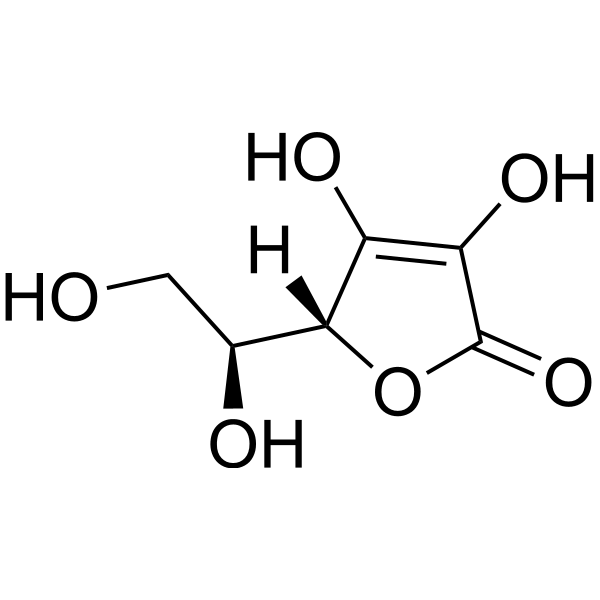
HY-B0166
L-Ascorbic acid -
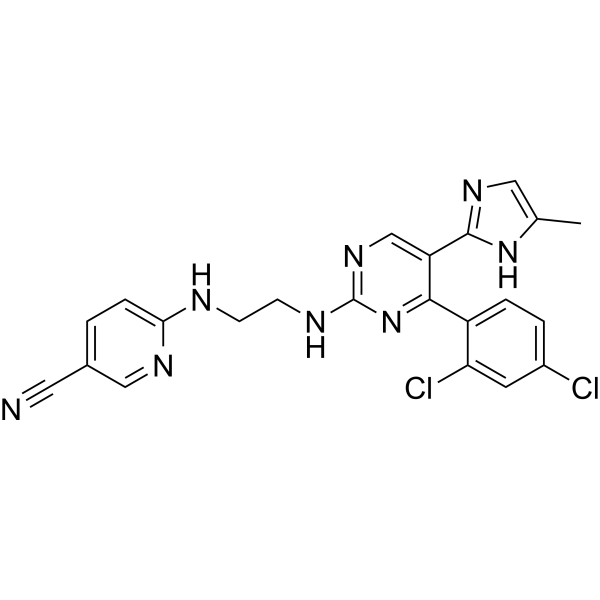
HY-10182
Laduviglusib -
HY-P7330
FGF basic/bFGF Protein, Human (145a.a) -
HY-P70648
TGF beta 1/TGFB1 Protein, Mouse/Rat (HEK293) -
HY-P700029AF
Animal-Free BMP-6 Protein, Human (His) -
HY-P70311
Activin A Protein, Human/Mouse/Rat (HEK293) -
HY-P72426
BMP-15 Protein, Human (His, Myc)


Biological Activity
Description
The GDF-5 protein is critical in bone and cartilage formation, complexly regulating chondrogenic tissue differentiation through dual pathways. It positively affects cartilage formation by inducing SMAD protein signaling by binding to BMPR1B and BMPR1A. GDF-5 Protein, Human is the recombinant human-derived GDF-5 protein, expressed by E. coli , with tag free.
Background
GDF-5 Protein plays a pivotal role in bone and cartilage formation, intricately regulating chondrogenic tissue differentiation through dual pathways. Firstly, it positively influences chondrogenic tissue differentiation by binding with high affinity to BMPR1B and with lower affinity to BMPR1A, leading to the induction of SMAD1-SMAD5-SMAD8 complex phosphorylation and subsequent SMAD protein signaling transduction. Simultaneously, it negatively regulates chondrogenic differentiation through interaction with NOG. This protein is essential for preventing excessive muscle loss upon denervation, a function mediated by phosphorylated SMAD1/5/8. Additionally, GDF-5 binds bacterial lipopolysaccharide (LPS) and mediates LPS-induced inflammatory responses, including TNF secretion by monocytes. Structurally, it forms homodimers linked by disulfide bonds and interacts with serine proteases HTRA1 and HTRA3. Following LPS binding, GDF-5 may form a complex with CXCR4, HSP90AA1, and HSPA8. Moreover, it interacts with high affinity with NOG to inhibit chondrogenesis and with BMPR1B and BMPR1A to positively regulate chondrocyte differentiation through SMAD-dependent signaling. Additionally, it engages in interactions with FBN1 and FBN2.
Verified Bioactivity
Measured by its ability to induce alkaline phosphatase production by ATDC5 mouse chondrogenic cells. The ED50 for this effect is 0.1-1.0 µg/mL.


Publications (2)
-
Journal Impact Factor
-
Most Recent
-
Adv Mater
Piezoelectric Injectable Anti-Adhesive Hydrogel to Promote Endogenous Healing of Tendon Injuries. [Abstract]2025 Jul 14:e2501306. PMID: 40658817 -


Technical Parameters
-
Species Human
-
Source E. coli
-
Tag Tag Free
-
Accession
P43026 (A382-R501)
-
Molecular Construction
-
N-term
-
GDF-5 (A382-R501)
Accession # P43026 -
C-term
-
-
Protein Length
Full Length of Mature Protein
-
Synonyms
GDF5; LAP-4; Growth Differentiation Factor 5; Cartilage-Derived Morphogenetic Protein 1; CDMP1; GDF5 Protein; BMP14; DUPANS; Growth/Differentiation Factor 5; CDMP-1; Bone Morphogenetic Protein 14; BDA1C; Cartilage-Derived Morphogenetic Protein-1; SYM1B; Lipopolysaccharide-Associated Protein 4; SYNS2; LPS-Associated Protein 4; GDF-5; Radotermin; LAP4; BMP-14; OS5
-
AA Sequence
APLATRQGKRPSKNLKARCSRKALHVNFKDMGWDDWIIAPLEYEAFHCEGLCEFPLRSHLEPTNHAVIQTLMNSMDPESTPPTCCVPTRLSPISILFIDSANNVVYKQYEDMVVESCGCR
-
Predicted Molecular Mass
13.6 kDa
-
Molecular Weight
Approximately 15-17 kDa, based on SDS-PAGE under reducing conditions.
-
Purity
≥ 90%, as determined by reducing SDS-PAGE.


Product Properties
Lyophilized powder
Lyophilized from a 0.22 μm filtered solution of 4 mM HCl, pH 2.5.
<1 EU/μg, determined by LAL method.
It is not recommended to reconstitute to a concentration less than 100 μg/mL in 4 mM HCl. For long term storage it is recommended to add a carrier protein (0.1% BSA, 5% HSA, 10% FBS or 5% Trehalose).
Stored at -20°C for 2 years from date of receipt. After reconstitution, it is stable at 4°C for 1 week or -20°C for longer (with carrier protein). It is recommended to freeze aliquots at -20°C or -80°C for extended storage.
Room temperature in continental US; may vary elsewhere.


Documentation
-
Data Sheet (236 KB)
-
SDS (254 KB)
- English - EN (254 KB)
- Français - FR (254 KB)
- Deutsch - DE (254 KB)
- Norwegian - NO (254 KB)
- Español - ES (254 KB)
- Swedish - SV (254 KB)
- Italian - IT (254 KB)
- Korean - KR (254 KB)
- Portuguese - PT (254 KB)
-
Handling Instructions (2659 KB)

Calculators
Concentration (start) × Volume (start) = Concentration (final) × Volume (final)


 Powered by Bioz

