



GFRA1/GDNFR-alpha-1 Protein, Mouse (HEK293, His)
Based on 1 Customer Validation
GFRA1/GDNFR-alpha-1, a receptor for GDNF, mediates GDNF-induced autophosphorylation and activation of the RET receptor. It interacts with RET and forms a complex with disulfide-linked GDNF dimer, and interacts with SORL1. The SORL1-GFRA1 interaction results in GFRA1 internalization without degradation. GFRA1/GDNFR-alpha-1 Protein, Mouse (HEK293, His) is the recombinant mouse-derived GFRA1/GDNFR-alpha-1 protein, expressed by HEK293 , with C-His labeled tag.
- Species: Mouse
- Source: HEK293
-
Storage:Stored at -20°C for 2 years from date of receipt. After reconstitution, it is stable at 4°C for 1 week or -20°C for longer (with carrier protein). It is recommended to freeze aliquots at -20°C or -80°C for extended storage.


To place orders, for customer services and technical support, please contact: MedChemExpress USA
Tel: 609-228-6898 E-mail: [email protected] [email protected]


-
 Biological Activity
-
Technical Parameters
-
Product Properties
- Documentation
- Help & FAQs




Biological Activity
Description
GFRA1/GDNFR-alpha-1, a receptor for GDNF, mediates GDNF-induced autophosphorylation and activation of the RET receptor. It interacts with RET and forms a complex with disulfide-linked GDNF dimer, and interacts with SORL1. The SORL1-GFRA1 interaction results in GFRA1 internalization without degradation. GFRA1/GDNFR-alpha-1 Protein, Mouse (HEK293, His) is the recombinant mouse-derived GFRA1/GDNFR-alpha-1 protein, expressed by HEK293 , with C-His labeled tag.
Background
GFRA1, known as GDNFR-alpha-1, operates as a pivotal receptor for glial cell line-derived neurotrophic factor (GDNF). Its functional significance lies in mediating the GDNF-induced autophosphorylation and activation of the RET receptor. In this molecular interplay, two molecules of GDNFR-alpha are proposed to intricately engage with the disulfide-linked GDNF dimer, forming a complex alongside two molecules of RET. This interaction with RET underscores GFRA1's role in orchestrating signaling cascades critical for cellular responses. Moreover, GFRA1 exhibits additional complexities in its interactions, forming complexes with SORL1, either independently or alongside GDNF. Notably, the interaction between SORL1 and GFRA1 results in the internalization of GFRA1 without degradation, adding a layer of regulatory sophistication to its cellular functions.
Verified Bioactivity
Immobilized Mouse GNDF at 25 ng/mL (100 μL/well) can bind Mouse GFRA1/GDNFR-alpha-1 Protein. The ED50 for this effect is 0.3750 μg/mL.
MCE Validation Data
-
Purity - SDS-PAGE
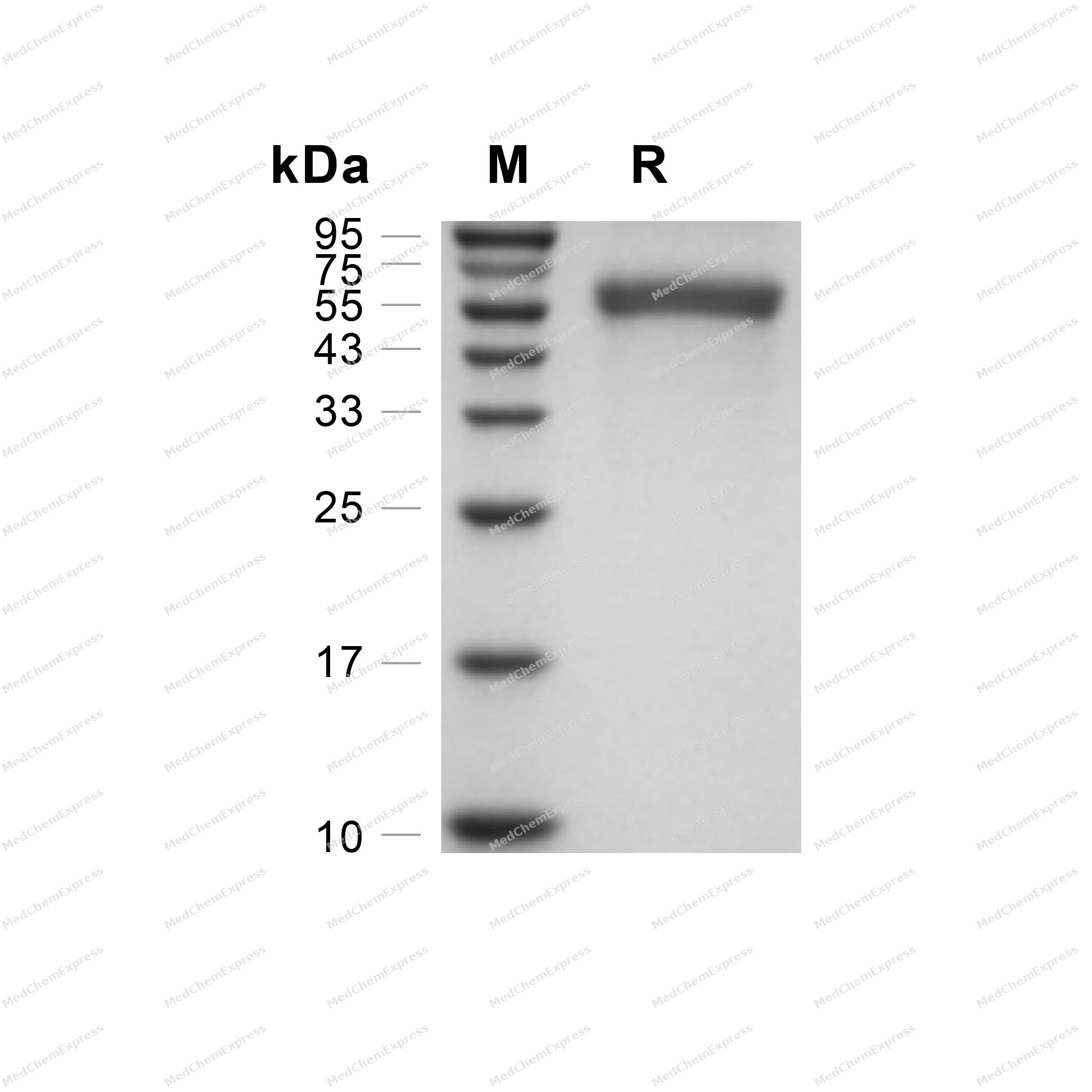
Purity - SDS-PAGE
-
Bioactivity - ELISA
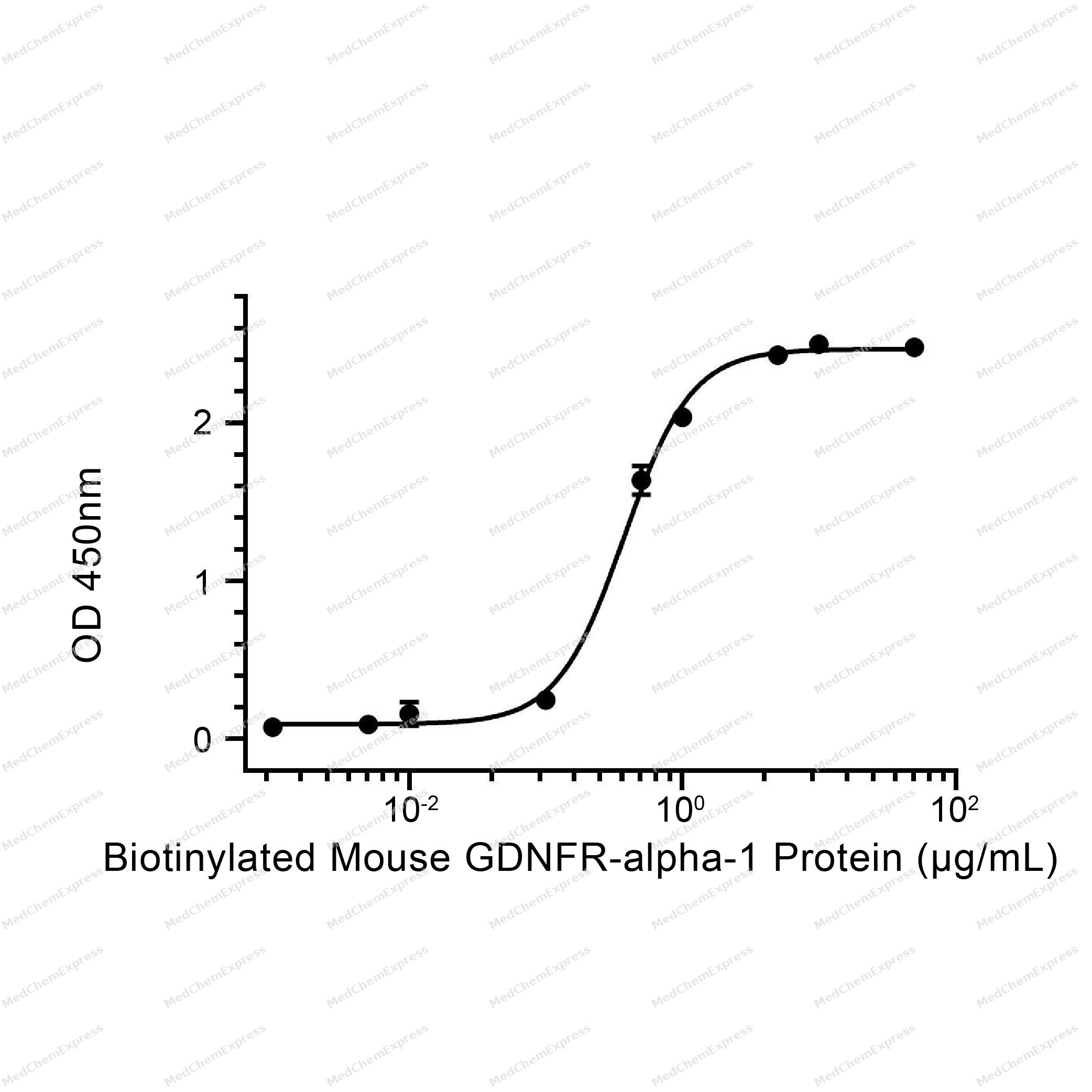
Bioactivity - ELISA


Technical Parameters
-
Species Mouse
-
Source HEK293
-
Tag C-His
-
Accession
P97785-2 (D25-S425)
-
Molecular Construction
-
N-term
-
GFRA1 (D25-S425)
Accession # P97785-2 -
His
-
C-term
-
-
Protein Length
Partial
-
Synonyms
GFRA1; GDNFR-Alpha-1; Prev. GDNFRA; Glial Cell Line-Derived Neurotrophic Factor Receptor Alpha; RETL1; PI-Linked Cell-Surface Accessory Protein; TRNR1; GPI-Linked Anchor Protein; GDNF Family Receptor Alpha-1; Alternative Protein GFRA1; GFR-ALPHA-1; GDNF R
-
AA Sequence
DRLDCVKASDQCLKEQSCSTKYRTLRQCVAGKETNFSLTSGLEAKDECRSAMEALKQKSLYNCRCKRGMKKEKNCLRIYWSMYQSLQGNDLLEDSPYEPVNSRLSDIFRAVPFISVEHISKGNNCLDAAKACNLDDTCKKYRSAYITPCTTSMSNEVCNRRKCHKALRQFFDKVPAKHSYGMLFCSCRDVACTERRRQTIVPVCSYEERERPNCLNLQDSCKTNYICRSRLADFFTNCQPESRSVSNCLKENYADCLLAYSGLIGTVMTPNYIDSSSLSVAPWCDCSNSGNDLEDCLKFLNFFKDNTCLKNAIQAFGNGSDVTMWQPAPPVQTTTATTTTAFRIKNKPLGPAGSENEIPTHVLPPCANLQAQKLKSNVSGSTHLCLSDNDYGKDGLAGASS
-
Molecular Weight
Approximately 55-60 kDa, based on SDS-PAGE under reducing conditions, due to the glycosylation.
-
Glycosylation
Yes
-
Purity
≥ 95%, as determined by reducing SDS-PAGE.


Product Properties
Lyophilized powder.
Lyophilized from a 0.22 μm filtered solution of PBS, pH 7.4.
<1 EU/μg, determined by LAL method.
It is not recommended to reconstitute to a concentration less than 100 μg/mL in ddH2O. For long term storage it is recommended to add a carrier protein (0.1% BSA, 5% HSA, 10% FBS or 5% Trehalose).
Stored at -20°C for 2 years from date of receipt. After reconstitution, it is stable at 4°C for 1 week or -20°C for longer (with carrier protein). It is recommended to freeze aliquots at -20°C or -80°C for extended storage.
Room temperature in continental US; may vary elsewhere.


Documentation
-
Data Sheet (238 KB)
-
SDS (251 KB)
- English - EN (251 KB)
- Français - FR (251 KB)
- Deutsch - DE (251 KB)
- Norwegian - NO (251 KB)
- Español - ES (251 KB)
- Swedish - SV (251 KB)
- Italian - IT (251 KB)
- Korean - KR (251 KB)
- Portuguese - PT (251 KB)
-
Handling Instructions (2659 KB)

Calculators
Concentration (start) × Volume (start) = Concentration (final) × Volume (final)


 Powered by Bioz

