



HB-EGF Protein, Human (CHO)
Based on 3 publication(s) in Google Scholar
HB-EGF Protein, Human (CHO) is shown to play a role in wound healing, cardiac hypertrophy, and heart development and function.
- Species: Human
- Source: CHO
-
Storage:Stored at -20°C for 2 years from date of receipt. After reconstitution, it is stable at 4°C for 1 week or -20°C for longer (with carrier protein). It is recommended to freeze aliquots at -20°C or -80°C for extended storage.


To place orders, for customer services and technical support, please contact: MedChemExpress USA
Tel: 609-228-6898 E-mail: [email protected] [email protected]


-
 Biological Activity
-
Technical Parameters
-
Product Properties
- Documentation
- References
- Help & FAQs




Biological Activity
Description
HB-EGF Protein, Human (CHO) is shown to play a role in wound healing, cardiac hypertrophy, and heart development and function.
Background
Heparin-binding epidermal growth factor-like growth factor (HBEGF) is a heparin-binding member of the EGF family. It is a potent mitogen and chemotactic factor for fibroblasts and smooth muscle cells. As with other EGF family members, HB-EGF binds and activates EGF receptors 1 and 4. HB-EGF has been shown to stimulate the growth of a variety of cells in an autocrine or paracrine manner and to be involved in stromal proliferation. HB-EGF is also a potent inducer of tumor growth and angiogenesis[1].
Verified Bioactivity
Measured in a cell proliferation assay using Balb/3T3 mouse embryonic fibroblast cells. The ED50 for this effect is 0.15-0.75 ng/mL.
MCE Validation Data
-
Purity - SDS-PAGE
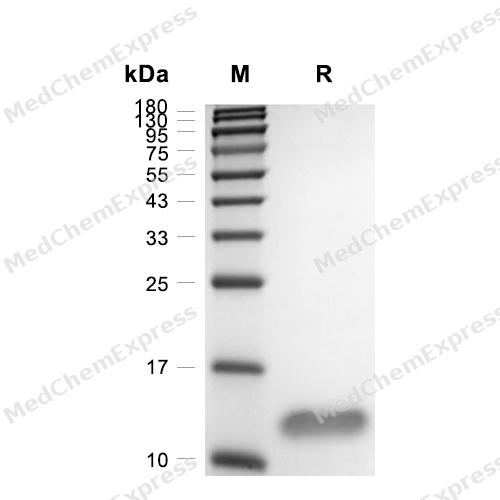
Purity - SDS-PAGE
-
Bioactivity - Cell-Based Assay
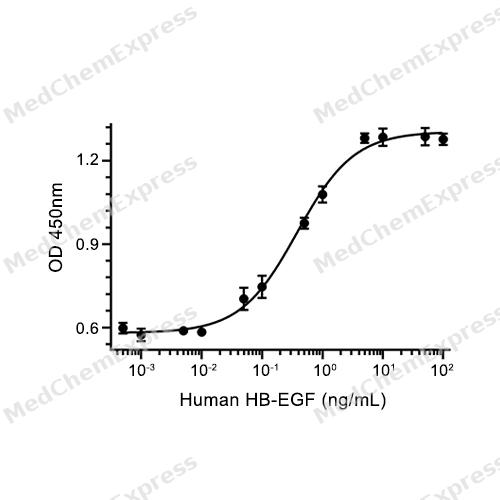
Bioactivity - Cell-Based Assay


Publications (3)
-
Journal Impact Factor
-
Most Recent


Technical Parameters
-
Species Human
-
Source CHO
-
Tag Tag Free
-
Accession
Q99075 (D63-L148)
-
Molecular Construction
-
N-term
-
HB-EGF (D63-L148)
Accession # Q99075 -
C-term
-
-
Protein Length
Full Length of Heparin-binding EGF-like growth factor Chain
-
Synonyms
HBEGF; Diphtheria Toxin Receptor (Heparin-Binding EGF-Like Growth Factor); Prev. HEGFL; Heparin-Binding Epidermal Growth Factor; Prev. DTR; Short Form Heparin-Binding EGF-Like Growth Factor; Prev. DTS; Heparin-Binding EGF-Like Growth Factor; Diphtheria To
-
AA Sequence
DLQEADLDLLRVTLSSKPQALATPNKEEHGKRKKKGKGLGKKRDPCLRKYKDFCIHGECKYVKELRAPSCICHPGYHGERCHGLSL
-
Predicted Molecular Mass
9.7 kDa
-
Molecular Weight
Approximately 12-14 kDa, based on SDS-PAGE under reducing conditions.
-
Glycosylation
Yes
-
Purity
≥ 95%, as determined by reducing SDS-PAGE.


Product Properties
Lyophilized powder
Lyophilized after extensive dialysis against PBS, pH 7.4.
<0.2 EU/μg, determined by LAL method.
It is not recommended to reconstitute to a concentration less than 100 μg/mL in ddH2O. For long term storage it is recommended to add a carrier protein (0.1% BSA, 5% HSA, 10% FBS or 5% Trehalose).
Stored at -20°C for 2 years from date of receipt. After reconstitution, it is stable at 4°C for 1 week or -20°C for longer (with carrier protein). It is recommended to freeze aliquots at -20°C or -80°C for extended storage.
Room temperature in continental US; may vary elsewhere.


Documentation
-
Data Sheet (261 KB)
-
SDS (254 KB)
- English - EN (254 KB)
- Français - FR (254 KB)
- Deutsch - DE (254 KB)
- Norwegian - NO (254 KB)
- Español - ES (254 KB)
- Swedish - SV (254 KB)
- Italian - IT (254 KB)
- Korean - KR (254 KB)
- Portuguese - PT (254 KB)
-
Handling Instructions (2659 KB)


References

Calculators
Concentration (start) × Volume (start) = Concentration (final) × Volume (final)


 Powered by Bioz

