



HER2/CD340 Protein, Canine (HEK293, His)

Based on 1 Customer Validation
The HER2/CD340 Protein is a member of the receptor tyrosine kinase family. HER2/CD340 Protein participates in the PI3K/Akt signaling pathway to regulate the differentiation and apoptosis of neural stem cells in the cochlear nucleus. HER2/CD340 Protein is an overexpressed oncogenic factor in bladder cancer that activates the oncogenic signaling pathway, thereby promoting tumor cell survival/proliferation. HER2/CD340 Protein, Canine (HEK293, His) is the recombinant canine-derived HER2/CD340 protein, expressed by HEK293 , with C-His labeled tag.
- Species: Canine
- Source: HEK293
-
Storage:Stored at -20°C for 2 years from date of receipt. After reconstitution, it is stable at 4°C for 1 week or -20°C for longer (with carrier protein). It is recommended to freeze aliquots at -20°C or -80°C for extended storage.


To place orders, for customer services and technical support, please contact: MedChemExpress USA
Tel: 609-228-6898 E-mail: [email protected] [email protected]


-
 Biological Activity
-
Technical Parameters
-
Product Properties
- Documentation
- Help & FAQs




Biological Activity
Description
The HER2/CD340 Protein is a member of the receptor tyrosine kinase family. HER2/CD340 Protein participates in the PI3K/Akt signaling pathway to regulate the differentiation and apoptosis of neural stem cells in the cochlear nucleus. HER2/CD340 Protein is an overexpressed oncogenic factor in bladder cancer that activates the oncogenic signaling pathway, thereby promoting tumor cell survival/proliferation. HER2/CD340 Protein, Canine (HEK293, His) is the recombinant canine-derived HER2/CD340 protein, expressed by HEK293 , with C-His labeled tag.
Background
The ErbB family consists of four separate plasma membrane-binding receptor tyrosine kinases. One of them is erbB-2, and the other members are erbB-1, erbB-3 (neuregulin-binding; Lack of kinase domains) and erbB-4. The receptor tyrosine-protein kinase erbB-2 is a protein normally found on cell membranes and is encoded by the ERBB2 gene. The human protein is also often referred to as HER 2 (Human epidermal growth factor receptor 2) or CD340 (differentiated cluster 340). HER2 has binding activity with Hsp90 protein, protein tyrosine kinase and ubiquitination protein. ErbB2 regulates differentiation and apoptosis of neural stem cells in the cochlear nucleus through PI3K/Akt pathway. HER2 is an oncogenic factor that is overexpressed in bladder cancer and activates the oncogenic signaling pathway, thereby promoting tumor cell survival/proliferation[1][2][3][4].
Verified Bioactivity
1.This product does not contain protein kinase domain.
2.Measured by its ability to block anti-ErbB2 mediated inhibition of SK-BR-3 human breast cancer cell proliferation. The ED50 this effect is 0.4594 μg/mL in the presence of 0.6 µg/mL Trastuzmab, corresponding to a specific activity is 2.177×10³ units/mg.
MCE Validation Data
-
Purity - SDS-PAGE
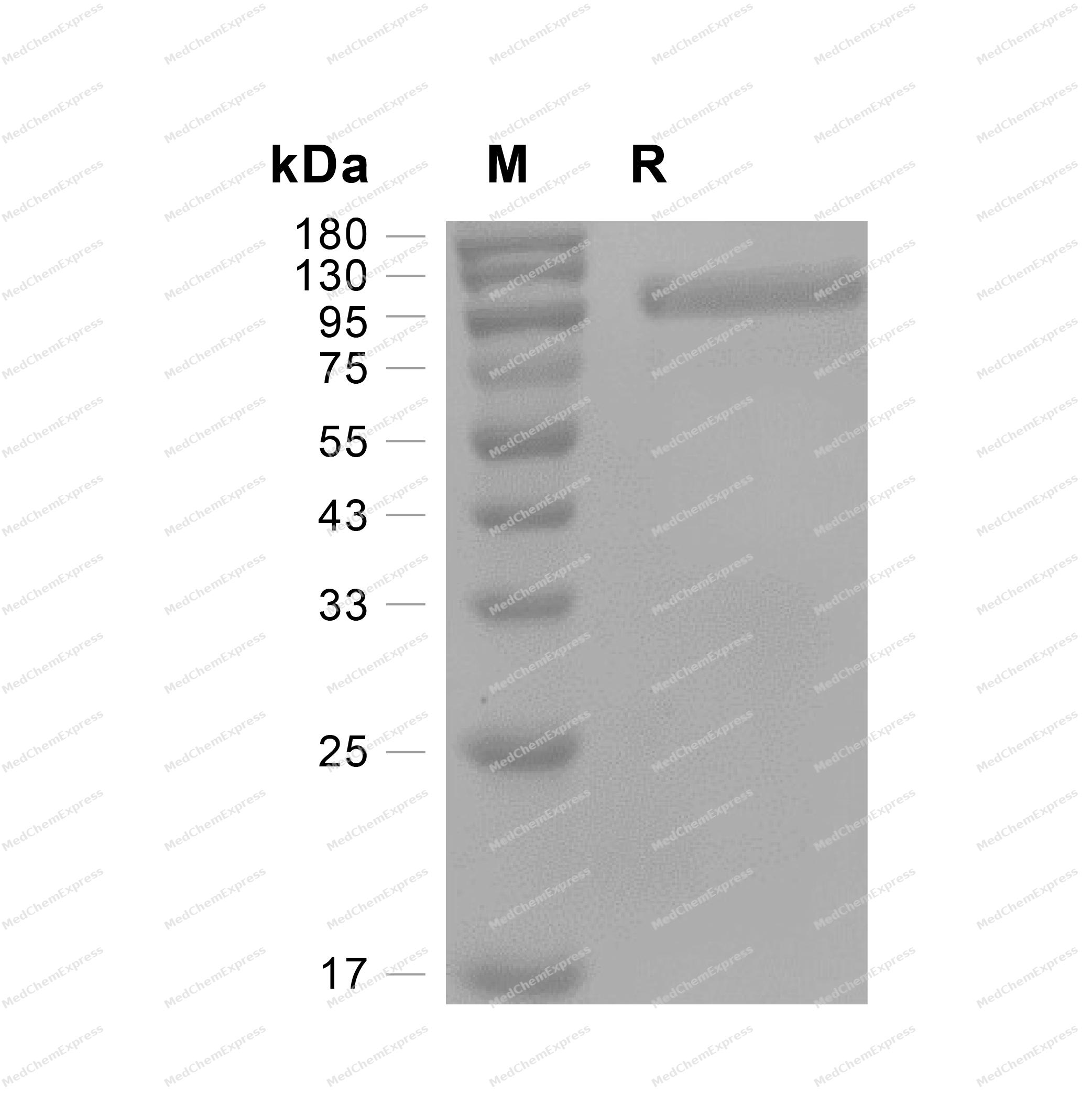
Purity - SDS-PAGE
-
Bioactivity - Cell-Based Assay
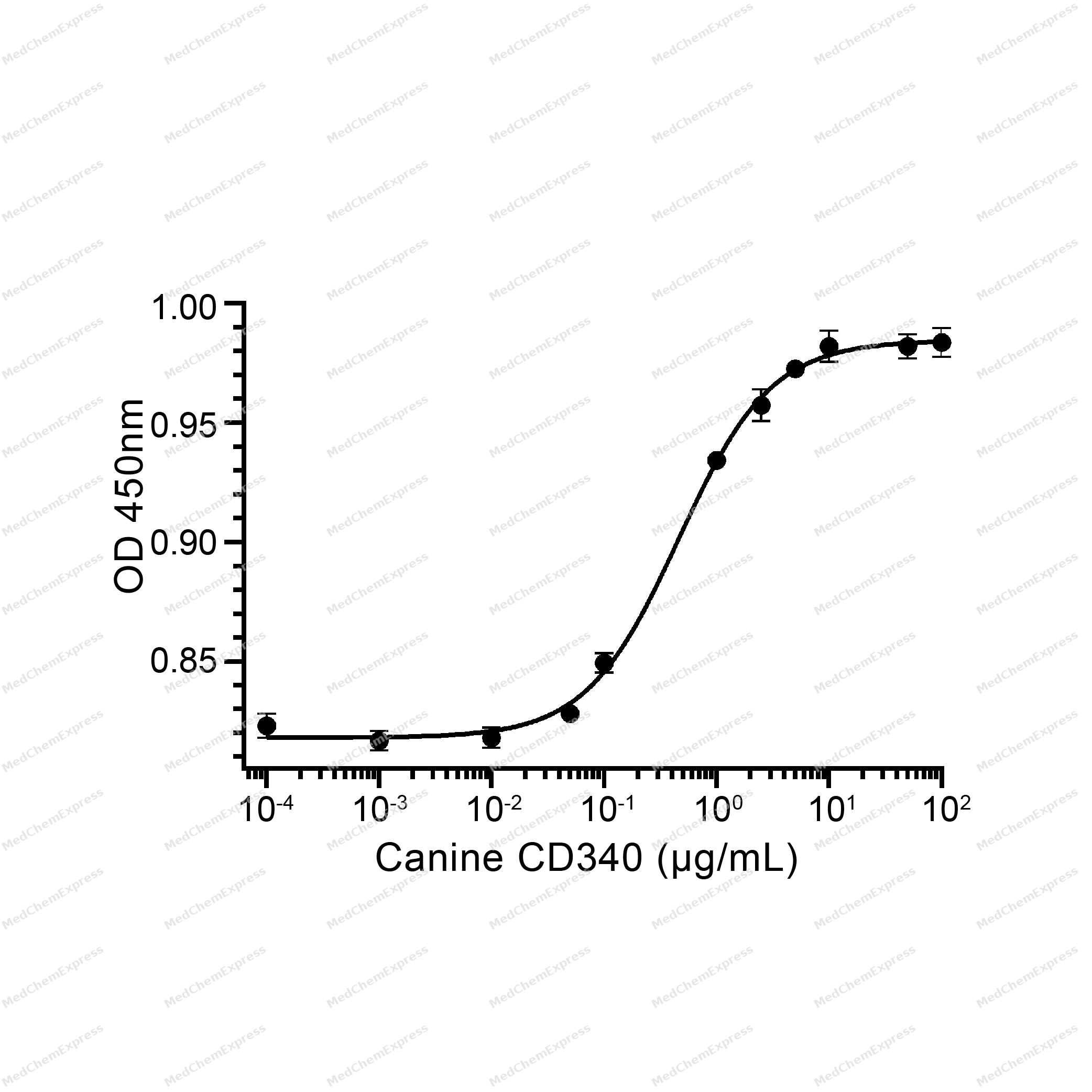
Bioactivity - Cell-Based Assay


Technical Parameters
-
Species Canine
-
Source HEK293
-
Tag C-His
-
Accession
A0A8I3NJW9 (T23-T652)
-
Molecular Construction
-
N-term
-
HER2 (T23-T652)
Accession # A0A8I3NJW9 -
His
-
C-term
-
-
Protein Length
Partial
-
Synonyms
ERBB2; P185erbB2; Prev. NGL; V-Erb-B2 Avian Erythroblastic Leukemia Viral Oncogene Homolog 2 (Neuro/Glioblastoma Derived Oncogene Homolog); HER2; V-Erb-B2 Erythroblastic Leukemia Viral Oncogene Homolog 2, Neuro/Glioblastoma Derived Oncogene Homolog; NEU;
-
AA Sequence
TQVCTGTDMKLRLPASPETHLDMLRHLYQGCQVVQGNLELTYLPANASLSFLQDIQEVQGYVLIAHSQVRQIPLQRLRIVRGTQLFEDNYALAVLDNGDPLEGGIPAPGAAPGGLRELQLRSLTEILKGGVLIQRSPQLCHQDTILWKDVFHKNNQLALTLIDTNRSRACPPCSPACKDAHCWGASSGDCQSLTRTVCAGGCARCKGPQPTDCCHEQCAAGCTGPKHSDCLACLHFNHSGICELHCPALVTYNTDTFESMPNPEGRYTFGASCVTSCPYNYLSTDVGSCTLVCPLNNQEVTAEDGTQRCEKCSKPCARVCYGLGMEHLREVRAVTSANIQEFAGCKKIFGSLAFLPESFEGDPASNTAPLQPEQLRVFEALEEITGYLYISAWPDSLPNLSVFQNLRVIRGRVLHDGAYSLTLQGLGISWLGLRSLRELGSGLALIHRNARLCFVHTVPWDQLFRNPHQALLHSANRPEEECVGEGLACYPLCAHGHCWGPGPTQCVNCSQFLRGQECVEECRVLQGLPREYVKDRYCLPCHSECQPQNGSVTCFGSEADQCVACAHYKDPPFCVARCPSGVKPDLSFMPIWKFADEEGTCQPCPINCTHSCADLDEKGCPAEQRASPVT
-
Molecular Weight
Approximately 75- 95 kDa, based on SDS-PAGE under reducing conditions.
-
Purity
≥ 95%, as determined by reducing SDS-PAGE.


Product Properties
Lyophilized powder.
Lyophilized from a 0.22 μm filtered solution of PBS, pH 7.4.
<1 EU/μg, determined by LAL method.
It is not recommended to reconstitute to a concentration less than 100 μg/mL in ddH2O. For long term storage it is recommended to add a carrier protein (0.1% BSA, 5% HSA, 10% FBS or 5% Trehalose).
Stored at -20°C for 2 years from date of receipt. After reconstitution, it is stable at 4°C for 1 week or -20°C for longer (with carrier protein). It is recommended to freeze aliquots at -20°C or -80°C for extended storage.
Room temperature in continental US; may vary elsewhere.


Documentation
-
Data Sheet (240 KB)
-
SDS (251 KB)
- English - EN (251 KB)
- Français - FR (251 KB)
- Deutsch - DE (251 KB)
- Norwegian - NO (251 KB)
- Español - ES (251 KB)
- Swedish - SV (251 KB)
- Italian - IT (251 KB)
- Korean - KR (251 KB)
- Portuguese - PT (251 KB)
-
Handling Instructions (2659 KB)

Calculators
Concentration (start) × Volume (start) = Concentration (final) × Volume (final)


 Powered by Bioz

